Science of Global Warming And Possible Man Made Causation

Why is the denialist argument so bad? There is a lot of science to be debated on the topic, but so much of the denialist rebuttal is just nonsense.

i think what counts as "bad" depends on what you are trying to achieve, and what is most effective in advancing those aims.

forecasting to motivate is rather different than forecasting to inform.

arguing to obfuscate/confuse is rather different than arguing to inform/clarify.
 
Intellectually, that's where I have a problem with accepting the AGW hypothesis as it's being expressed now. ... You can't really know something unless you've established all the seminal underpinnings and that hasn't been done yet. And, as there is some information that demonstrates that the currently-chosen underpinnngs are not correct, I remain a fence-sitter.

by definition, climate change is a problem of extrapolation; if one can NEVER "establish all the seminal underpinnings" in systems of this complexity then how do you justify always sitting on the fence?

it would be nice of all big decisions could be made based on relevant probability distributions, but you can still make decisions under ambiguity even if you do not "believe" the science is complete, no? in fact it is irrational not too, if the time delays and inertia of the system are so large that you realise effective action (if you decide to take it) is significantly more effective if taken in the near term. (that does not imply you should take action, but you should recognise that waiting on the fence is expected to carry a high cost.)
 
Various things that are have been considered "of low understanding" have moved into "we understand it a bit better now". That process should continue since "the science is not settled".

Just in 2007 several major advances have been seen in understanding clouds, both low clouds with rain and high cirrus. These alone change the "radiative forcing" summation of effects table. Where positive feedbacks were presumed, the studies indicate negative feedbacks exist.

Other recent work shows that the Asian brown cloud is of more importance than previously thought, that black soot may be a major factor in Artic melt, that unusual atmospheric air currents, not global warming, was responsible for the recent Arctic ice melt. Land use change is another factor that may have been underestimated.

Increasingly it appears that the AGW theory which holds that "urgent action now" is required or else there will be "drastic consequences later" is flawed in it's central premise of reduction of CO2 emissions as being a good thing that will "solve the problem".

Various problems do exist, yes. How many of the above issues mentioned relate to CO2 emissions? Not many....
 
Various things that are have been considered "of low understanding" have moved into "we understand it a bit better now". That process should continue since "the science is not settled".
See, this is where the semantic games and rhetorical tricks start. Science is about NEVER being 100% sure. You never can be; that's the nature of the real world. What you can be is sure beyond a reasonable doubt. And that's the level of certainty that the scientific community expresses about AGW. That's sufficient to convict a man of murder, and sentence him to life in prison. If that's not good enough for you, then you're demanding things of the real world that the real world will never deliver.

Just in 2007 several major advances have been seen in understanding clouds, both low clouds with rain and high cirrus.
Please cite scientific papers; please try to cite ones that haven't been thoroughly debunked already on this thread. And as a measure of dishonesty, please note that you HAVE cited papers on this, and they HAVE been debunked, and you HAVE NOT responded effectively to the debunking, and all you're doing here is bringing up another red herring, another long-disproven bunch of horsepucky. It's the fact that you do exactly this, present something, get it debunked, and then bring it back around again, that makes me label you as dishonest. You do it every single time you have run out of arguments. It's dishonest.

What I have not seen is a claim that low rain cloud dynamics either are not present in the GISS GCM, not to mention other climate models (and it would be very curious if they were not present in a program that contains a module specifically coded to simulate cloud dynamics), or that claims that they have an as-yet unrealized effect on global warming. I note that you did not explicitly state that they did; you merely implied it, which is one of the ways you lie. I therefore want to see a paper.

These alone change the "radiative forcing" summation of effects table. Where positive feedbacks were presumed, the studies indicate negative feedbacks exist.
They do not. At most, they indicate that negative feedbacks MIGHT exist. This is, therefore, a lie. In fact, Inhofe lies about it, on a US Government site. I sure do wish they'd make these sites liable for perjury. It would cut down on a lot of this. Here is an article on a study on cirrus clouds in the tropics. Here is Inhofe's latest list of lies. See number 4 at the bottom. The following quote is provided:
Inhofe said:
This study published on August 9, 2007 in the Geophysical Research Letters finds that climate models fail test against real clouds. "To give an idea of how strong this enhanced cooling mechanism is, if it was operating on global warming, it would reduce estimates of future warming by over 75 percent," Dr. Roy Spencer said. "At least 80 percent of the Earth's natural greenhouse effect is due to water vapor and clouds, and those are largely under the control of precipitation systems. "
Yet, going to the actual paper he links to, immediately after the 75% statement, we find the following quote:
UAH News said:
"To give an idea of how strong this enhanced cooling mechanism is, if it was operating on global warming, it would reduce estimates of future warming by over 75 percent," Spencer said. "The big question that no one can answer right now is whether this enhanced cooling mechanism applies to global warming."
And that is how they, and you, lie. It's all there in black and white for anyone to read.

Other recent work shows that the Asian brown cloud is of more importance than previously thought,
I debunked that about five pages back, here. Here is the NASA article. You had no meaningful response to the science. My post and your response are on page 12 of this thread. Just so you don't lie and accuse me of only providing a link to my post, and not your response. I challenge you to show the science in your response that rebuts the source I presented and the conclusions it draws.

that black soot may be a major factor in Artic melt,
Another red herring. The study was done by- guess who? :D - James Hansen and Dorothy Koch, using- guess what? :D - the GISS GCM. You can read the detailshere. Notable quotes:
NASA said:
"This research offers additional evidence that black carbon may have a significant warming impact on the Arctic," Koch said. Warmer temperatures in the Arctic mean melting ice and snow, among other things. These temperature and ice changes also wind up affecting climate patterns around the world.
Yet another dishonest red herring from mhaze. This is how you lie.

that unusual atmospheric air currents, not global warming, was responsible for the recent Arctic ice melt.
And what, praytell, was responsible for the unusual atmospheric air currents, air currents that (if they are in fact the only thing responsible- which you have explicitly stated here) have not occurred in the last hundred thousand years or more? And don't start on why I say a hundred thousand years; I said that already, it was challenged, and I proved it. And here is yet another way you lie. Here is my post on the subject, to which you never replied; and here is a link to the paper that reports the results.

Land use change is another factor that may have been underestimated.
Reference, please. I need some fresh meat.

Increasingly it appears that the AGW theory which holds that "urgent action now" is required or else there will be "drastic consequences later" is flawed in it's central premise of reduction of CO2 emissions as being a good thing that will "solve the problem".
First, strawman: no one is claiming, particularly not at this late date, that it will "solve the problem." At best it will mitigate it. Perhaps we'll be able to avoid having a nuclear war when the Chinese figure out they can't grow enough food because the temperate zone has moved north. Second, you've completely failed to provide a reference that proves anything you say that has not been rebutted, and you have been proven to have lied in the very post that I am replying to no less then eight times. The only reason it isn't ten is because you failed to provide any references that substantiate your claims on two of the points, and I expect fresh meat from you soon, and you had better know that I will do with it precisely what I have done with what you already provided. You have absolutely not one single leg to stand on; and this, you know, is why you so rarely make a substantive post. Every time you do, this is what happens to it. I prove you are lying, cherry picking, manipulating data, using rhetorical tricks and semantics, and using every trick in the book to try to avoid anyone noticing that you in fact have nothing. You may now go back to making desultory lying rhetorical posts, instead of outright falsifying scientific data.

Various problems do exist, yes. How many of the above issues mentioned relate to CO2 emissions? Not many....
Yeah, I kind of noticed that too. So tell me, why is it that you're making a post that doesn't have anything to do with global warming, on a global warming thread? All it has to do with is a bunch of lies. I thought this was a thread about the science of global warming, not the lies of global warming deniers.

 
Last edited:
I think first that the underpinnings are correct; to wit,
...We now appear to be in a situation, due to suppression of science, a massive PR campaign, and the deliberate effort to discredit legitimate research and prevent satellite data gathering, that will be very expensive to address. There is significant reason to believe that there will be some pretty unpleasant economic consequences, and it is entirely possible that there will be tens or hundreds of millions of deaths as a result.

Schneibster, you won't get any argument from me on any of the above. I think you know your science very well and, as I wrote previously, more CO2 will mean more CO2-related absorbance and re-emission. You and I are in full agreement in the construct of the problem. What remains now is to observe. Is it really happening? If it is, then we in truth already have a working model of the atmosphere with which to indes the best course of action and manage the progress. If not, then we're overlooking something that's critical. What is it? I dunno but that's how science is conducted. For that and various reasons, I like your approach to take moderate steps in educating people to conserve and preserve. Once we have a metric to manage, we can manage...if the nations go along.

The politicization was primarily if not exclusively on one side. Because there's really no way to hide it if the North Pole melts, enough people are starting to get the idea that the people who did it are starting to look for somewhere to hide, but that politicization has turned something that might have meant a few rich people might not get a new Rolls this year ten years ago into something people are liable to die over in droves. It's no big deal, though, they're just brown people.

I wouldn't judge the unconcerned too harshly here. Yes, there's always the egotist miser in the crowd but, if you consider what the direst predictors are saying, there's ample room for skepticality among the industrialized nations. Let's face it, it's the industrialized nations that will take the brunt of any AGW program. The nations that will be most deeply hurt, however, are the emerging nations (China, Korea, India, Brazil, etc.) that are finally breaking into the big time. These countries are the least likely to heed the call and I can't say I blame them without rock solid proof.

I've made some rater harsh remarks here, Slime, and I want to be sure you know they're not directed at you. Please don't take them that way; we've achieved at least a detente, and I've no wish to disturb it. If I'd say anything directly to you, it's that I think you should do more research. I think you're wrong about it not being pretty clear at this point, but at least you'll have a scientifically-based conversation about it, which is better than I can say for many. It's the subjects you're addressing and the extent to which you've accepted data that appear to me to be unreliable that bothers me, not you personally.

Yah, Schneibster, I've been too strident as well. No worries. This is more better by far. I promise to do more research as that is what it will undoubtedly take for me. I have already written that I don't believe in discarding/ignoring data unless there is clear reason and that takes minute scrutiny for which I don't, and I suspect you also, don't have the time or resources.

I know it rankles you but I'm going to hold until I see that the tools needed to even manage this problem have been attained. Once that is in the pocket, everything else is childs' play.
 
by definition, climate change is a problem of extrapolation; if one can NEVER "establish all the seminal underpinnings" in systems of this complexity then how do you justify always sitting on the fence?

it would be nice of all big decisions could be made based on relevant probability distributions, but you can still make decisions under ambiguity even if you do not "believe" the science is complete, no? in fact it is irrational not too, if the time delays and inertia of the system are so large that you realise effective action (if you decide to take it) is significantly more effective if taken in the near term. (that does not imply you should take action, but you should recognise that waiting on the fence is expected to carry a high cost.)

lenny, good points all but let me tell you where I disagree. My concerns in taking actions right now are two-fold. You've identified the first one: extrapolation. Of the measurements I've seen, data of different methods of collection and quality are being glued together to form a long-term picture of what the planet has experienced in the near and distant past with regard to temperatures and atmospheric composition. From what I have read, the only data with what I would call an A pedigree is for the past thirty or so years. I'm not willing to extrapolate over, say, ten years with that type of data. It's just not done.

The second, but to me a more important point, is that we don't have a fixed, accepted, reliably predictive model on which to index various courses of action. With my new-found respect for the IPCC, I am taking them at their word (their recent report) that several model compartments have proven to be less-than-relevant while others are being introduced. To me, that means that we are blind to the course of action.

Several posters have, in this and other threads, advocated rather mild steps toward the change needed: planting more trees, preserving what we've got, moderate and achievable emission reduction from industries. That, I have no problem with and, frankly, all I could say is "about time!" However, some of the more vehement AGW proponents are calling for whole-scale dismantling of industries and economies. That, I find premature and objectionble given the present state of the data. That type of action could also lead to calamity if poorly executed. (But we know governments can be trusted, yes? :rolleyes:) So, if dire action is needed to save humanity, we'd be thrashing in the dark right now.

And, then, there's the possibility that AGW is just GW. Or maybe not even W. We're dealing with human beings here, and respect must be paid to their interests. My vote is for no abrupt actions until we know more. Of course, there's a lot more constructive and palatable action that can be, and really should be, undertaken yesterday.
 
Schneibster, you won't get any argument from me on any of the above. I think you know your science very well and, as I wrote previously, more CO2 will mean more CO2-related absorbance and re-emission. You and I are in full agreement in the construct of the problem. What remains now is to observe.
I'd only add, and to act- prudently. Electric cars are something of a fad in the place I work. And I think that's a good thing. My water heater and furnace are getting pretty long in the tooth- and I'm replacing them with the highest efficiency ones I can buy. As lamps fail in my house, they are replaced with the fluorescent ones that make low mercury contamination if they aren't already low consumption. Many of my lights are already high-efficiency; I bought chandeliers that take low-wattage bulbs ten years ago, and bought special lamps for them that don't go out for a long time and are extremely efficient. I'm putting in new windows; they're the most efficient I can buy. These things all reduce the expense of running my household anyway. They'll pay for themselves in the long run, and they'll help the environment.

Is it really happening? If it is, then we in truth already have a working model of the atmosphere with which to indes the best course of action and manage the progress. If not, then we're overlooking something that's critical. What is it? I dunno but that's how science is conducted. For that and various reasons, I like your approach to take moderate steps in educating people to conserve and preserve. Once we have a metric to manage, we can manage...if the nations go along.
I don't think there's anything radical to be done to current models, but I don't think they're beyond improvement. I think those improvements are being made on an ongoing basis. I think we've found out the most important facts about what's happening, enough to begin to act; human society is ponderous, and will take a while to get mobilized. If anyone can make money off adversity, we will. If we help save the world doing it, then that's a bonus. You can't do things too quickly for folks to figure out what's going on, and economics is peoples' lives. But we gotta move on it with all deliberate speed. Politics driven by greed have held the response up until the problem threatens us all. It's time to act. Time to advocate. Time to move on what we know.

I wouldn't judge the unconcerned too harshly here. Yes, there's always the egotist miser in the crowd but, if you consider what the direst predictors are saying, there's ample room for skepticality among the industrialized nations. Let's face it, it's the industrialized nations that will take the brunt of any AGW program. The nations that will be most deeply hurt, however, are the emerging nations (China, Korea, India, Brazil, etc.) that are finally breaking into the big time. These countries are the least likely to heed the call and I can't say I blame them without rock solid proof.
Which we're about getting, if they'll stop blocking money for it in the Senate to pay for their playtime over in Iraq and pay the war profiteers. Sorry, this isn't the political forum, but these... individuals have made it impossible to talk about it without getting into politics.

Yah, Schneibster, I've been too strident as well. No worries. This is more better by far. I promise to do more research as that is what it will undoubtedly take for me. I have already written that I don't believe in discarding/ignoring data unless there is clear reason and that takes minute scrutiny for which I don't, and I suspect you also, don't have the time or resources.
And so it goes. You have to say at a certain point, look, it's time to do something about it. And you do your part. That's all you can do. If you're smart about it, it doesn't cost you too much you weren't going to spend anyway. The key is to do it early. That way, when the hammer comes down (and it will), you're already used to it.

As far as the personal stuff goes, I'm glad we're on the same page. It's better to talk than yell.

I know it rankles you but I'm going to hold until I see that the tools needed to even manage this problem have been attained. Once that is in the pocket, everything else is childs' play.
Mmmm, perhaps not childs' play, but certainly nothing we can't handle if we want to. No skin off my nose; doesn't rankle me at all to have an honest iconoclast in the neighborhood. Work with them all the time. It's pretty apparent something's getting done PDQ no matter what. I'm always the canary in the coal mine anyway, so it's not like I'm not used to it already. ;)
 
lenny, good points all but let me tell you where I disagree. My concerns in taking actions right now are two-fold. You've identified the first one: extrapolation. Of the measurements I've seen, data of different methods of collection and quality are being glued together to form a long-term picture of what the planet has experienced in the near and distant past with regard to temperatures and atmospheric composition. From what I have read, the only data with what I would call an A pedigree is for the past thirty or so years. I'm not willing to extrapolate over, say, ten years with that type of data. It's just not done.

The second, but to me a more important point, is that we don't have a fixed, accepted, reliably predictive model on which to index various courses of action. With my new-found respect for the IPCC, I am taking them at their word (their recent report) that several model compartments have proven to be less-than-relevant while others are being introduced. To me, that means that we are blind to the course of action.

Several posters have, in this and other threads, advocated rather mild steps toward the change needed: planting more trees, preserving what we've got, moderate and achievable emission reduction from industries. That, I have no problem with and, frankly, all I could say is "about time!" However, some of the more vehement AGW proponents are calling for whole-scale dismantling of industries and economies. That, I find premature and objectionble given the present state of the data. That type of action could also lead to calamity if poorly executed. (But we know governments can be trusted, yes? :rolleyes:) So, if dire action is needed to save humanity, we'd be thrashing in the dark right now.

And, then, there's the possibility that AGW is just GW. Or maybe not even W. We're dealing with human beings here, and respect must be paid to their interests. My vote is for no abrupt actions until we know more. Of course, there's a lot more constructive and palatable action that can be, and really should be, undertaken yesterday.

Maybe Wunsch is more on your train of thought.

http://www.realclimate.org/index.php/archives/2007/03/swindled-carl-wunsch-responds/
 

Interesting, although Motl predicted within hours after GGWS was aired that Wunsch would be up in arms about it. I'll find the discussion, basically he does not like his comments cut and chopped - he wants them to be exactly the way he stated them, with all the qualifications and exceptions.

Many other actual scientists are similar. If you look at their comments about the GW/AGW debate, they display far less certainty and have a nuanced attitude about the various constituent parts of the entire debate.

Christy - Yes there is AGW but more due to land use than CO2
Lomborg - Yes there is AGW but adapting is smarter than reducing CO2
Schwartz - Climate sensitivity is 1.1C, much lower than IPCC says but we still need to reduce CO2
Tsonis - most or all of the recent temperature increase is due to natural variations but there may be an overlaid AGW component

etc. The list could go on. No doubt my brief summaries of these individuals' attitudes is inadequate. My point is they don't fall into "camps". Most, anyway. Hansen and Mann are definitely in a "camp.....

There is an active discussion at Climateaudit about a recent paper of Wunsch that concerns errors scientists make in reading and interpreting statistics. It's written for a general audience. Pretty interesting, amusing at times. The paper is online here.

From the abstract -
The human eye and brain are powerful pattern detection instruments. Coupled with the clear human need to perceive the world as deterministic and understandable, and the often counter-intuitive results of probability theory, it is easy to go astray in making inferences. In particular, many examples exist where attention was called to apparent extreme behavior, whether in time or space series, or in the appearance of unusual patterns, that are just happenstance.

​
One example Wunsch uses is the misreading of the Walker circulation changes in Australia being related to GW/AGW.
 
Lomborg is not a scientist.

Wunsch agrees with the basic science of AGW.

Christy is a contrarian, but, due to the scarcity of people like him and Lindzen, a very popular person on the denier circuits. He has had to change his claims, due to errors in his science.

Hansen and Mann are a "camp". Good grief.

Hansen and Mann are but 1% of the scientific input into AGW science.
 
Tsonis didn't claim that "most or all of the recent temperature increase is due to natural variations" that I saw; he in fact specifically indicated that global warming could be the signal behind the results he got using his networking and chaos oriented methodology. In what paper do you claim that was said? In addition, the mechanism behind the "teleconnections" he talks about is unspecified.
 
i think what counts as "bad" depends on what you are trying to achieve, and what is most effective in advancing those aims.

It should also take account of the effort that's been put into shining-up the argument. Including that, the contrarian argument is really bad.

You've been away a little while (noticed and remarked on :)) and is there anything new on offer? I haven't seen it. The cooling-trend has become a not-warming, which rocks nobody's boat. There are some fresh-baked cycles that are expected to just happen because that's what cycles do. The next three-to-eight years should see them off. And the next El Nino will see the "not warming" off.
 
And what, praytell, was responsible for the unusual atmospheric air currents, air currents that (if they are in fact the only thing responsible- which you have explicitly stated here) have not occurred in the last hundred thousand years or more?

It's not climate change, it's an "unusual event". Just like all the others :).
 
IPCC Errors in Rates of Sea Level Rise

IPCC Errors in Rates of Sea Level Rise
The IPCC's statement of "High Confidence" regarding sea level rise is shown to be false. Most or all of the data for thermal expansion, contribution of glaciers and ice caps, Greenland and Antartica ice sheets are incorrect. Conclusions that follow from this incorrect data are invalid, including the following (also p. 7 of SPM).
  • "widespread decreases in glaciers and ice caps have contributed to sea level rise"
  • "losses from the ice sheets of Greenland and Antartica have very likely contributed to sea level rise from 1993-2003."
  • "There is high confidence that the rate of observed sea level rise increased from the 19th to the 20th century"
There is no evidence of global warming in the sea level rise data.

Click to enlarge. The chart is from the Summary for Policymakers, page 7 of 18.


The United Nations Intergovernmental Panel on Climate Change says very clearly in the Summary for Policymakers “Global average sea level rose at an average rate of 1.8 [1.3 to 2.3] mm per year over 1961 to 2003. The rate was faster over 1993 to 2003: about 3.1 [2.4 to 3.8] mm per year.... high confidence that the rate of observed sea level rise increased from the 19th to the 20th century.”

IPCC - Wrong.

There was no "faster rate" for 1993-2003, it was slower, and all previous estimates were also in error. A recent accurate analysis of the satellite data by Woppelmann et. al. provides corrected data. Following is a brief description and the reference.

Wöppelmann et al. note that “two important problems arise when using tide gauges to estimate the rate of global sea-level rise. The first is the fact that tide gauges measure sea level relative to a point attached to the land which can move vertically at rates comparable to the long-term sea-level signal. The second problem is the spatial distribution of the tide gauges, in particular those with long records, which are restricted to the coastlines”

When Wöppelmann et al. factored their measurements of land motion into the estimate of sea-level rise, they determined a global value of 1.31 ±0.30 mm per year compared to the 1.8±0.5 mm per year value given by the IPCC for the recent half century.

The revised number of 1.31 mm per year when split between the constituent parts for sea level rise, shows the gross errors in the IPCC table above mentioned. Since all land based ice loss creates a sea level rise, where is dramatic land based ice loss now?

Reference:
Wöppelmann, G., B. Martin Miguez, M.-N. Bouin, and Z. Altamimi. 2007. Geocentric sea-level trend estimates from GPS analyses at relevant tide gauges world-wide. Global and Planetary Change, 57, 396–406.
 
The United Nations Intergovernmental Panel on Climate Change says very clearly in the Summary for Policymakers “Global average sea level rose at an average rate of 1.8 [1.3 to 2.3] mm per year over 1961 to 2003. The rate was faster over 1993 to 2003: about 3.1 [2.4 to 3.8] mm per year.... high confidence that the rate of observed sea level rise increased from the 19th to the 20th century.”

IPCC - Wrong.

There was no "faster rate" for 1993-2003, it was slower, and all previous estimates were also in error. A recent accurate analysis of the satellite data by Woppelmann et. al. provides corrected data. Following is a brief description and the reference.
They corrected tidal gauge data not satellite data. They also don't seem to have published a figure for 1993-2003, comparing their figure with that of 1961-2003 as you might expect as they were interested in correcting tide gauge readings and not satellite data.

Wöppelmann et al. note that “two important problems arise when using tide gauges to estimate the rate of global sea-level rise. The first is the fact that tide gauges measure sea level relative to a point attached to the land which can move vertically at rates comparable to the long-term sea-level signal. The second problem is the spatial distribution of the tide gauges, in particular those with long records, which are restricted to the coastlines”
So...right here where you quote them talking about tide gauges...

When Wöppelmann et al. factored their measurements of land motion into the estimate of sea-level rise, they determined a global value of 1.31 ±0.30 mm per year compared to the 1.8±0.5 mm per year value given by the IPCC for the recent half century.
...And here you talk about the 1961 - 2003 figures and not the 1993 - 2003 figures...

Wires crossed perhaps?

The revised number of 1.31 mm per year when split between the constituent parts for sea level rise, shows the gross errors in the IPCC table above mentioned. Since all land based ice loss creates a sea level rise, where is dramatic land based ice loss now?
So, as I understand it from reading the conclusions of Woppelmann et al, the measured sea level rise was always too high to account for the "dramatic land based ice loss".

Munk (2002) stressed that the sum of climate-related
contributions to sea-level change was low (0.7 mm/yr)
compared to the observations over the last 50–100 years
(1.8 mm/yr) by referring to this factor 2 difference as the
‘enigma’ of sea-level change. Since then, the more
recent results now indicate a 1 mm/yr contribution from
the melting of global land ice reservoirs (Mitrovica
et al., 2006), as well as a 0.4 mm/yr contribution from
the thermal expansion of the world ocean (Antonov
et al., 2005).We show here an exercise of combining
GPS and tide gauge results that reduces the globalaverage
sea-level rise to 1.3 mm/yr. This appears to
resolve the sea-level enigma.
Reference:
Wöppelmann, G., B. Martin Miguez, M.-N. Bouin, and Z. Altamimi. 2007. Geocentric sea-level trend estimates from GPS analyses at relevant tide gauges world-wide. Global and Planetary Change, 57, 396–406.
 
On what do you base that? The IPCC reports a faster increase over that period compared to the 1961-2003 average. Is anyone reporting a slower increase?

Yes. Fsol comments on some aspects I may have not stated clearly, but looks like we agree on what the article says.

There never was a faster increase, and all the old numbers were wrong.

The number for sea level is 1.3mm. Period. Going back to 1900 or so.

My browser is seeming to crash or I'd post the link to the article which is on line. Well, it can be found by typing "Geocentric sea-level trend estimates from GPS analyses" into Google.

Very interesting.

IPCC says 1.8 +-0.5 mm/yr
Woppelman says 1.31 +-0.3 mm/yr

Looks to me like the estimates overlap somewhat. To say that all the old numbers were wrong is not something I would agree with. To say that the number for sea level is 1.3 mm "period" going back to 1900 or so, is also not something that I would agree with.

Woppelmans paper doesn't say that there is no faster rate for 1996-2003, and it definately doesn't say that it was slower than the rest of the century. So, again I don't agree with that.

What the paper does say is that if you take into account the motion of the earths surface using GPS measurements and correct the tide gauge measurements accordingly, then the amount of sea level rise you get corresponds pretty well with that which would be expected if the ocean had warmed as much as we think it has and if the land ice had melted as much as we think it has.
 
There never was a faster increase, and all the old numbers were wrong.

The number for sea level is 1.3mm. Period. Going back to 1900 or so.

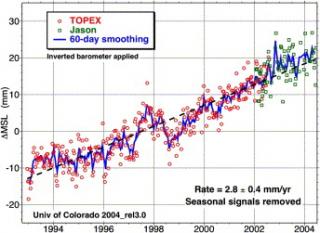
From Fu & Le Traon (2006)

Fu & Le Traon (2006) said:


Fig. 3. Globally averaged mean sea level calculated from the altimeter data from T/P and Jason (courtesy of S. Nerem of University of Colorado [46]).

That's a faster increase, and it's recent (93-04). I don't know what was the IPCC source, but again, the values overlap.

Do you stick to your claim that there's not a recent faster increase?
 
Last edited:
From Fu & Le Traon (2006)


That's a faster increase, and it's recent (93-04). I don't know what was the IPCC source, but again, the values overlap.

Do you stick to your claim that there's not a recent faster increase?

It's difficult to tell from that graph with any certainty. A fair bit of the datapoints in the middle of the plot lie below the line (best-fit linear?). The later points do seem to be "taking off" but may not signal a significant rate increase just as those points steadily below the line during some years are no evidence of slowing.

I was going to ask if there was a graph with data further back but I realized that it would not resolve this question. You simply need more datapoint at this point, not back then.
 

ISF - Join now!

Every member here is approved by hand. No bots, no spam, just people who care about evidence and honest debate.

Membership is free!

Create your free account

Back
Top Bottom