(continued)
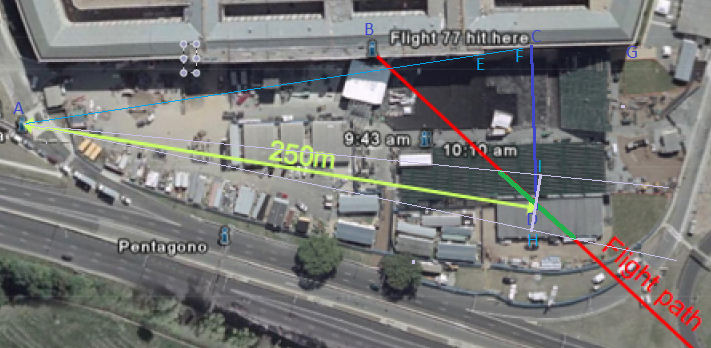
Here are some of my measurements:
1. A-E (Camera to protruding corner) is 131mm
2. A-D (camera to center of plane) is 146mm
-> An object that has an apparent size of 100% at point E would appear at size (131/146)% = 89.7%
3. Length of plane is 28mm
4. Length of I-H (projection of both ends of plane into the distance of D) is 16mm
-> The plane appears (16/28) = 57% of it's 100% size due to it flying at an angle.
If the plane were at point E, and at 90° to the sight line, we could directly compare it to the height of the Pentagon. Let's define the apparent length of the plane at that point as 100, then at point D (where it really was), its apparent length would shrink to 89.7% because it's farther away, and to another 57% due to its angle.
Multiply both: 89.7% * 57% = 51%.
The Pentagon is 23m tall, a 757 is 47.3m long. It would appear (47.3/23)=2,1 times longer than the Pentagon at E is high, but because the plane is farther away and at an angle, it really would appear only 2.1 * 51% 1.05 times as long as the Pentagon is high at that point.
In this image:

I drew a white line where I guess the base of the Pentagon is, and a vertical line to highlight the height of the protruding corner. It is 14-15mm on my screen.
I drew a pink line on the yellow box to indicate how much plane it could obscure. The pink line is 18mm, or about 1.25 times the apparent height of the Pentagon corner.
I found earlier that at the distance and angle that AA77 flew, it would appear only 1.05 times longer than that Pentagon corner.
Conclusion:
The yellow box is wide enough to obscure a 757 entirely




 didn't think about that. LOL