
You are using an out of date browser. It may not display this or other websites correctly.
You should upgrade or use an alternative browser.
You should upgrade or use an alternative browser.
Clear evidence that 9/11 was an inside job
- Thread starter FatFreddy88
- Start date

leftysergeant
Penultimate Amazing

- Joined
- Jul 13, 2007
- Messages
- 18,863
All of this blather about the height of the building is, of course, unneccessary. We know from physical damage to objects along the glide path the angle from which the plane approached. We know the location of the camera. Thus we know the location of the aircraft at any given time.
We also know that the lens of the camera reduces immages at different rates depending on where in its field of vision the object is.
Since we know where the aircraft was when it was partly hidden behind the yellow box, and since enough of it was exposed to measure it, all we need to know to measure its actual size is the rate by which the lens reduces an image at that distance.
(Frankly, it looks plenty high enough at that point, just based on measurements made with my Mark I eyeball, to have made a hole of the right size in the facade.)
We also know that the lens of the camera reduces immages at different rates depending on where in its field of vision the object is.
Since we know where the aircraft was when it was partly hidden behind the yellow box, and since enough of it was exposed to measure it, all we need to know to measure its actual size is the rate by which the lens reduces an image at that distance.
(Frankly, it looks plenty high enough at that point, just based on measurements made with my Mark I eyeball, to have made a hole of the right size in the facade.)
FatFreddy88
Critical Thinker
- Joined
- Jan 20, 2010
- Messages
- 388
You're missing the point.I agree that 62 is 31.9% larger than 47, and that 47 is 24.2% smaller than 62. (Subject to a small amount of rounding error.)
Is that a problem?
Look at posts #228 and #243.
http://www.internationalskeptics.com/forums/showpost.php?p=7203863&postcount=228
http://www.internationalskeptics.com/forums/showpost.php?p=7208375&postcount=243
If there is a line that's 62mm long with a mark where it's 47mm, the distance between the 47mm mark and the 62mm mark is 24% of the whole line and the distance between the 47mm mark and the 0mm mark is 76% of the line. That figure is what is arrived at when 47 is divided by 62. Therefore, when we calculate the length of the craft in this picture...
http://0911.site.voila.fr/index3.htm
...which is at an angle, we have to increase the length by 24% to account for the angle.
If 62 is divided by 47 we get a percentage of 32%. Oystein maintains that the length of the craft must be increased by 32% to get the real length of the craft but this is incorrect as the above proof shows that the distance between the 47mm mark and the 62mm mark on a line is 24%–not 32%. The space between the 43mm mark and the 62mm mark is 32%.
I want to hear the opinion of all the pro-official version posters on this thread. Do you agree with Oystein when he says the 32% figure is the correct figure to use to increase the size of the craft behind the picture to get its length?
ladmo
Muse

- Joined
- Dec 30, 2009
- Messages
- 676
I tend to agree. Microsoft created "onmouse events" to allow measurements to be captured in HTML and since the same photo can be used... that should answer all concerns.All of this blather about the height of the building is, of course, unneccessary. We know from physical damage to objects along the glide path the angle from which the plane approached. We know the location of the camera. Thus we know the location of the aircraft at any given time.
We also know that the lens of the camera reduces immages at different rates depending on where in its field of vision the object is.
Since we know where the aircraft was when it was partly hidden behind the yellow box, and since enough of it was exposed to measure it, all we need to know to measure its actual size is the rate by which the lens reduces an image at that distance.
(Frankly, it looks plenty high enough at that point, just based on measurements made with my Mark I eyeball, to have made a hole of the right size in the facade.)

I'm not answering that until you explain why it's so important to you that the people on the other side of the debate have a unified opinion.I want to hear the opinions of all the pro-official version posters here. Do you all agree with Olstein?
NoahFence
Banned

....we also know that personal items which could NOT have been planted were found.
AA 77 hit the Pentagon. Period, end of discussion.
Yep.
AA 77 hit the Pentagon. Period, end of discussion.
I want to hear the opinions of all the pro-official version posters here. Do you all agree with Olstein?
Yep.
FatFreddy88
Critical Thinker
- Joined
- Jan 20, 2010
- Messages
- 388
You're putting words in my mouth. I never said that. I just think that it's so clear that he's wrong that this makes a good objectivity test to see who is to be taken seriously on this thread and who isn't. Now please answer.I'm not answering that until you explain why it's so important to you that the people on the other side of the debate have a unified opinion.
I'm not answering that until you explain why it's so important to you that the people on the other side of the debate have a unified opinion.
Its just his "objectivity test". If you don't answer EXACTLY how he thinks you should then you are a "shill who doesn't believe his own arguments". He does it on every forum he goes to. By "exactly" I mean if you generally agree with him except for a few small points then you're still a shill. He follows this same pattern everywhere he goes. The new thing is calling a forum moderator a liar on the same forum (he usually waits until he's on a different forum) as he did on the moon hoax thread. I expect that won't end well.
Off topic a bit: I think it is hilarious that after years of posting the EXACT SAME THINGS on forum after forum he still doesn't know how to post an image online.
BCR
Master Poster

- Joined
- Dec 6, 2008
- Messages
- 2,278
Now please answer.
What is the question?
FatFreddy88
Critical Thinker
- Joined
- Jan 20, 2010
- Messages
- 388
See post #263. I see most of you are tap dancing around and avoiding the question. You're avoiding the question because you know that it's so clear that he's wrong that you'll look silly if you agree with him but you can't say he's wrong because you'll make your whole team look silly. Your behavior is not that of truth-seekers.What is the question?
BCR
Master Poster
- Joined
- Dec 6, 2008
- Messages
- 2,278
See post #263.... Your behavior is not that of truth-seekers.
No, I'm not going back through that jumble of nonsense. If you want a question answered, then just ask it in a clear defined way.
Sir, just because I find it hard to take measurements taken by you with a ruler on your computer screen seriously (much less evidence of anything but incompetence), does not reflect on me being a 'truth-seeker' one way or another.
And I just know the question does involve your math or trig. If it does, then please be mindful my degree is in mathematics and I've been dying to use Latex again. But if you want to impress us further with your lack of math skills, then by all means ask away.
tsig
a carbon based life-form

- Joined
- Nov 25, 2005
- Messages
- 39,049
Do all the rest of you pro-official version posters agree with Oystein when he says these things?
Yes.
tsig
a carbon based life-form
- Joined
- Nov 25, 2005
- Messages
- 39,049
See post #263. I see most of you are tap dancing around and avoiding the question. You're avoiding the question because you know that it's so clear that he's wrong that you'll look silly if you agree with him but you can't say he's wrong because you'll make your whole team look silly. Your behavior is not that of truth-seekers.
What kind of team is this? I never even got a lousy T-shirt!
See post #263. I see most of you are tap dancing around and avoiding the question. You're avoiding the question because you know that it's so clear that he's wrong that you'll look silly if you agree with him but you can't say he's wrong because you'll make your whole team look silly. Your behavior is not that of truth-seekers.
Well, I suppose that's an answer, of a sorts, so I'll respond in kind; I don't know enough to judge whether Oystein is right or wrong, so I haven't.I'm not answering that until you explain why it's so important to you that the people on the other side of the debate have a unified opinion.
I know you're already ready to claim I'm running away from admitting he's wrong, but I honestly don't know. He's been correct a lot more more often than you on the stuff I have been able to check, so the statistics would indicate he's right again, but I'm not going to make a definitive statement. One of the behaviors of "truth seekers" is admitting when they don't know enough to come to a decision.
However, I'm pretty sure this is all irrelevant. It doesn't really matter how many people think he's right or wrong, what matters is whether he actually is right or wrong.
I'm curious as to why you've never been able to find a ruler and a cell phone. Any well-equipped household should have one already, and if you're not well equipped, just stroll around to your corner store and buy one. They're about a buck. Cameras are even easier to find. You could just ask a guy to take a picture with his cell phone and email it to you. Or find a photography booth. Or am I thinking of a challenge issued to someone else?
Also.
Last edited:

BCR
Master Poster
- Joined
- Dec 6, 2008
- Messages
- 2,278
Nothing on TV tonight, so I thought I would go back through those mind-numbing posts and see if I could figure out what the question was. Boy, did I ever just waste an hour of my life. I must confess, I have absolutely no idea what FatFreddy88 is talking about. Some crazy stuff about C-D, but what the heck is C-D?
FatFreddy88 ... pose your question in a logical and concise format and I will do the math and we'll see who is right and who I agree with.
Anyone else here understand what the question is?
FatFreddy88 ... pose your question in a logical and concise format and I will do the math and we'll see who is right and who I agree with.
Anyone else here understand what the question is?
The Pig
Thinker

- Joined
- May 16, 2006
- Messages
- 171
Where did Oystein say this? Have another look at posts 214 and 215, and quote Oystein directly if you can!If 62 is divided by 47 we get a percentage of 32%. Oystein maintains that the length of the craft must be increased by 32% to get the real length of the craft but this is incorrect as the above proof shows that the distance between the 47mm mark and the 62mm mark on a line is 24%–not 32%.
Oystein's workings were very clear, elegant, and easy to follow in my opinion: in the security camera photo, the plane would appear only 57% of the length it would have appeared had it been ordinated perpendicular to the line-of-sight. I think your 24% and 32% figures are a red-herring; although I'd be happy to read a mathematical proof of why dividing the length of line BD by the length of line CD (or vice versa) would give you the effective foreshortening of the plane. Looks like a crock to me.
Like you, I haven't done much trig lately, but this is what I came up with after a few minutes on Google (any corrections welcome):
* Paste the overhead Google Earth image into Paint (link).
* Take two coordinates on both the line-of-sight and the flight-path (by hovering the cursor).
* Assuming you don't know how to do this; (2101,827) and (369,542) were on the line-of-sight; and (2721,1349) and (1518,234) were on the flight-path.
* Find the gradient of each line (m1 and m2) by dividing the change in the y coordinate by the change in the x coordinate (link).
* Assuming you don't understand this step; I got gradients of 0.16455 (line-of-sight); and 0.92685 (flight-path).
* Find the angle between the 2 lines using the formula tan(A) = (m1 x m2) / (1 + [m1 x m2]) (link).
* Assuming you don't understand this step; I got an angle of 33.19204 degrees.
* So we now have a notional triangle and we want to know the ratio between the opposite length (the effective length of the plane from our line-of-sight) and the hypotenuse (the actual length of the plane).
* Sin (33.19204) x 100 = 55%, rounded up (link) - this is, very roughly, the effective length of the plane (close enough to Oystein's figure of 57%; way more than your 24 or 32%).
* Conclusion: following a different method, and using different measurements, I confirmed Oystein's conclusion that the plane would appear approximately 57% of the length it would have appeared had it been ordinated perpendicular to the line-of-sight.
Prediction: accusation of obfuscation, and insistence that 24% is still correct, without the necessary smarts to prove it. Truth-seeker?
BCR
Master Poster
- Joined
- Dec 6, 2008
- Messages
- 2,278
Lets make this easy. Using exactly the same camera F/L using a 757 size plane at the same distance from the camera, modeled in 3D.
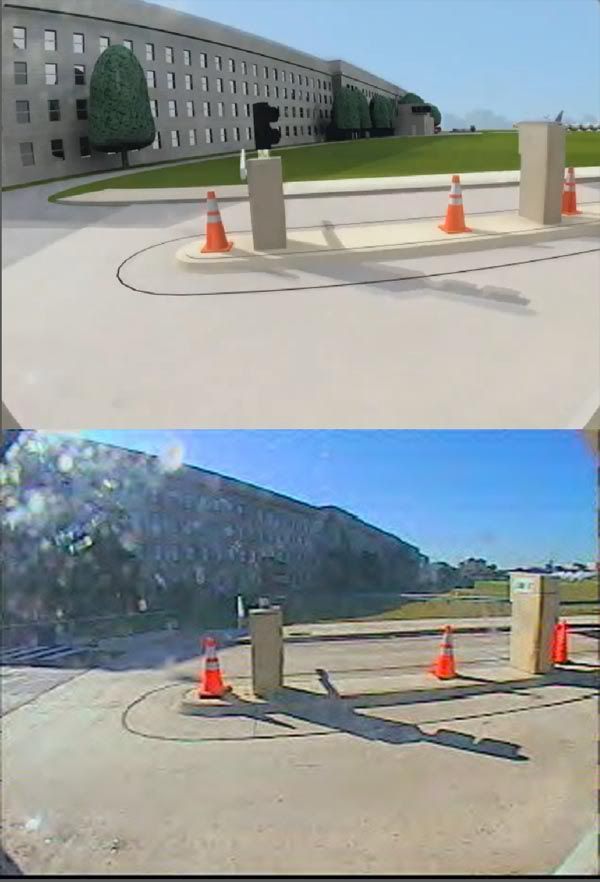
It is exactly what you see in the Pentagon gate camera. Perfect match. Much better than a ruler laid on a computer screen.
Footnote:
I hear a lot of talk about angle of the aircraft relative to the camera. The camera plane is 64 degrees from N, the aircraft is oriented 62 degrees from north. Only 2 degrees of difference and will not make that much difference in angular length. What will make the big difference is the fact that it is a wide-angle lens with distortion that increases the further from center you go. Invalid method of measurement from the get-go.
It is exactly what you see in the Pentagon gate camera. Perfect match. Much better than a ruler laid on a computer screen.
Footnote:
I hear a lot of talk about angle of the aircraft relative to the camera. The camera plane is 64 degrees from N, the aircraft is oriented 62 degrees from north. Only 2 degrees of difference and will not make that much difference in angular length. What will make the big difference is the fact that it is a wide-angle lens with distortion that increases the further from center you go. Invalid method of measurement from the get-go.
Last edited:
TJM
Potsing Whiled Runk

Prediction: accusation of obfuscation, and insistence that 24% is still correct, without the necessary smarts to prove it. Truth-seeker?
A more likely prediction:
Most excellent post, BTW.