• Quick note - the problem with Youtube videos not embedding on the forum appears to have been fixed, thanks to ZiprHead. If you do still see problems let me know.

Sound Money?

or they could just open a bank and profit from "free" interest on money they never had and seizing property of the ones who default because there is never enough money for everyone to pay back principal and interest.
1) I have no idea what you mean by "opening a bank and profiting on free interest" in the context of a scenario of perpetual deflation. "Opening a bank" is investing, so it's exactly the opposite of what a rich would do. I have no idea of what you mean by "profiting on free interest".

2) How does the issue of defaulting on a debt has anything to do with economies in inflation or deflation?

so we have to licence governments to steal directly from the bank accounts of the rich (and the poor too) using inflation, on top of the taxes they pay, so the rich will go out and spend instead? this is a fair system is it?
I'm not sure what you mean by "so the rich will go out and spend instead". I didn't say spend, I say invest, do you understand the difference between the two? As for "fair", I don't understand why you are using that word at all. The goal of having a monetary policy aiming for low inflation is to encourage wealth creation overall. And my point is that the drawbacks of inflation affect the rich in a worst way than the poor.

my point is that the current system is not doing what you want it to do. I think this is because it is fundamentally flawed and needs reform.
Just for fun, what do you mean by "system", and what do you mean by "what you want it to do"? Reading you, and your answers, you seem to be mixing a lot of different "systems" and not understand what they are each supposed to do. Generally, it's better to have a good understanding of what the status-quo is and why it works that way before attempting to provide new alternatives.

:) seriously? you're happy with the way it is all working and heading now are you? wow indeed.

Speaking about monetary policy with regards to deflation, you claimed that they were "influenced by something or someone, for sure. vested interests, not the interests of the people.", which I believed meant you think monetary policies exist for some nefarious reasons, instead of rational, empirical reasons. You failed to provided any evidence whatsoever of this, thus my answer. I don't understand how you could interpret it as meaning "I'm happy the way it is all working and heaning now". There are many things I'm not happy with and would like to see changed. But that doesn't mean I automatically believe that an economy in perpetual deflation is a good idea.
 
says who?
Rational people.

why are steadily falling prices so bad?
Have you seen what's happening in Japan the last few decades?

isn't that what happens when productivity rises anyway?
No.

where is the monetary law that says prices have to constantly rise, so we have to constantly print more money to make that happen?
It's not a law, it's the smart thing to do. When prices start falling you're in trouble.

I quite like the idea of my savings going further with time.
And that's the trouble with deflatioon, everyone saves and no one spends. See Japan. If everyone decides not to vacation in Ibiza because it will be cheaper to do so next year (and so on and so on), where does that leave you?

How have falling real estate prices in the US been a good thing for the economy?
 
Last edited:
Rational people.

lol. evidence?

Have you seen what's happening in Japan the last few decades?

not the same, the Japanese experience was caused by supporting zombie banks and not purging the debt. ZIRP4EVA didnt work there and it wont work for you.

It's not a law, it's the smart thing to do. When prices start falling you're in trouble.

ok lets go all JREF on you. evidence?

And that's the trouble with deflation, everyone saves and no one spends. See Japan. If everyone decides not to vacation in Ibiza because it will be cheaper to do so next year (and so on and so on), where does that leave you?

happy, I prefer it when they all leave again anyway. I make my living via the internet and assuming TEOTWAWKI doesn't arrive there's no reason that should really change.

How have falling real estate prices in the US been a good thing for the economy?

how was a massive unsustainable bubble supposed to end?

it would have been way better not to blow it up in the first place, by actually having the correction due after tech stocks / Y2K / 911

this all was done by rational people remember?
 
does it have to be commodity based to be sound? and how do you regulate something so it can't be cheated?

Wildcat & TCS I have un-ignored you both, but please no more truther / jew hater BS?

I absolutely guarantee you, you would only ever say the Jewish jibe in particular to my face the once, so would it be possible to just stick to the topic here too please?

I am more than willing to learn anything you or anybody else here is able to convince me of.

No it's not about gold, it could be tied to anything, what else would you suggest to give stability over long periods and prevent debasement?

can it be done without tying to something tangible?

if so how do we make it fail-safe so that it cannot be debased, when you dont trust the political establishment to abide by their regulations?

after all I'm pretty sure somewhere there are regulations that prevent the Fed bailing out foreign banks with $16,000,000,000,000, but they did it anyway?

No one forces you or anyone else to keep their assets in money. If you spend or invest any money you get immediately, inflation will make no difference to you. How would you store your wealth? What would happen if 7 billion people were to store their wealth that way?

Me, I keep my wealth as money in the bank. The bank pays me interest above the current rate of inflation, and I don't mind the low return since it carries virtually zero risk. (If the Norwegian government goes bankrupt at the same time as the Danish bank that owns my bank it might be gone.)

You're trying to solve issues with world finance that you grossly misrepresent, misunderstand and exaggerate, by suggesting a method that's obviously unworkable. There's no way to tie money to anything tangible available today without ridiculously inflating the value of those tangibles.
 
or is continual debasement a useful and necessary part of modern economic theory?

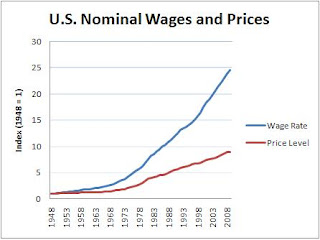
Oh the humanity! Our (or at least US) purchasing power of wages have doubled in the last ~60 years, even though the value of units has been horribly debased ad nauseum. The end is nigh!

Nominal+Wage+and+Price.JPG
 
Me, I keep my wealth as money in the bank. The bank pays me interest above the current rate of inflation, and I don't mind the low return since it carries virtually zero risk. (If the Norwegian government goes bankrupt at the same time as the Danish bank that owns my bank it might be gone.)

As a Norwegian I believe you are exempt from this conversation. Think of yourself as an American, or a Brit, with your money in their banking systems.

comfortable with that?

You're trying to solve issues with world finance that you grossly misrepresent, misunderstand and exaggerate..

I believe you have grossly misrepresented, misunderstood and exaggerated my question and understanding of the matters.

by suggesting a method that's obviously unworkable.

what exactly did I suggest, and why is it unworkable?

There's no way to tie money to anything tangible available today without ridiculously inflating the value of those tangibles.

evidence?
 
kevsta said:
There is another thread here about "the Gold standard", so this one is not about that.

I would like to know if people are in principle in favor of "sound money" however that may be achieved.

by "sound money" I just mean some form of money that cannot be debased by whichever passing politico it suits to do so, either directly, or via their favourite central planners bank

or is continual debasement a useful and necessary part of modern economic theory?

thoughts please gentlemen and ladies?

Perhaps it is merely an error in translation, but your rhetorical choices suggest one who has already arrived at a conclusion and seeks to frame the debate in such a way as to allow no other conclusion to be adequately supported. I suggest a more mild form of phrasing, while I respect the depth of your feelings upon this matter I do not agree that the situation (if it be as dire as you fear) is made better by your approach.

First, the use of "debasement" in this paragraph is somewhat disingenuous. The term originally has roots in ancient times, referring to the addition of inferior metals into what once were solid metallic coins, enabling for more coins to be produced with the same amount - in other words, inflation. Greed is not just restricted to the modern day, it would seem. Wikipedia's article on Roman currency is a fascinating glimpse into the economic problems faced by the ancient empires through the narrow yet surprisingly detailed world of the coins they produced.

I'm afraid that the definition matters. For example, I currently possess two $1 bills; one printed as part of the "Series 2006" and the other "Series 2003 A." These two are functionally identitical, with the same quality of ink and paper used in both. In ancient times this may well not have been the case, the earlier coin (minted in a time of prosperity) may have a higher concentration of the more valuable metal, usually silver, than the latter coin, minted during a time of famine. The image on the Wiki page entitled "DECLINE OF THE ANTONINIANUS" suggests quite clearly how rapidly a change for the worse can occur. With the modern system, at least, my bills stand a much higher chance of being spendable at the face value, though what that value buys me will have changed.

Clearly, then, a metallic standard (for it needn't just be gold, or silver - personally I prefer Einsteinium, it at least has name recognition going for it) is no hedge against absolute economic disaster. Posters far smarter than I have mentioned economic collapses that have occurred under a system of presumably 'unsound' money in the past as well, many of these are quite instructive. Personally I enjoy reading about them, for the smarter I get about these issues, the less likely I am to be adversely affected by them.

Inflation, more generally the accurate term for what we experience, seems to have some benefits. Admittedly the money I currently have buys less and less, but there is far more money out there for me to get my rather greedy hands on. I suppose the reason why the majority of us are here is to find out more ways to do that

I can't think of a better place.

~ MattC
 
Last edited:
I posted a question. What is it that I am supposed to be thinking and why can't you "possibly comment"?

I take it you didn't recognize the quote then.

I assumed that you meant that it isn't possible, and with that I would agree. correct me if Im wrong.

Matt, thank you for your thoughtful answer. I'll bear in mind some of the things you said next time I'm starting a thread.
 
So I take your lack of response to my post to indicate you accept the fact that

According to this (publicly available) data, the price-level (CPI) has increased by about a factor of 10 since 1948. But the average nominal wage rate has increased by a factor of 25…The figure above implies that the real wage (the nominal wage divided by the price-level) has increased by a factor of 2.5 since 1948. This is undoubtedly a good thing because it implies that labor (the factor we are all endowed with) can produce/purchase more goods and services. More output means an increase in our material living standards

http://andolfatto.blogspot.com/2011/03/ron-pauls-money-illusion-sequel.html

?
 
I take it you didn't recognize the quote then.

I assumed that you meant that it isn't possible, and with that I would agree. correct me if Im wrong.
Nope, that expression is a new one on me. (I haven't seen the "House of Cards" series either).

If you are not disagreeing then doesn't that suggest that we should focus on the banking system rather than what we use as base money?
 
lol. evidence?


not the same, the Japanese experience was caused by supporting zombie banks and not purging the debt. ZIRP4EVA didnt work there and it wont work for you.
It illustrates the problem with deflation, which you have ignored. Why buy anything today, when it will be cheaper tomorrow?

ok lets go all JREF on you. evidence?
I already gave you the real-worl Japan example. Another real-world example is real estate in the US. No one wants to buy a house that will be worth less tomorrow.

This isn't that difficult to understand.
 
It illustrates the problem with deflation, which you have ignored. Why buy anything today, when it will be cheaper tomorrow?

because you want or need it now? because it's a fair price?

you know I'm a gold fan. Everything is deflating against my "money" for years now. I bought a boat earlier this year, that was 30% cheaper in real terms than last year, even though it had gone up in Euros from last year.

why did I do that? because I wanted it now, and because it was a fair price.

I already gave you the real-worl Japan example. Another real-world example is real estate in the US. No one wants to buy a house that will be worth less tomorrow.

This isn't that difficult to understand.

I understand it, I just disagree with you about how undesirable it is.

Real estate in the US was a massive unsustainable bubble, deflation in that case is simple maths (or physics) and is unavoidable.

"what goes up, must come down" - or Im sure youre aware of this:

"There is no means of avoiding the final collapse of a boom brought about by credit expansion.

The alternative is only whether the crisis should come sooner as a result of a voluntary abandonment of further credit expansion, or later as a final and total catastrophe of the currency system involved."

mild deflation under a sustainable system is not the same as massive crack up boom bubbles bursting following a totally unsustainable binge.

when RE reaches a decent valuation again in the US, buyers will return, it hasnt bottomed yet.

if you don't blow huge unsustainable bubbles first, then mild deflation is not such a terrible thing to be feared IMO.

your argument could be likened to somebody prone to very mild headaches from time to time, realising that all the time he gets and stays completely paralytic blind drunk they don't come. - it cant last forever, and the inevitable morning will be a thousand times worse than his previous headaches ever were.
 
Nope, that expression is a new one on me. (I haven't seen the "House of Cards" series either).

If you are not disagreeing then doesn't that suggest that we should focus on the banking system rather than what we use as base money?

Im not disagreeing with this either, but can you stop trying to change the subject of my thread? :)

I appreciate your point, I don't like fractional banking either, and it may well be necessary to sort that out first / as well but I wanted to explore options for the transaction medium here.

presumably you have seen this? www.positivemoney.org.uk - I know Ben. sort of.
 
So I take your lack of response to my post to indicate you accept the fact that

http://andolfatto.blogspot.com/2011/03/ron-pauls-money-illusion-sequel.html

?

this is an interesting site, thank you for the link, Im going to need more time to explore and do my own calculations.

Im wondering what your charts would look like from 1980 onwards if we plugged the Shadowstats figures into their calculations instead.

because it doesn't seem statistically valid to me to look at long term charts over a period where halfway through the period they started changing and adjusting the main inputs (CPI).

anecdotally, all I hear is about how it used to be possible for one wage earner to support a family in the 50's and 60's (under the gold standard lol) , and now it takes two, working more hours. this could be nostalgia coloured glasses of course.
 

Back
Top Bottom