Abenomics: medicine or poison for Japan?

Medicine or poison?

  • Medicine

    Votes: 12 27.3%
  • Poison

    Votes: 3 6.8%
  • Don't know

    Votes: 18 40.9%
  • Planet X

    Votes: 11 25.0%

  • Total voters
    44
2 trillion yen here, 2 trillion yen there, and pretty soon you're talking about real money!

:boxedin:

I guess maybe this is where we find out if the BoJ really has everything under control and this plan is going to work as they hope it will. I wouldn't want to be holding JGBs right now.
 
standard corrections don't usually come with circuit breakers, and especially not corresponding ones in the bond market & attendant CB interventions.

CNBC currently reporting it as "extraordinary" which on a down move, is quite unusual for them.

"This can only be described as panic selling, and ending the day on the lows.."

..which is usually a bearish sign, especially when the trading was on record volumes. ..remember gold on the Friday..?

..another 13% and its back in a bear market again. :boxedin:
 
Bass Sees BOJ Bond Purchases Overwhelmed as Investors Dump Debt

J. Kyle Bass, whose Hayman Advisors LP made $500 million amid the U.S. subprime crisis, said the Bank of Japan will have to “dramatically” increase bond-buying efforts that have been “overwhelmed” by investors selling.

Benchmark 10-year Japanese government bond yields rose to 1 percent yesterday for the first time since April 2012, more than triple the all-time low reached last month, a day after the BOJ announced unprecedented bond buying. Japanese shares also plunged the most in two years, trimming gains since November when Shinzo Abe called for expanded fiscal and monetary stimulus before elections that made him prime minister.

“Abe and the BOJ face what I call the ‘rational investor paradox,’” Dallas-based Bass, who has predicted a financial collapse in Japan since 2010, wrote in an e-mailed response to questions. “If JGB investors begin to believe that Abenomics will be successful, they will ‘rationally’ sell JGBs to buy foreign bonds or equities.”

Yields on 10-year JGBs are 0.83% today after briefly surging above 1% yesterday.
 
Bass Sees BOJ Bond Purchases Overwhelmed as Investors Dump Debt

Yields on 10-year JGBs are 0.83% today after briefly surging above 1% yesterday.

interview and more details here http://www.cnbc.com/id/100762194

Bass said he saw it first-hand.
"After being in Japan last week, I think that many investors are believing that the BOJ will be at least partially successful in generating some growth—so the rational investor will sell some bonds," he said. "There's a quadrillion yen in bonds out there. If 5 percent of them get sold, that's 50 trillion yen. So it doesn't look to me like the plan is big enough."

According to a plan announced April 4, the Bank of Japan will buy 60 trillion yen ($590 billion) in bonds both this year and next.

"They're going to run a fiscal deficit of 50 trillion yen this year, or 10 to 11 percent of GDP," he said. "That means they'll have only a 10 trillion yen cushion to buy more bonds,"
he said.

The market reaction is apparent, he said.

"Look at the three biggest banks in Japan. ... You're seeing rational investors start to sell (Japanese Government Bonds) and buy foreign bonds or even Japanese equities with the money."
 
and Nomura's Koo yesterday

http://www.telegraph.co.uk/finance/...the-end-for-Japan-as-bond-market-buckles.html

Yields on 10-year Japanese bonds (JGBs) have doubled in a month and spiked dramatically to 1pc on Thursday, triggering a 7.3pc crash in the Nikkei stock index. It was the biggest one-day fall since the tsunami two years ago, comparable with wild moves seen at the height of the Asian crisis in 1998.

The contagion effect set off a retreat from stocks across the world, though Wall Street later pared losses. The iTraxx Crossover or “fear gauge” for corporate bonds jumped 25 points to 392.

The Bank of Japan (BoJ) intervened with $20bn (£13bn) to drive down yields again but the failure to ensure an orderly debt market has started to rattle investors. Banks, pension funds and insurers appear to be dumping JGBs for fear of being caught on the wrong side of a bond rout.

Richard Koo from Nomura, an expert on Japan’s Lost Decade, said the sell-off in recent days has shown that the BoJ may not be able to hold down yields “no matter how many bonds it buys”. This could lead to a “loss of faith in the Japanese government” and the “beginning of the end” for its economy, if handled badly.
 
Very hard to see the upside of holding JGBs right now.

They pay very little interest (low yield). Only if you think the yen is a "safe haven" but the argument for that seems predicated on a strong yen and deflation or low inflation relative to other currencies. If you have 2% inflation, why would you want to buy a JGB with a yield less than 1%? Only if you think the yen will be stronger than other currencies.
 
Very hard to see the upside of holding JGBs right now.

They pay very little interest (low yield). Only if you think the yen is a "safe haven" but the argument for that seems predicated on a strong yen and deflation or low inflation relative to other currencies. If you have 2% inflation, why would you want to buy a JGB with a yield less than 1%? Only if you think the yen will be stronger than other currencies.

hmm. if I'm not mistaken you seem to be agreeing with Mr Bass? :)

so bonds sell off, rates rise.. then what? rates don't have to go very far before they consume the entire tax revenue, do they?
 
The Nikkei seems to be bouncing back this morning.

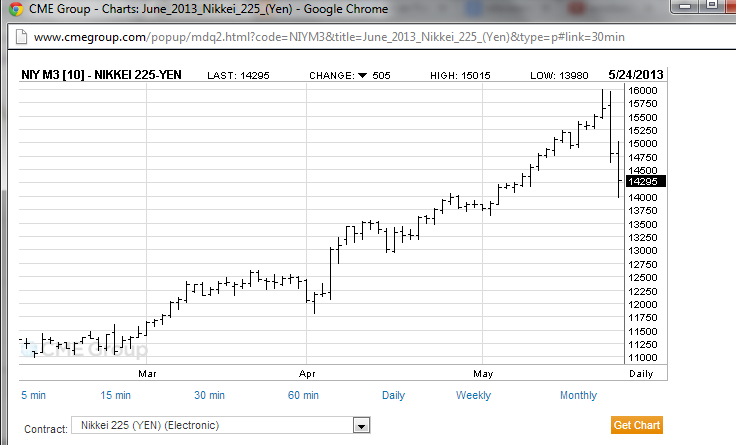
Futures selling off again.. 16000 to 14295 = -11% ?

17852519f63ae05ec5.png
 
hmm. if I'm not mistaken you seem to be agreeing with Mr Bass? :)

so bonds sell off, rates rise.. then what? rates don't have to go very far before they consume the entire tax revenue, do they?

The high levels of debt make me nervous for that reason. Yields on government bonds cannot be allowed to rise very much without significantly increasing borrowing costs for the government. It seems like it's all balanced on a knife's edge.
 
The high levels of debt make me nervous for that reason. Yields on government bonds cannot be allowed to rise very much without significantly increasing borrowing costs for the government. It seems like it's all balanced on a knife's edge.

I don't understand how they think it can possibly work? how can you tell the bond market they're all going to lose money if they keep holding these, but then "not let" rates rise?

calculations floating around in various places on Friday and this morning wrt to bank capital losses supposedly:

"every 1% rate rise = 10 to 20% (mark to market) Tier 1 capital losses for banking system"

http://seekingalpha.com/article/1461941-the-abenomics-experiment-major-risks-for-japan-s-banks

​​Banks in Japan have larger exposure to domestic sovereign debt than those in any other advanced economy. The BOJ (2012) notes that regional banks in Japan in particular are especially vulnerable to the risks of these large holdings: according to the BOJ, a 100-basis-point increase in interest rates across the yield curve would lead to mark-to-market losses of 20 percent of Tier 1 capital for regional banks and 10 percent for the major banks.
 
I don't understand how they think it can possibly work? how can you tell the bond market they're all going to lose money if they keep holding these, but then "not let" rates rise?

calculations floating around in various places on Friday and this morning wrt to bank capital losses supposedly:

"every 1% rate rise = 10 to 20% (mark to market) Tier 1 capital losses for banking system"

I guess it means that the BoJ has to keep buying up the excess bonds that are sold to keep the yield curve where they want it to be.
 
I guess it means that the BoJ has to keep buying up the excess bonds that are sold to keep the yield curve where they want it to be.

The BoJ wants bond yields to go up, now down as that would signal an end to deflationary pressure. While it would increase debt servicing costs the benefits of growth would vastly outweigh this.
 
The BoJ wants bond yields to go up, now down as that would signal an end to deflationary pressure. While it would increase debt servicing costs the benefits of growth would vastly outweigh this.

Yes, but not too much (or too rapidly) as their intervention last week showed.

I agree that growth is the only way out of this conundrum (the only desirable way that is). So they have to pursue this course and hope it works. You do see why the huge principal on the debt limits the scope within which rates can safely be allowed to rise, don't you?

Also, Kevsta has a point when he says that the banks (and pension funds I'll add) would be hurt as their bond investments lose value. It's a fine balancing act.
 
Last edited:
Also, Kevsta has a point when he says that the banks (and pension funds I'll add) would be hurt as their bond investments lose value. It's a fine balancing act.

I imagine they will have pain thresholds probably set by VAR limits and be forced to sell if it gets too much, thereby adding to yield volatility. I think some of this has probably been going on already.
 
The BoJ wants bond yields to go up, now down as that would signal an end to deflationary pressure. While it would increase debt servicing costs the benefits of growth would vastly outweigh this.

lol. If that were the case, then the BoJ would merely have to begin liquidating its bond portfolio, except, it's doing the opposite. Bond yields rise as bond prices fall. Want to try again? I think the only reason I browse this forum anymore is for the pure comedy.
 
Also, Kevsta has a point when he says that the banks (and pension funds I'll add) would be hurt as their bond investments lose value. It's a fine balancing act.

Banks investments are primarily the loans they issue. Older loans don’t suddenly become unprofitable because the money the banks raised to issue the loan was at similarly low rates. Perhaps you mean the value of their reserves could drop, but in the near deflationary environment Japan has had banks were undoubtedly sitting of far larger reserves than they needed.
 
lol. If that were the case, then the BoJ would merely have to begin liquidating its bond portfolio, except, it's doing the opposite.

Yes, the BoJ is doing the opposite and the result has been a rise in bond yields...
 

ISF - Join now!

Every member here is approved by hand. No bots, no spam, just people who care about evidence and honest debate.

Membership is free!

Create your free account

Back
Top Bottom