Follow along with the video below to see how to install our site as a web app on your home screen.
Note: This feature may not be available in some browsers.
Quick note - the problem with Youtube videos not embedding on the forum appears to have been fixed, thanks to ZiprHead. If you do still see problems let me know.
For my 5000th post, I'm going to tell a joke about differential geometry.
(Stop me if you've heard this one before.)
An engineer, physicist, and mathematician were visiting a farmer friend in Wales. The farmer enlisted their help in designing a fence that would surround his sheep using as little fencing as possible.
The engineer drew some rectangles on graph paper, did some calculations, and said a square fence would be best.
The physicist said no, the fence should be circular, like the sheep.
The mathematician said it doesn't matter whether it's a square or a circle. Either way, there is no lower bound to the perimeter. To demonstrate, she used a stick to draw a circle in the ground, then drew a square inside the circle, then a circle inside the square. "These circles and squares represent the perimeter of a fence that surrounds the sheep. By induction, the perimeter can be made arbitrarily small. I am of course assuming you don't need to stand outside the fence."
For my 5000th post, I'm going to tell a joke about differential geometry.
(Stop me if you've heard this one before.)
An engineer, physicist, and mathematician were visiting a farmer friend in Wales. The farmer enlisted their help in designing a fence that would surround his sheep using as little fencing as possible.
The engineer drew some rectangles on graph paper, did some calculations, and said a square fence would be best.
The physicist said no, the fence should be circular, like the sheep.
The mathematician said it doesn't matter whether it's a square or a circle. Either way, there is no lower bound to the perimeter. To demonstrate, she used a stick to draw a circle in the ground, then drew a square inside the circle, then a circle inside the square. "These circles and squares represent the perimeter of a fence that surrounds the sheep. By induction, the perimeter can be made arbitrarily small. I am of course assuming you don't need to stand outside the fence."
Reminds me of one of the mathematical/physical methods for capturing wild lions in the Sahara desert - the method of inversive geometry.
We place a spherical cage in the desert, enter it and lock it. We perform an inversion with respect to the cage. The lion is then in the interior of the cage and we are outside.
We've discussed most of the pieces we need though.
Let's start with a space dimension of x. It's a number line, and at each point is a basis vector, http://latex.codecogs.com/gif.latex?\overrightarrow{e}_x = 1.
To make it easier to visualize, point the arrows up.
Let's take the Schwarzschild metric change the basis vectors, and x becomes a radius, r:
There's an object with gravity at x=0, and a Schwarzschild radius of rs=1. If you place a test particle somewhere (outside the Schwarzschild radius) with zero kinetic energy, it will "roll uphlil" toward the mass on its own. This is matter telling space how to curve, and space telling matter how to move in action.
The basis vectors tell the object how to move.
Now take a look at the TDP metric:
These are now the basis vectors for a time dimension. If you place a ball here, it will want to roll up hill, just as the Schwarzschild example.
Let's hypothesize that this is the elusive arrow of time.
In which case there would be physical justification for adding it to Minkowski spacetime.
Let us also postulate that the test particle, the ball we place here, will always remain at t=0. That is to say, the ball always exists only at the present time, even though it is rolling up hill. This has the effect of all the events in the spacetime diagram moving further into the past, where it will encounter smaller basis vectors, causing time dilation, stretching an electromagnetic waves period, reducing its frequency.
Therefore, Minkowski spacetime + an arrow of time = redshifts.
Mike - again the map is not the territory - you keep playing with the map, and then saying “look if I do this with the map, north is south and south is west” which it may be on the map, but your manipulation of the map did not change the territory. Think of it this way your “transformations” have broken the relationship the map had with the territory. To address that you’d have to do your transformation in reverse and we end up in the same territory.
Mike - again the map is not the territory - you keep playing with the map, and then saying “look if I do this with the map, north is south and south is west” which it may be on the map, but your manipulation of the map did not change the territory. Think of it this way your “transformations” have broken the relationship the map had with the territory. To address that you’d have to do your transformation in reverse and we end up in the same territory.
This is a thread in "Science, Mathematics, Medicine, and Technology" where we are supposed to stick pretty closely to the subject, which isn't maths jokes
Replying to this modbox in thread will be off topic Posted By: jimbob
Mike - again the map is not the territory - you keep playing with the map, and then saying “look if I do this with the map, north is south and south is west” which it may be on the map, but your manipulation of the map did not change the territory. Think of it this way your “transformations” have broken the relationship the map had with the territory. To address that you’d have to do your transformation in reverse and we end up in the same territory.
Would you prefer a map whose coordinates are induced by an underlying change in geometry over time, or a map that's accurate to empirical reality?
The map-territory analogy is a good one for understanding a very specific "zoomed-in" concept, how a choice of coordinates (polar, Cartesian, meter, parsec, etc.) don't change the underlying manifold, but the underlying manifold can effect what happens in the coordinates.
But if you zoom way out, at the end of the day, the real territory is empirical data, and our map includes all our theories and assumptions about the territory, that includes the coordinates, and the manifolds, and the differential geometry, including the assumption that our choice of coordinates cannot have any physical significance.
If we permit an exception for the arrow of time, which we needed to find anyways, then the map is accurate.
You can confirm this by taking a range of H0, and for each value, calculating a sum of squared errors against the data:
Sometimes you have to explain the point of a joke.
The joke I told concerned the differential geometry and topology of the 2-sphere S2. To be specific, that joke dramatized an important difference between the intrinsic geometry of S2 and R2. (ETA: For even more specific specifics, see the spoiler below.)
That particular difference between S2 and R2 illustrates the same difference between S3 and R3, but in a lower dimension that's easier for most people, particularly non-mathematicians, to visualize.
That difference between S3 and R3 is the most important difference between de Sitter space and a de Sitter universe. Both de Sitter space and the de Sitter universe have been discussed within this thread, having been introduced into this discussion by the author and sole proponent of Helland physics. He brought up the de Sitter universe because, by cherry picking among its equations, he could pretend the de Sitter universe was some kind of precedent for his own equations. He introduced de Sitter space because a Wikipedia article on that subject misled him to think the 4-dimensional submanifold of Minkowski spacetime addressed by his TDP coordinates might somehow be non-flat even though Minkowski spacetime is flat, and he hoped thereby to evade the well-established fact that (cosmological) redshifts are impossible within his flat TDP submanifold.
Now he is back to pretending he can change the territory by playing with maps. To disguise the tiresomeness of making that same mistake for months on end, he has of late begun to natter about basis vectors, a subject he obviously understands not at all.
We could, in all seriousness, simply observe that he's posting his usual ackamarackus because he doesn't know what he's talking about, but listing his mistakes itself becomes tiresome after awhile. At this point, there is no better way to respond to his mistakes than by pointing and laughing at the stupidity of his claims. A joke that highlights his mistakes (e.g. his stated belief that all FLRW models are homeomorphic to R × S3) is very much on topic for this thread.
ETA: In case there's someone out there who still doesn't understand the point of the joke:
The farmer wanted to build a fence that could surround his sheep, and was hoping the professional expertise of his three friends could tell him how to minimize the perimeter of that fence. The engineer and the physicist thought about solutions with perimeters on the order of a few tens or hundreds of meters. The mathematician, knowing the topology of S2, realized you could expand the size of their solutions to a fence that enclosed an entire hemisphere of the earth. By continuing to move that fence away from the sheep, the perimeter of the fence shrinks on the other side of the earth even as it continues to surround the sheep in exactly the same sense that the engineer's and physicist's designs surround the sheep. Furthermore, you can make the fence as small as you like, say 5cm in diameter. It still surrounds the sheep. Finally, you can translate that tiny fence from the opposite side of the earth onto the farmer's land, without changing the fact that it still surrounds the sheep.
On a flat earth (R2), that trick wouldn't be possible.
Now he is back to pretending he can change the territory by playing with maps. To disguise the tiresomeness of making that same mistake for months on end, he has of late begun to natter about basis vectors, a subject he obviously understands not at all.
The metric is defining a basis vector field. Isn't that all we've been talking about?
The metric tensor, the coefficients to the line element, the geodesic equation, the connection coefficients/Christoffel symbols, the Riemann curvature tensor.
All of it boils down to the basis vectors changing from point to point.
If you place a test particle in basic Minkowski space with no kinetic energy, it won't move in space, but it will in time, mapping out a world line that points up (assuming t-axis is vertical).
In Schwarzschild's metric, if there is a mass present, the world line of the test particle points up, but bends in the direction of the mass.
What's the difference? The geodesic. How are those computed? The basis vectors.
Also... why does the particle automatically move in time? Why does it go in that direction? Because that's the way it is?
The hypothesis accidentally solves that problem. Put another way, the arrow of time describes how something moves through time, specifically the relative motion through time between an observer and a past event, and that consequently creates time dilation and redshift.
By writing that, Mike Helland confirms that he is mistaking the map for the territory. The coordinate-dependent
value of tensor components such as gtt is (as a sensible person might infer from the highlighted adjective) coordinate-dependent, which is to say gtt = − (eH0t)2 is an artifact of the map, not a property of the territory. In standard Minkowski coordinates for exactly that same territory, gtt = − c2.
With characteristic sloppiness, Mike Helland omitted that c2 from his equation above. It is likely that his omission resulted from mindless copying of something he found on the World-Wide Web, from a source that assumes geometrized units.
The metric defines a tensor field, not a vector field. All vectors are tensors, but not all tensors are vectors. The tensors of the tensor field defined by the metric are not vectors.
If Mike doesn't understand the difference between "some tensors are vectors" and "all vectors are tensors", he should go back and re-read hecd2's joke about Welsh sheep.
Although he's been going on and on about basis vectors for several days now, he doesn't understand basis vectors and probably wouldn't even be able to identify the vector space spanned by the basis vectors he's been going on about.
The metric tensor, the coefficients to the line element, the geodesic equation, the connection coefficients/Christoffel symbols, the Riemann curvature tensor.
All of it boils down to the basis vectors changing from point to point.
The metric tensor field (unlike the coordinate-dependent metric forms we use to describe the metric tensor field) is a geometric object that exists independently of any coordinate system or metric form you might use to describe it, and cannot be altered by choosing to use some ridiculously stupid coordinate system such as TDP coordinates. In other words, the metric tensor field is territory, not map.
The "coefficients to the line element" are coordinate-dependent: map, not territory.
but Mike Helland doesn't understand the covariant derivative so (on the rare occasions when he actually cites the geodesic equation) he copy/pastes the coordinate-dependent version that involves coordinate-dependent derivatives and coordinate-dependent connection coefficients/Christoffel symbols.
Those coordinate-dependent derivatives are map, not territory.
Connection coefficients and Christoffel symbols are map, not territory.
The Riemann curvature tensor is a tensor, so it is territory, not map.
Basis vectors are vectors, which are a special case of tensors, so basis vectors are territory, not map. The numerical components of basis vectors are coordinate-dependent, however: map, not territory.
Furthermore a choice of basis vectors is arbitrary. Because Mike Helland has been unable to identify the vector space spanned by whatever basis vectors he thinks he's been talking about, it is impossible for those of us reading this thread to identify the specific basis vectors he is choosing to use. It is very likely he himself has no idea.
When your entire approach to physics is that of a cargo cultist, based entirely on guessing and Googling, you latch onto any technical terms you find on the web and start using them as though you actually understood what they mean. After all, the airplanes arrived on cleared strips of land, so the cargo cult clears strips of land in hope of making airplanes arrive.
If you place a test particle in basic Minkowski space with no kinetic energy, it won't move in space, but it will in time, mapping out a world line that points up (assuming t-axis is vertical).
In Schwarzschild's metric, if there is a mass present, the world line of the test particle points up, but bends in the direction of the mass.
What's the difference? The geodesic. How are those computed? The basis vectors.
Geodesics are computed by using the geodesic equation.
The coordinate-independent version of the geodesic equation mentions the vector http://latex.codecogs.com/gif.latex?\dot {\gamma }, but that equation doesn't care whether you or anyone else considers that vector to be a basis vector.
The coordinate-dependent version of the geodesic equation doesn't mention any vectors at all (the coordinate-dependent derivatives and Christoffel symbols are not vectors), so it doesn't have anything to do with basis vectors.
"It is possible to make an association between" the coordinate-dependent derivatives and a certain vector basis, but choosing to make that association just emphasizes the fact that your decision to choose those particular basis vectors is coordinate-dependent: map, not territory.
Mike Helland's concluding paragraphs are pure unadulterated cargo cult gibberish:
Also... why does the particle automatically move in time? Why does it go in that direction? Because that's the way it is?
The hypothesis accidentally solves that problem. Put another way, the arrow of time describes how something moves through time, specifically the relative motion through time between an observer and a past event, and that consequently creates time dilation and redshift.
Now he is back to pretending he can change the territory by playing with maps. To disguise the tiresomeness of making that same mistake for months on end, he has of late begun to natter about basis vectors, a subject he obviously understands not at all.
I'm not following the math here, because it's beyond my mathematical knowledge and because the reasons wrong guesses are wrong aren't all that interesting. Can I discuss the time-slowing hypothesis in descriptive English instead, at the understanding level of "dots on an inflating balloon"?
As best I can tell, the hypothesis is that the apparent correlation of redshift with distance is not due to cosmic expansion, but due to the acceleration of time over long periods of, um, time. Most or all of the redshift we observe for a photon from a distant galaxy is not because of relative motion due to expansion, but because it was emitted (on the order of) billions of years in the past when time was slower.
Does it follow that if someone were to build a very accurate durable clock on Earth, and let it run, it would be observed to run measurably slow after a few million years and obviously slow after a few billion years? Or that such a clock built on Earth when it formed would be slow today? (Of course I don't mean slow relative to solar days or years, which we know can change in duration on that time scale.)
I think Mike Helland would have to say it does not, because the acceleration of time [audience: "Itself?" Frankenfurter: "Itself!"] would also have to accelerate the clock. Regardless of how the clock operates.
So the obvious question here is, isn't the frequency of the photon from the distant galaxy a clock? And doesn't that mean we would not observe any redshift even if time [itself!] had accelerated?
I'm not following the math here, because it's beyond my mathematical knowledge and because the reasons wrong guesses are wrong aren't all that interesting. Can I discuss the time-slowing hypothesis in descriptive English instead, at the understanding level of "dots on an inflating balloon"?
As best I can tell, the hypothesis is that the apparent correlation of redshift with distance is not due to cosmic expansion, but due to the acceleration of time over long periods of, um, time. Most or all of the redshift we observe for a photon from a distant galaxy is not because of relative motion due to expansion, but because it was emitted (on the order of) billions of years in the past when time was slower.
The idea is that events that occur in the present are moving to the past, due to the passage of time.
It seems intuitive to assume that all events are moving through time at the same rate.
That is to say, it's natural to think http://latex.codecogs.com/gif.latex?\overrightarrow{e}_t = 1 at every point in space.
Empirical observations of events such as supernovae tell us it's not that simple.
Either everything is moving away from us, making them appear time dilated to us, or things don't move through the past at the same rate, which makes them time dilated to us.
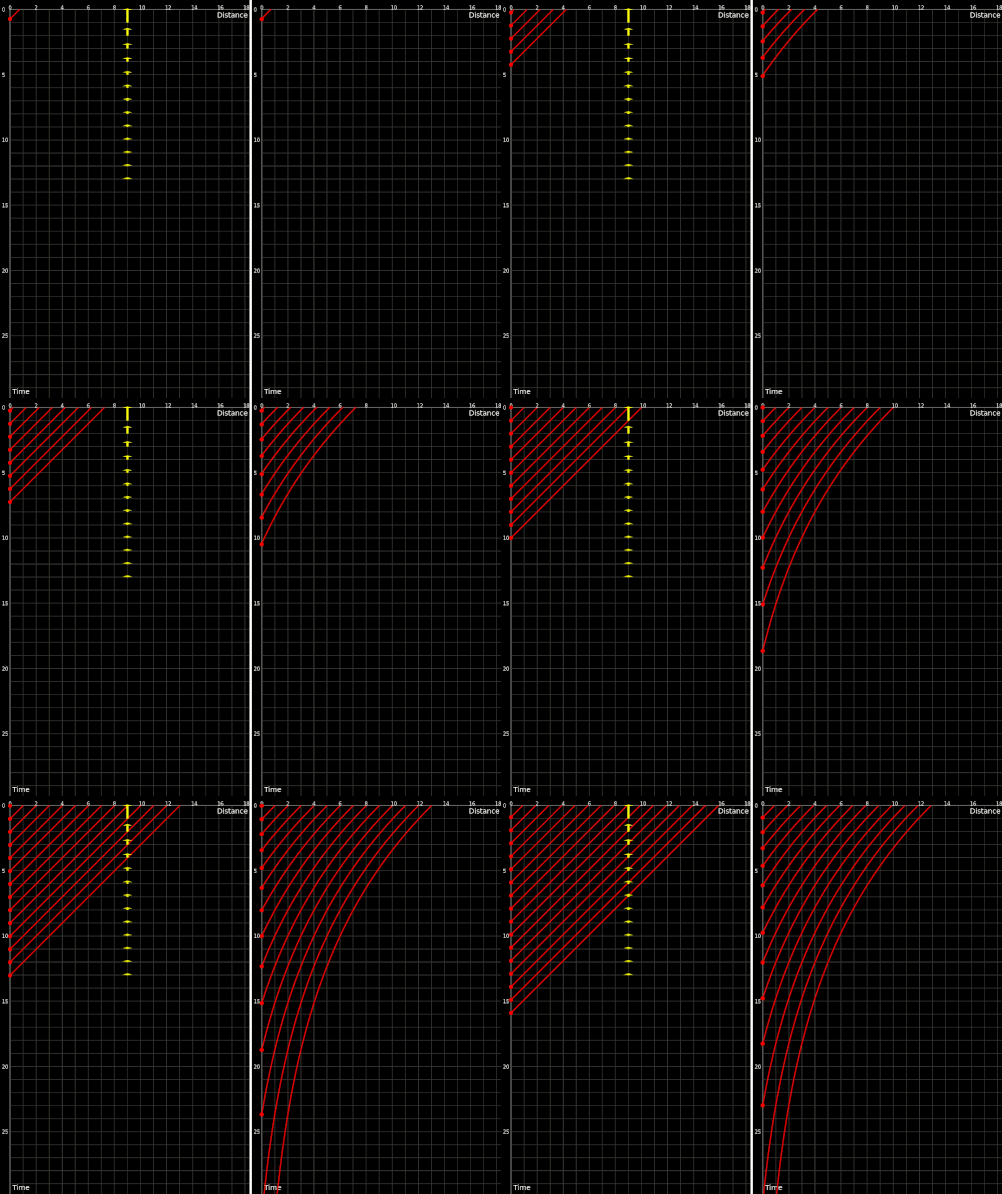
Watch the dots in this animation, they are the event of a photon being emitted. The photon's path through spacetime is the line connecting it to the present. As time passes, the events move further to the past. Notice (eta: on the right) how they seem to pick up speed as they go:
The passage of time at a given point would be the slope of the line f(t)=eH0t at that t. For an observer, which will always be in the present, t=0, f(t)=1. As time passes, events in the present (t=0) move to the past (t<0)
Does it follow that if someone were to build a very accurate durable clock on Earth, and let it run, it would be observed to run measurably slow after a few million years and obviously slow after a few billion years? Or that such a clock built on Earth when it formed would be slow today? (Of course I don't mean slow relative to solar days or years, which we know can change in duration on that time scale.)
If we place a large mirror at z=1, and shine a light at it for 1 second, billions of years later, it will be much longer than 1 second long when the light returns.
I think Mike Helland would have to say it does not, because the acceleration of time [audience: "Itself?" Frankenfurter: "Itself!"] would also have to accelerate the clock. Regardless of how the clock operates.
The clock operates in the present. It's always at t=0. It's always over the same basis vectors.
The ticks of the clock are spacetime events, which occur in the present, but as time passes, they move farther and farther into the past, where they encounter smaller basis vectors, so in a sense, the events are accelerating backwards in time, whereas the clock itself is comfortable at a constant speed in the present.
So the obvious question here is, isn't the frequency of the photon from the distant galaxy a clock? And doesn't that mean we would not observe any redshift even if time [itself!] had accelerated?
It's an observed fact that the time between events in the past is stretched, that means the oscillations of an electromagnetic wave from the past will have an elongated period. That's redshift.
The issue here is that, despite past events being observed to be time dilated, the stretching of the time coordinate, which would accurately reflect our observations, is not induced by some kind of curvature.
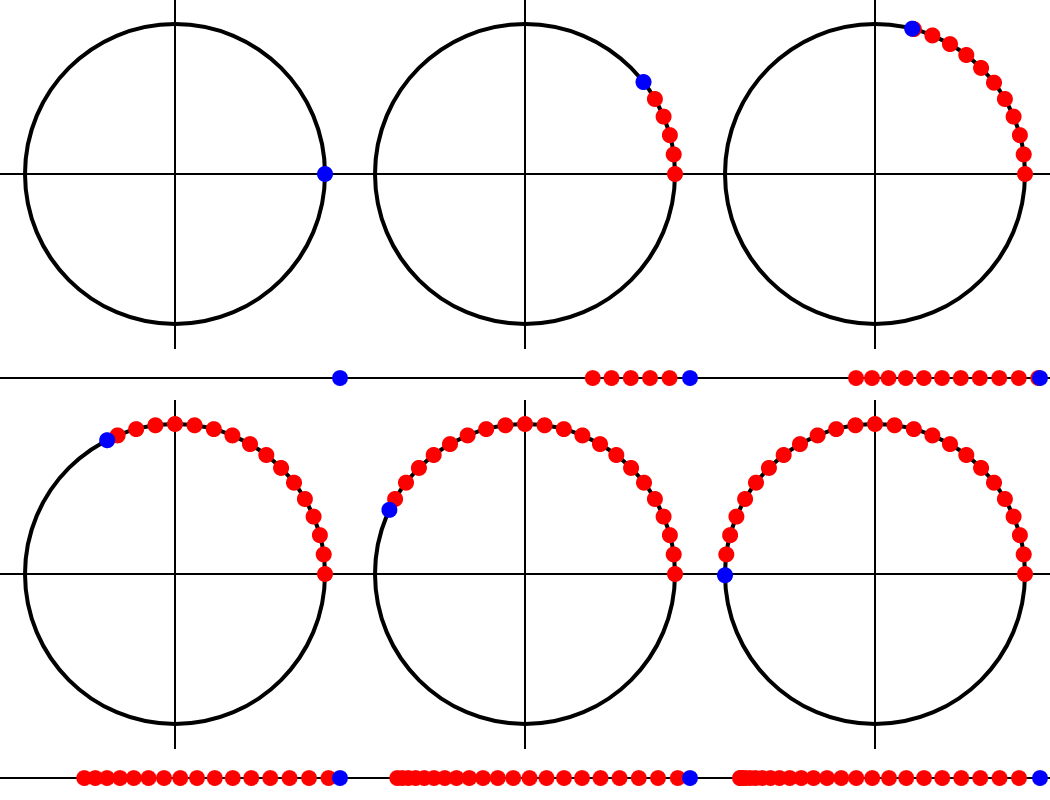
I think you can probably get there, if one insists. Take a circle, which is a 2-dimensional ball. It's surface is a 1-sphere. Make that surface the time dimension, and slap on three dimensions for space. Walla. I'm guessing that's laughably wrong, but even if it were right, it's way more complicated than it needs to be. And the curvature tensor would still be zero. And it would imply that if you wait long enough, time will have gone in a circle and you would wind up "when" you started.
I think you can probably get there, if one insists. Take a circle, which is a 2-dimensional ball. It's surface is a 1-sphere. Make that surface the time dimension, and slap on three dimensions for space. Walla. I'm guessing that's laughably wrong, but even if it were right, it's way more complicated than it needs to be. And the curvature tensor would still be zero. And it would imply that if you wait long enough, time will have gone in a circle and you would wind up "when" you started.
It's natural to think a vector is equal to a scalar?
Methinks it would be more natural to think the norm of a vector is equal to a scalar, but that puts me in mind of something I forgot to mention earlier:
Either everything is moving away from us, making them appear time dilated to us, or things don't move through the past at the same rate, which makes them time dilated to us.
Watch the dots in this animation, they are the event of a photon being emitted. The photon's path through spacetime is the line connecting it to the present. As time passes, the events move further to the past. Notice (eta: on the right) how they seem to pick up speed as they go:
You show two distinct dimensions of time in the GIF on the right. The y axis is time, and the progress of the animation is also time, and they don't match up with one another (or else the animation would look like a steady upward pan of an otherwise static diagram, like the one on the left).
It's an observed fact that the time between events in the past is stretched, that means the oscillations of an electromagnetic wave from the past will have an elongated period. That's redshift.
We only observe photons (or anything else) in the present. The photon was emitted in the present (that is, at the time it was emitted, obviously) and remains in the present (t=0, as you put it) while en route from the distant galaxy. You haven't explained why we should expect a redshift in the photon in the present, any more than we would expect a clock to run slower in the present than it did in the past just because it started running a long time ago.
We do in fact observe redshift, but can changes taking place "in the past" explain it, or any observation? Note that the phrase "changes taking place in the past" is a contradiction unless there's some separate additional time dimension to account for "changes in the timeline" like in a time travel SF story.
You show two distinct dimensions of time in the GIF on the right. The y axis is time, and the progress of the animation is also time, and they don't match up with one another (or else the animation would look like a steady upward pan of an otherwise static diagram, like the one on the left).
Well, they aren't distinct, because you don't go one way through one, and another way through another.
This is the relation between t and t'. The coordinates on the left, encounter the basis vectors on the left, and produce the coordinates on the right. You can go from right to left with the reverse transformation.
You haven't explained why we should expect a redshift in the photon in the present, any more than we would expect a clock to run slower in the present than it did in the past just because it started running a long time ago.
Because the light signals are coming from the past. The time between them will be longer.
We do in fact observe redshift, but can changes taking place "in the past" explain it, or any observation? Note that the phrase "changes taking place in the past" is a contradiction unless there's some separate additional time dimension to account for "changes in the timeline" like in a time travel SF story.
Well, they aren't distinct, because you don't go one way through one, and another way through another.
This is the relation between t and t'. The coordinates on the left, encounter the basis vectors on the left, and produce the coordinates on the right. You can go from right to left with the reverse transformation.
A photon is emitted at a particular frequency at a particular location in spacetime. A billion years later, you say the same photon was emitted at that location but at a different frequency, because it's now farther in the past. That's a change in a physical event that already happened. To change the past you need a dimension other than time for that change to take place in.
Because the light signals are coming from the past. The time between them will be longer.
Thought experiment: I set up a blue laser so that the beam passes through a prism. Beyond the prism is a detector, positioned so that only blue light from the direction of the laser will be refracted by the prism by the right amount to hit the detector. If the detector detects the beam, it will launch a rocket set up to put a small satellite into orbit around Pluto. If it doesn't detect that, for instance if the laser beam were green or yellow or red instead, the rocket doesn't launch. I turn the laser on and observe the rocket blast off and eventually place its payload in the Pluto orbit.
Five billion years later, you observe the experiment from a distant galaxy, and you observe that the laser emitted yellow photons, because the event is now so far in the past. So you observe the rocket did not launch, and there is now no such satellite in orbit around Pluto. How do you explain the difference in what we observe?
Or do you observe that the rocket did launch and the satellite is there? If so, how do you explain how it got launched?
(Note that if the observed redshift is due to a Doppler shift and relativistic time dilation due to relative motion, the equivalent question can be answered.)
A photon is emitted at a particular frequency at a particular location in spacetime. A billion years later, you say the same photon was emitted at that location but at a different frequency, because it's now farther in the past. That's a change in a physical event that already happened. To change the past you need a dimension other than time for that change to take place in.
Thought experiment: I set up a blue laser so that the beam passes through a prism. Beyond the prism is a detector, positioned so that only blue light from the direction of the laser will be refracted by the prism by the right amount to hit the detector. If the detector detects the beam, it will launch a rocket set up to put a small satellite into orbit around Pluto. If it doesn't detect that, for instance if the laser beam were green or yellow or red instead, the rocket doesn't launch. I turn the laser on and observe the rocket blast off and eventually place its payload in the Pluto orbit.
Five billion years later, you observe the experiment from a distant galaxy, and you observe that the laser emitted yellow photons, because the event is now so far in the past. So you observe the rocket did not launch, and there is now no such satellite in orbit around Pluto. How do you explain the difference in what we observe?
Or do you observe that the rocket did launch and the satellite is there? If so, how do you explain how it got launched?
(Note that if the observed redshift is due to a Doppler shift and relativistic time dilation due to relative motion, the equivalent question can be answered.)
In that animation, why is the vertical axis labelled with positive numbers? Why aren't all of those labels zero?
By convention, the time coordinates of past events are less than the time coordinate for the present time. We can't accuse Helland physics of being conventional. We can't even accuse Helland physics of being consistent with itself.
To people who know what they're talking about, that would be rather counter-intuitive because events, being points of the spacetime manifold, do not move through time.
Watch the dots in this animation, they are the event of a photon being emitted. The photon's path through spacetime is the line connecting it to the present. As time passes, the events move further to the past.
The passage of time at a given point would be the slope of the line f(t)=eH0t at that t. For an observer, which will always be in the present, t=0, f(t)=1. As time passes, events in the present (t=0) move to the past (t<0)
Are those the same basis vectors whose norm is 1 at t = 0? Or are those the basis vectors in that alleged inner product space where et · et is negative?
The ticks of the clock are spacetime events, which occur in the present, but as time passes, they move farther and farther into the past, where they encounter smaller basis vectors, so in a sense, the events are accelerating backwards in time, whereas the clock itself is comfortable at a constant speed in the present.
I'm wondering why Mike Helland chooses to use smaller basis vectors at past events. Isn't there a rather obvious orthonormal basis he could have used instead?
I'm kidding, of course. I understand why he makes stupid choices.
Helland physics is about choosing and even inventing maps that allow Mike Helland to confuse himself about the territory. Choosing conventional and obvious coordinate systems, basis vectors, whatever, would make it harder for him to fool himself.
This is the relation between t and t'. The coordinates on the left, encounter the basis vectors on the left, and produce the coordinates on the right. You can go from right to left with the reverse transformation.
He's talking about maps, not territory. Coordinates are map, not territory. A choice of basis vectors is map, not territory. An invertible coordinate transformation converts one map into another without altering territory.
Any given point of 4d spacetime should tell you tt, tx, ty, tz, xt, xx, xy, xz, yt, yx, yy, yz, zt, zx, zy, zz. Those are the elements of the metric tensor.
Not sure what you're getting at. How does TDP answer that question any differently than other metrics.
I'm disappointed. I was so looking forward to hearing about an inner product space in which an inner product et · et is negative.
"In the embedded-manifold picture, a tangent vector at a point x is thought of as the velocity of a curve passing through the point x. We can therefore define a tangent vector as an equivalence class of curves passing through x while being tangent to each other at x."
If TDP can be embedded in Minkowski space, and both are completely flat, all the tangent lines will be the lines themselves.
But the magnitudes differ. So they basically act as a scalar here, yes.
Map, territory, cargo cult, yeah yeah.
In 1915, Einstein was all like "Yo, I can do gravity with nuthin' but curved space, homie!"
And the plane landed.
108 years later, we're trying to explain the time dilation of cosmic phenomena with nothing but curved space. And that plane hasn't landed. Maybe curving space is not the right way to dilate time? Maybe the one pointing the finger should take a self-examination.
But I get where you're coming from.
Let's say:
Exhibit A: the elongating of light's wavelength.
Someone says "tired light!"
You say, ahh! But:
Exhibit B: is the elongating of a supernovae's duration
I think the expansion of space is well argued there.
But let's say the star witness, Exhibit A, gets asked... how do we know it's not the electromagnetic wave's period that is elongating? Then Exhibit A says, yeah, I guess that's possible too. So now:
Exhibit A: the period of an electromagnetic wave is elongated Exhibit B: the duration of a supernovae is elongated
All of a sudden, space has nothing to do with it. Exhibit A and B are both just stretching time.
It's easy to represent that mathematically, and it actually fits the data.
If both observers observe the rocket taking off, that means the same prism of the same material and the same geometry has refracted yellow light in exactly the same way as blue light. Not just the rate of the clock but the physical behavior of the system is inconsistent.
Any given point of 4d spacetime should tell you tt, tx, ty, tz, xt, xx, xy, xz, yt, yx, yy, yz, zt, zx, zy, zz. Those are the elements of the metric tensor.
Not sure what you're getting at. How does TDP answer that question any differently than other metrics.
What I'm getting at is the Dunning-Kruger hilarity of a cargo cultist who's been blathering about basis vectors for several weeks now, but is unable to identify the vector space spanned by those basis vectors.
He's pretending his list of the 16 coordinate-dependent components of the metric tensor identifies the vector space in which his basis vectors reside. So he doesn't have a clue. But we knew that already, didn't we?
That imaginary number hack was popular for a few years. In his guess and Google approach to physics and math, Mike Helland must have found an online source that still uses imaginary numbers when explaining special relativity.
That imaginary number hack doesn't work in general relativity. In particular, it doesn't work for FLRW models.
In general relativity, it is necessary to accept that the manifolds are pseudo-Riemannian rather than Riemannian.
"In the embedded-manifold picture, a tangent vector at a point x is thought of as the velocity of a curve passing through the point x. We can therefore define a tangent vector as an equivalence class of curves passing through x while being tangent to each other at x."
But Mike Helland still doesn't understand how that vector space is related to the manifold, which means he still doesn't understand what his blathering about "basis vectors" had to do with the manifold:
There's no "if" about it. The TDP submanifold is embedded within Minkowski space, and both are completely flat.
But the tangent space is R4, which is a Riemannian manifold. Minkowski spacetime and the embedded TDP submanifold are pseudo-Riemannian, not Riemannian. Tangent vectors, including the basis vectors that Mike has been blathering about for weeks, reside within the Riemannian R4. The "lines themselves" lie within the pseudo-Riemannian manifold.
And saying the tangent vectors "basically act as a scalar here" is really stupid, especially after he's Googled some online source that correctly says "Vectors have a direction, and a magnitude."
As usual, Mike Helland doesn't know what he's talking about.
108 years later, we're trying to explain the time dilation of cosmic phenomena with nothing but curved space. And that plane hasn't landed. Maybe curving space is not the right way to dilate time? Maybe the one pointing the finger should take a self-examination.
Einstein's general theory of relativity is one of the most successful and well-tested scientific theories in the history of humanity. Its explanation of cosmological redshift is supported by a wide range of disparate evidence, as laid out in great detail within standard texts such as Steven Weinberg's Cosmology.
But Mike Helland doesn't read physics books. He can't. They use calculus and stuff.
If both observers observe the rocket taking off, that means the same prism of the same material and the same geometry has refracted yellow light in exactly the same way as blue light. Not just the rate of the clock but the physical behavior of the system is inconsistent.
Myriad has a point. Myriad's point is fatal to Helland physics.
But Helland physics has made lots and lots of failed predictions, most of which were fatal to Helland physics. The stupidity of Helland physics hasn't yet stopped the author and sole proponent of Helland physics from promoting that stupidity, so we can expect him to entertain us with still more math jokes of the sort I'm laughing at here.
If both observers observe the rocket taking off, that means the same prism of the same material and the same geometry has refracted yellow light in exactly the same way as blue light. Not just the rate of the clock but the physical behavior of the system is inconsistent.
In an expanding universe, the prism would be changing size while the light was in it. You get around that by saying the prism is gravitationally bound, so the expansion stuff doesn't apply to it.
In the time dilated past the light actually travels through the prism all the same. It takes longer though.
In an expanding universe, the prism would be changing size while the light was in it. You get around that by saying the prism is gravitationally bound, so the expansion stuff doesn't apply to it.
In an expanding universe, the prism would be changing size while the light was in it. You get around that by saying the prism is gravitationally bound, so the expansion stuff doesn't apply to it.
That's absurd. The light only passes through the prism for as long as it takes for the sensor to detect it. Much less than a second. Even without gravitation, the universe isn't going to expand any detectable amount in that time.
It's true that in an expanding universe where the redshift observed by the later observer is caused by relative motion there's no change in the outcome, but it's not because prisms work inconsistently.
In your account, the light in the prism behaves inconsistently between different observers, which should lead to different outcomes, which is only possible if past events change.
Yes, the author and sole proponent of Helland physics really does think the tangent vector for a photon travelling east points in the same direction as the tangent vector for a photon travelling north.
In an expanding universe, the prism would be changing size while the light was in it. You get around that by saying the prism is gravitationally bound, so the expansion stuff doesn't apply to it.
In the time dilated past the light actually travels through the prism all the same. It takes longer though.
Assuming the thickness of the prism is 2cm, with a refractive index of 1.5, it takes about 100 picoseconds for light to travel through the prism. According to the author and sole proponent of Helland physics, the size of that prism changes so much during those 100 picoseconds that yellow light is refracted the same as blue light.
ETA: Sorry, I got the pseudo-scientist's stupid explanation wrong. According to the author and sole proponent of Helland physics, it takes longer than 100 picoseconds for light to travel through the prism.
But that explanation is so stupid that the paragraph below doesn't need to be revised, even though the stupidity of the "phenomenon" it discusses is different in its stupid details.
I suppose the reason we don't observe this truly striking phenomenon in laboratories is that it happens only in the distant past. Odd, though, that (according to the author and sole proponent of Helland physics) the detector in Myriad's thought experiment was able to detect the phenomenon even though the phenomenon occurred within its present.
That's absurd. The light only passes through the prism for as long as it takes for the sensor to detect it. Much less than a second. Even without gravitation, the universe isn't going to expand any detectable amount in that time.
It's true that in an expanding universe where the redshift observed by the later observer is caused by relative motion there's no change in the outcome, but it's not because prisms work inconsistently.
In your account, the light in the prism behaves inconsistently between different observers, which should lead to different outcomes, which is only possible if past events change.
Well, the distances traveled by photons in a 2cm thick prism today, would be 1/10th of those distances at z=9. But expanding space isn't really applied that way, so it can be ignored.
The TDP says the prism never changed size, nor did the paths they took. They didn't expand into something larger over time. But it took ten times longer. The photons still separate per their wavelength, but it takes longer. And the clock next to the prism clicks slower too.
Well, the distances traveled by photons in a 2cm thick prism today, would be 1/10th of those distances at z=9. But expanding space isn't really applied that way, so it can be ignored.
Expanding space is derived from, and applied to, the relativistic physics of relative motion. The distant (moving) observer observes the prism as being thinner (and the paths of the beams different angles, and so forth) due to length contraction, and the color of the light as being redder due to time dilation, and the end result is the exact same outcome, that is, the beam still hits the detector.
The TDP says the prism never changed size, nor did the paths they took. They didn't expand into something larger over time. But it took ten times longer. The photons still separate per their wavelength, but it takes longer. And the clock next to the prism clicks slower too.
Yes, that's a good summary of the problem. The geometry and materials don't change, except the prism now refracts yellow light in the same way it originally refracted blue light, which is inconsistent.
Can't be. At high redshift, that would mean things are moving faster than the speed of light.
The newer, modern take is that the distances themselves are expanding. Someone with a bit more credibility than I might want to jump in on that.
Yes, that's a good summary of the problem. The geometry and materials don't change, except the prism now refracts yellow light in the same way it originally refracted blue light, which is inconsistent.
You have yet to comprehend the full implications of Helland Physics. The time will come when all physics textbooks make reference to Before Helland and After Helland, and Einstein will be relegated to a mere historical curiosity.
Let's say we have an RGB LED, and a prism, and a detector calibrated to detect a yellow photon.
When the RGB's light goes through the prism, it will only be broken into red, blue, and green, because that's all that's going on. Let's consider one photon of each. The red photon will be photon 1, green is 2 and blue is 3.
When the detector is close by, it won't go off. There are no yellow photons.
If you move the detector father and farther away, eventually it will go off, because photon 2 (green) will have redshifted to yellow.
This site uses cookies to help personalise content, tailor your experience and to keep you logged in if you register.
By continuing to use this site, you are consenting to our use of cookies.