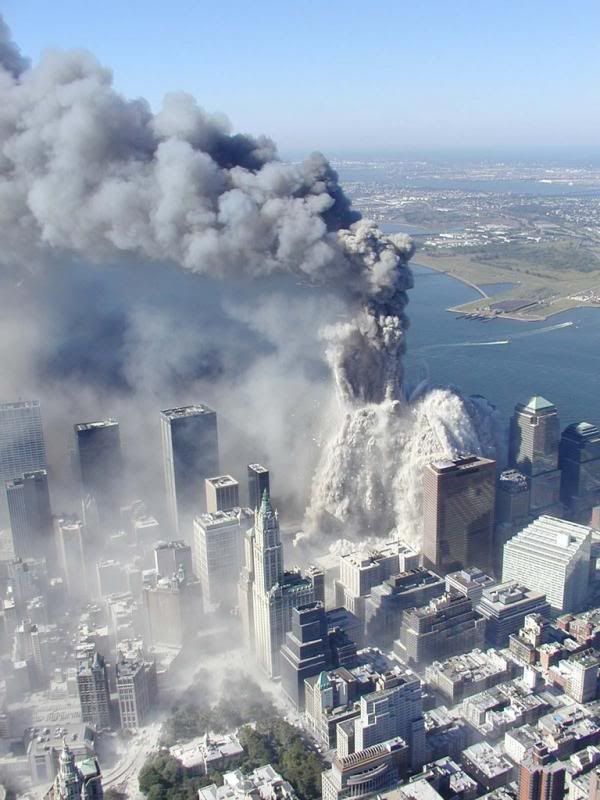
Experiment:
1) Take hammer.
2) Smash an ice cube.
Is the ice cube hammered into the ground? What's that you say? Chunks fly out horizontally?

Repeat experiment using 20 stories of skyscraper as hammer.
A few problems with this analogy.
1) The hammer doesn't shatter, only the ice. With WTC, the "hammer" (the upper part of the building) disintergrates along with the lower part. Odd.
2) Breaking the ice requires not only the hammer hitting from above, but also tremendous resistance from below. Yet, according to NIST, the intact structure below offered "very little resistance". This low resistance, of course, is needed to explain the rapid collapse times.
3) Swinging the hammer is imparting great energy into the system beyond gravitational potential energy. WTC supposedly crushed themselves using gravity alone.
So, if you want to construct for us a valid analogy, try to come up with an example where these two things occur:
1) An object stands there maintaining its shape for a long time.
2) Then, after some internal part of the object fails (for whatever reason) and goes away, the top part falls into the bottom part, and both top and bottom are crushed, and then great amounts of the resulting stuff is thrown sideways, and it all happens within, say 150% of free fall time.