• Quick note - the problem with Youtube videos not embedding on the forum appears to have been fixed, thanks to ZiprHead. If you do still see problems let me know.

An email from a Conspiracy theorist, and I have no idea how

So ? Do you have any idea how much fire weakens steel ?


You're not very good at this.

The sagging was due to HEAT, not excess loads. The floors were NOT disconnected from the columns and that's the WHOLE point. Because they weren't, they pulled on the columns.


You only need ONE wall to fail to initiate collapse. In fact, you can see the top section of 2 WTC tilt at the beginning. Then the strain snaps the remaining columns and the whole thing comes down. Dammit, man. You can see this on the videos quite clearly.


[qimg]http://www.internationalskeptics.com/forums/imagehosting/thum_608045892c4f64e35.jpg[/qimg]


The theory explains what happened and is supported by VISUAL evidence. What do you need ? A signed document from the Maker confirming this ?


Please tell us how much time it would take, and the exact percentage of redistribution...


Begging the question.


Again, please explain the following:

1) What kind of demolition charge produces no explosion and no sound ?
2) How can 47 columns fail simultaneously and STILL result in the top section tilting as it fell ?
3) How do you know the core failed first since we can clearly see it collapse LAST ?
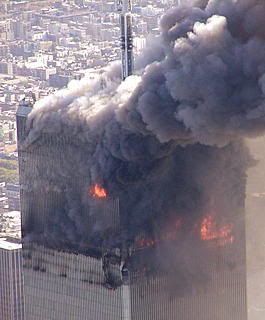
4) What kind of explosive can caused the extreme bowing seen in this photograph ?

[qimg]http://www.internationalskeptics.com/forums/imagehosting/thum_608045892c65f25a4.jpg[/qimg]


Nonsense. Thousands of engineers and scientists around the world, with no affiliation to the US government, would be able to spot the discrepancies.


Toughen up.

I don't know how to quote above with sub-quotes but here we go.

There was no load on the floors above, except their own weight + furniture. Why concrete floors + steel trusses would then sag due to heat is beyond me but it will not be much. I know steel expands due to heat ... but concrete!! No way. The floors were >95% concrete. And that combination supported the perimeter columns regardless of any sagging.

Sorry - one (east) wall - supporting only 12.5% of the total load cannot initiate total global collapse. Why - the other structure, particularly the core, will easily support the load transferred to it. Basic. It is seen on the photos! The east wall is deformed ... and the other parts are intact. The tower stands.

And suddenly the whole thing explodes! But videos of the roof - far above - shows that it sags a little before that = the 47 core columns apparently failed before the east wall. Similar to WTC7? Strange case. But support for Controlled Demolition.

It would have been easy to check why the 47 off 400 metres tall core columns failed by proper forensic examination. But it was not done. This is why I suspect an Inside Job. And it is easiest decided by a re-hearing of the whole case in a law court. I actually believe in the Law of Justice. Do you?
 
Umm arent these supposed to be pictures of the sagging floors:

Fig9_52.jpg


sag.ht1.jpg
 
I actually believe in the Law of Justice. Do you?
I believe in evidence and you've presented nothing but an argument from incredulity. Which means nothing to science, engineering and the court of law.

But please come back when you are able to present something tangible.
 
Good grief, it gets worse.

Let's try some imaginary scenarios:

First, let's say we have a beam that is spanning across a void 3.0m wide. For the sake of argument will say it is 152x152mm UB.

Now this beam is nice and flat and when we stand on it it doesn't move a millimetre. Lovely beam it is. We like this beam.

Now, we have an endless supply of beams like this, only in varying lengths. And because we like it so much, we decide to use a similar beam to span across a void 30 metres wide.

But this time we're not so happy. Can anyone tell me why?

..................

We've learned our lesson from the unhappy experience with the 30.0m beam and now we've got all clever and stuff and we've figured out how to span that distance using our favourite beams. We'll use two of them!! Aren't we clever?

Even clevererer we'll have one baem above the other and we'll connect them together with struts and braces until we have a very pretty beam indeed. We're feeling very good now.

We span our new sooper dooper beam across the void and it's solid and steady and ohhhh so fantastic, so it is.

But we really need to hold it in place with something because sometimes, when we've had a very very hot curry and we're standing on our beam, it starts to wobbly. oooooooo scarey.

So we get another couple of our most favourite beams and this time we put them upright. They look so good like that. We put one at each end of our sooper dooper beam and we fix it all together with magic fairy nuts.

ooooooooo we are soooooo clever. The most clererest thing in the whole whole..... but wait. What's this? An evil troll is in the void just under our lovely beam. And he's cooking his socks! What a smelly old troll he is. And what a big fire he has built. The flames are almost touching our beam.

But we're not scared are we boys and girls? Noooooooo. We can stand on the middle of our beam and blow rasberries at the smelly troll because he can't reach us.

But then we feel our beam begin to move. What's happening? Oh my, the fire is somehow making our beam go weak. But, not to worry, because it is safely fixed at both ends and can't fall on top of the smelly troll.

But wait...oh no!!! the eccentric forces applied to the upright members is causing them to rotate about their axis, and the fairy nuts aren't letting go!!

Help! Help! we cry, as our beam sags more and more and the fire starts to touch our toes and then, with a crack and a bang and a whoosh and a twang, our beam and our posts tumbles down into the trolls fire.

And we're sad, because the troll is now applying barbeque sauce to our nether regions.

Goodnight boys and girls.
 
There was no load on the floors above, except their own weight + furniture. Why concrete floors + steel trusses would then sag due to heat is beyond me but it will not be much. I know steel expands due to heat ... but concrete!! No way. The floors were >95% concrete. And that combination supported the perimeter columns regardless of any sagging.


Annnnnnnnd you just proved to me that you know nothing about structural engineering. Let's explain some concepts that you should have picked up in the second or third year of your undergraduate program:

The concrete slab in the WTC was composite with the floor trusses, which means that they acted together to resist bending moments. This translates to the concrete slab and the top chord of the truss being in compression, and the bottom chord of the truss in tension. Fairly basic concept for most people, you seem to be implying that the concrete did most of the work in holding the floors up.

The important point here, is how steel behaves when it is heating. You think that it only expands. Probably something you picked up watching a cooking show on TV. Something else important thing that changes is the modulus of elasticity. This modulus is the ratio of pressure to percent deformation. When the steel heats up, the modulus of elasticity goes down. So the bottom chord expierences higher amounts of elongation, hence sagging. This is immediately obvious to anyone who took a basic course in mechanics of materials, which you've either forgotten or never took.

There's something else that happens with the above, since the top chord is in compression and the bottom chord is tension, any increase in heat would result in strain compability issues with the web members. The web, being welded to the top and bottom chord of the truss, will be stretched as the bottom chord elongates and the top chord shrinks.

The above is probably the first explanation most engineers would come to when looking at a bending member that sagged due to heat. However it is not the only one.

The second one that comes to mind is the change in the yield stress of the truss due to heat. If the truss yields, then it will elongate a great deal without any further increase in stress. Also a basic concept.

There are more explanations as well:

Any damage to the web members of the truss would result in the top chord becoming more of a bending member than an axial only member. This will cause the stress in the top chord to increase and might even cause it to yield.

Localized point loads from very heavy objects (large pieces of the planes or debris from above) can overload the shear capacity of the truss. This would likely have the biggest effect if the point load was near the middle of the span of the truss as that is where an economical design will have the smallest web members.

Any large deflection in the truss, probably in the range of L/180 would crack the floor slab, further lowering the strength of the composite floor. Furthermore, floor slabs are NEVER used to brace steel columns as concrete has no tensile capacity. The only thing that braced the columns were the floor members.
 
Annnnnnnnd you just proved to me that you know nothing about structural engineering. Let's explain some concepts that you should have picked up in the second or third year of your undergraduate program:

The concrete slab in the WTC was composite with the floor trusses, which means that they acted together to resist bending moments. This translates to the concrete slab and the top chord of the truss being in compression, and the bottom chord of the truss in tension. Fairly basic concept for most people, you seem to be implying that the concrete did most of the work in holding the floors up.

The important point here, is how steel behaves when it is heating. You think that it only expands. Probably something you picked up watching a cooking show on TV. Something else important thing that changes is the modulus of elasticity. This modulus is the ratio of pressure to percent deformation. When the steel heats up, the modulus of elasticity goes down. So the bottom chord expierences higher amounts of elongation, hence sagging. This is immediately obvious to anyone who took a basic course in mechanics of materials, which you've either forgotten or never took.

There's something else that happens with the above, since the top chord is in compression and the bottom chord is tension, any increase in heat would result in strain compability issues with the web members. The web, being welded to the top and bottom chord of the truss, will be stretched as the bottom chord elongates and the top chord shrinks.

The above is probably the first explanation most engineers would come to when looking at a bending member that sagged due to heat. However it is not the only one.

The second one that comes to mind is the change in the yield stress of the truss due to heat. If the truss yields, then it will elongate a great deal without any further increase in stress. Also a basic concept.

There are more explanations as well:

Any damage to the web members of the truss would result in the top chord becoming more of a bending member than an axial only member. This will cause the stress in the top chord to increase and might even cause it to yield.

Localized point loads from very heavy objects (large pieces of the planes or debris from above) can overload the shear capacity of the truss. This would likely have the biggest effect if the point load was near the middle of the span of the truss as that is where an economical design will have the smallest web members.

Any large deflection in the truss, probably in the range of L/180 would crack the floor slab, further lowering the strength of the composite floor. Furthermore, floor slabs are NEVER used to brace steel columns as concrete has no tensile capacity. The only thing that braced the columns were the floor members.

So what? The vertical load on the floor assembly was only 20 kgs/m² = furniture and outfitting. No heavy members of an alleged plane landed on the floor! All that material flow in and out of the windows at once. If it was a plane? To me most fuel - 30 tons - also disappeared through the windows - at once. Why would the fuel stop inside the building, if it arrived at 800 kms/h? To me the impact looks like an explosion ... and not a plane impact. A plane impact would look completely different.

It is alleged that the temperature was high, so the steel and the concrete warmed up and material properties changed. And that the floors above impact sagged. But where is the evidence? As soon as the temperature falls again (the fire fades - only 20 kgs/m² of furniture burning you know) the material properties return to normal and the floor - even if deformed and with some cracked concrete - becomes an effective support again. The connections to the columns are still intact, i.e. the columns' supports are effective. And that accounts for 80% of the columns according NIST.

It seems on most photos that the fire was gone long before the sudden collapse ... that ensued. The small fires we see on photos are negligible. Just to roast a chicken on! So I assume most heat had escaped with the smoke, the temperature had fallen as fresh air was sucked in. It was not a big space and open all around. All columns in the south, west and north walls were effective then again before the collapse and could carry the 10-15% extra load from the failed east wall. So no global, sudden collapse could ensue. The mistake of NIST is that they ignore many things, e.g. that the temperature falls again, that the structure, even if damaged becomes more effective again, etc. But they were too afraid to admit it.

What a sloppy explanation of the collapse. It just ensued.
 
[...]
I know steel expands due to heat ... but concrete!! No way. The floors were >95% concrete. And that combination supported the perimeter columns regardless of any sagging.
[...]

I would highly suggest reading any book on concrete. Mindness, Young and Darwin in Concrete 2nd edition list the coefficient for thermal expansion in concrete as between 7.4/C and 13/C. It lists the coefficient of thermal expansion for steel as between 11/C and 12/C. The PCA's Design and Control of Concrete Mixtures lists the value as 10/C. Jack McCormac's Design of Reinforced Concrete lists the value for reinforced concrete as between 9/C and 12/C.

So to answer your question, yes, concrete does indeed expand, deform and sag under load. The only appreciable difference between steel and concrete is in ductility and toughness, not in thermal expansion.
 
OT but an easy one answered by Euler already 1744. The critical load P is

P = pi² x E x I / L² where L is the unsupported length of the column.

So if P = 100% when L is one unit, it is 25% when L is two units, it is 11.11 % when L is three units, etc. This is basic! Didn't you know Euler?

So you don't believe in inelastic buckling? Perhaps your studies in structural analysis would have led you to the path of Shanley and true column behavior, but ah well. Column buckling wasn't figured out until the middle of the 20th century. Euler buckling is only correct for extremely slender columns.

If you actually did REAL structural analysis, you would know this.
 
The small fires we see on photos are negligible. Just to roast a chicken on! So I assume most heat had escaped with the smoke, the temperature had fallen as fresh air was sucked in.

Why did people jump from the building if the fires weren't hot?

And where did all that smoke come from?
 
So you don't believe in inelastic buckling? Perhaps your studies in structural analysis would have led you to the path of Shanley and true column behavior, but ah well. Column buckling wasn't figured out until the middle of the 20th century. Euler buckling is only correct for extremely slender columns.

If you actually did REAL structural analysis, you would know this.

Of course - I was just testing this fool Alferd. And I like basics. But this is OT. We are discussing the NIST load re-distribution theory after alleged buckling of the east wall due lack of support and what happens to the core columns. OK - the core columns were not slender at all - some were box shaped - quite strong - why did they suddenly collapse? Did they buckle, compress, go up in smoke? You agree with NIST? Were they only softened?

Have you seen the core columns arrangement of WCT2? I was there a couple of times before the collapse on various floors. Looked very strong.
 
Heiwa, click the link below my post. I have actually calculated the compressive strength of the columns near the plane impact. It's overly conservative in favor of collapse prevent because it's based on Gordon Ross's assumptions.

If you REALLY knew what Euler buckling was, you wouldn't have used the I term, you would have used the more generic and modern (KL/r).

If you claim to be an engineer, use some actual engineering to make your arguments. Don't just use things you find on google, actually take the time to write a real paper with a real mathematical model. All your doing now is blowing smoke out of your filing cabinet.
 
In my comment #49 I quoted the NIST suggestion how global collapse ensued due to a small load distribution, which I queried. Nobody has so far explained why a small load distribution caused total collapse, so I assume we all agree that NIST suggestion is wrong. Most respondents have queried my knowledge about basic structural strength etc., which is of course OT.

But NIST is quite specific what happens when the east wall buckles and before total collapse ensues:

"The section of the building above the impact zone tilted to the east and south (observed at about 7° to 8° to east and about 3° to 4° to south, (…) as column instability progressed from the east wall to the adjacent south and north walls. The release of potential energy due to downward movement of the building mass above the buckled columns exceeded the strain energy that could be absorbed by the structure. Global collapse ensued (sic)."

So now we turn from structural analysis to pure mechanics and dynamics.

Thus - due to the east wall collapse that started at time T and before global collapse ensued at time T + t1, i.e. in t1 seconds, the section above the impact zone tilted 7-8° to east due to release of potential energy. Assume that the section above is 100 metres high with its centre of gravity, CoG, at 50 metres above the impact zone. This means that the CoG of the section above shifted abt 6.14 metres to the east and the top of the lose section 12.28 metres to the east during time t1, before it started to fall straight down, when the south, west and north walls and the centre core collapsed - disappeared.

What is the rate of tilting (°/s) of the section above the impact zone at time t1. It was 0 °/s at time T but what was it at time t1? 15 °/s or more? As many observers have pointed out the section above the impact zone was completely undamaged and should evidently continue to rotate or tilt as it falls down. Its rotating momentum cannot be stopped.

How long time, t2, does it take for the undamaged section above the impact zone to fall down to the ground. Say its CoG was 350 metres above ground. Say that t2 is 8 seconds. How much should the 100 metres tall section above the impact zone rotate/tilt in that time? 120° or 90°? Did it? Or did it disappear in smoke?

You also wonder how the west part of the tower below the impact zone collapsed as there was no weight - potential energy - released above it. The potential energy that caused collapse - the intact section above the impact zone - was evidently shifting is CoG to east during the collapse. The CoG of section above the impact zone must in the end have been east of the east wall.

Regardless - the undamaged section above the impact zone obviously lands on top of rather on the east side of the remains of the tower that globally collapsed (for unknown reasons) below it.

Did it? I assume that the undamaged section above the impact zone should have landed more or less on its east wall side with the west wall on top, i.e. after the total collapse of the tower, we should have observed 100 metres of west wall columns on the east side of or on top of the rubble.

This 80 x 100 metres west wall column assembly should be more or less intact before it hits the ground/rubble on the ground and should then deform a little. It should have been easy to document this section. It was on top of everything.

Did anybody? Under the 100 metres of west wall columns, we should find 100 metres of 47 centre core columns, etc. They should be more or less continuous, i.e. one piece each but maybe deformed. It would have been easy to see how these core columns were torn apart at the impact zone.

But strangely enough it was not done. No forensic examination was done of section above the impact zone. It seems, which many observers have noted, that the intact section above the impact zone - four walls and its core - disintegrated in air between times t1 and t2. How to explain that? NIST does not explain it.
 
Do you believe that airliners hit the Twin Towers, the Pentagon, and a field in Pennsylvania on 9/11?

Good question. As I didn't see the incidents in person, I can only study the effects (holes in WCT1,2, Pentagon and a Pennsylvania field and rubble everywhere) and try to establish what caused them. Witnesses have given many different testimonies of what happened just before the impacts so I leave that analysis to others. It seems that forensic documentation of parts from any objects hitting the various locations is sloppy, so I have given up analysis of that too.

Subject here is of course the alleged by NIST load redistribution in WTC2 long after impact and what happens then. I have my doubts that global collapse ensued due to load redistribution as described by NIST, so what caused the global collapse? And how did the intact section above the impact zone get damaged, etc. It was the potential energy released, but it seems it flew away eastward during the collapse.
 
Good question. As I didn't see the incidents in person, I can only study the effects (holes in WCT1,2, Pentagon and a Pennsylvania field and rubble everywhere) and try to establish what caused them. Witnesses have given many different testimonies of what happened just before the impacts so I leave that analysis to others. It seems that forensic documentation of parts from any objects hitting the various locations is sloppy, so I have given up analysis of that too.
Really ? I guess it is beyond your wildest dreams that planes that were hijacked by Islamic terrorists were the cause of all the death and destruction? I guess we should start to look for hidden explosives, missiles, maybe planes that flew over the buildings or hey maybe we should question whether sinister top secret US black guys staged it all in order to gain public support for the war on terror eh ?

Your analysis to date is one of wild speculation, based on wishful thinking and a desire to be oh so clever and spot something that the entire planet missed. You have failed, you have not spotted anything because there is nothing to spot other than your small anomalies that goes with every large event. An event that you and your like minded buddies wish to be a part of, you wish the importance that comes with this event upon yourself, again you will fail because you are not important, you are just some guy who plays at being the internet detective when the rest of the planet has moved on.

I guess the truth really is too terrifying for you, that being we really are hated , hated enough for 19 guys to board four planes, kill all their path and slam three of them into buildings full of innocent people. Is that enough truth for you ? Or did you actually fail to get the message that was sent to you on 911?I guess you did.


Subject here is of course the alleged by NIST load redistribution in WTC2 long after impact and what happens then. I have my doubts that global collapse ensued due to load redistribution as described by NIST, so what caused the global collapse? And how did the intact section above the impact zone get damaged, etc. It was the potential energy released, but it seems it flew away eastward during the collapse.

Really? and where exactly do you expect a massive dynamic weight that is falling on floor trusses to go? Just how on earth do you expect the floors that simply braced the external columns to core to support it ?

The core survived the collapse, the floors and the external columns did not, why oh why do you have such a difficult time with such a simple process. The weight fell on the floors,the floors were violently ripped away from the inner core and the external columns. The core collapsed later.

SIMPLE.

Oh wait maybe not, lets look at explosives, thermite, secret death squads, fires that could not possibly cause any further damage to a already damaged steel framed structure and while we are at it lets investiagte Flight 77 not hitting the Pentagon but actually flying over it . Oh wait theres more, lets all say the desperate calls from the passengers on flight 93 were faked, as was the crash site. Wow lets just make up all sorts of nonsense and pretent we are all self important.

Yeah sure, what ever you say Mr Offshore Structural Engineer ( not).
 
Last edited:
Heiwa, click the link below my post. I have actually calculated the compressive strength of the columns near the plane impact. It's overly conservative in favor of collapse prevent because it's based on Gordon Ross's assumptions.

If you REALLY knew what Euler buckling was, you wouldn't have used the I term, you would have used the more generic and modern (KL/r).

If you claim to be an engineer, use some actual engineering to make your arguments. Don't just use things you find on google, actually take the time to write a real paper with a real mathematical model. All your doing now is blowing smoke out of your filing cabinet.

Interesting link. So there are two possibilities - global collapse ensues (NIST) or global collapse should have been prevented (and something else initiated the collapse). Anyway - global collapse was prevented for some time, so the structure was not too bad ... until it suddenly disintegrated due load redistribution. It is a pity that a forensic analysis was nor carried out of the structural parts in question. Of course I am an engineer, but I try to explain matters in layman terms for easy understanding. It is very practical when working in the field with welders and platers, etc. I can do 3D FEM/beam analysis, etc. but the input has to be correct, e.g. the actual conditions and loads. And NIST establishing actual conditions and loads is sloppy. And then it is very easy to chose some assumed conditions and loads to achieve the given result. I have seen it before.

Interesting reactions on this forum. Many believes anything and do not like open discussions.
 
Really ? I guess it is beyond your wildest dreams that planes that were hijacked by Islamic terrorists were the cause of all the death and destruction? I guess we should start to look for hidden explosives, missiles, maybe planes that flew over the buildings or hey maybe we should question whether sinister top secret US black guys staged it all in order to gain public support for the war on terror eh ?

Your analysis to date is one of wild speculation, based on wishful thinking and a desire to be oh so clever and spot something that the entire planet missed. You have failed, you have not spotted anything because there is nothing to spot other than your small anomalies that goes with every large event. An event that you and your like minded buddies wish to be a part of, you wish the importance that comes with this event upon yourself, again you will fail because you are not important, you are just some guy who plays at being the internet detective when the rest of the planet has moved on.

I guess the truth really is too terrifying for you, that being we really are hated , hated enough for 19 guys to board four planes, kill all their path and slam three of them into buildings full of innocent people. Is that enough truth for you ? Or did you actually fail to get the message that was sent to you on 911?I guess you did.


Really? and where exactly do you expect a massive dynamic weight that is falling on floor trusses to go? Just how on earth do you expect the floors that simply braced the external columns to core to support it ?

The core survived the collapse, the floors and the external columns did not, why oh why do you have such a difficult time with such a simple process. The weight fell on the floors,the floors were violently ripped away from the inner core and the external columns. The core collapsed later.

SIMPLE.

Oh wait maybe not, lets look at explosives, thermite, secret death squads, fires that could not possibly cause any further damage to a already damaged steel framed structure and while we are at it lets investiagte Flight 77 not hitting the Pentagon but actually flying over it . Oh wait theres more, lets all say the desperate calls from the passengers on flight 93 were faked, as was the crash site. Wow lets just make up all sorts of nonsense and pretent we are all self important.

Yeah sure, what ever you say Mr Offshore Structural Engineer ( not).

Thank you but you are 200% OT as we discuss another matter - alleged load re-distribution and its effects on WTC2.
 
Interesting link. So there are two possibilities - global collapse ensues (NIST) or global collapse should have been prevented (and something else initiated the collapse). Anyway - global collapse was prevented for some time, so the structure was not too bad ... until it suddenly disintegrated due load redistribution. It is a pity that a forensic analysis was nor carried out of the structural parts in question. Of course I am an engineer, but I try to explain matters in layman terms for easy understanding. It is very practical when working in the field with welders and platers, etc. I can do 3D FEM/beam analysis, etc. but the input has to be correct, e.g. the actual conditions and loads. And NIST establishing actual conditions and loads is sloppy. And then it is very easy to chose some assumed conditions and loads to achieve the given result. I have seen it before.

Interesting reactions on this forum. Many believes anything and do not like open discussion
s.

That is because I am close minded and beleive every single thing that my Government tell me, I am a sheep you see, I simply all fall in and obey the NWO. Oh Wait...............

Maybe , just maybe all your bunk as already been debunked , maybe just maybe that people actually find it quite offensive when internet detectives start accusing perfectly innocent people of being involved in mass murder.

You see, sunbeam you are actually acussing your fellow countrymen of mass murder and trying to excuse the real terrorists who committed this wicked act. So my learned fellow offshore worker( not) maybe you can start your open discussion by explaining to me why on earth I should listen to a word you say. Why should I listen to somebody who is trying to tell me that every single event that took place on 911 is not as it seems? You are the detective you are the one doing all the investigating , not me, I have no such delusions of grandeur, this is because I believe everything I am told, oh wait...... except your bunk that is.

So in the spirit of fair play and open discussion why don't you tell me what happeend on 911, no more "I'm just asking questions", no more sliding out of it, a simple summary of the day events. It goes something like this.

" On 911 four planes were hijacked by Islamic terrorists, two hit the towers, which burnt and then fell down. They fell on top of other buildings , which also fell down. A third plane hit the Pentagon and the forth crashed after the passengers fought back. A Group called Al Qaeda have repeadley claimed responsibility for this attack"

Now that is a simple summary, please offer up your own, do not have a go at mine, after all I am just a sheep who buys into anything, so why don't you tell , in your own words what happened?
 
I can do 3D FEM/beam analysis, etc. but the input has to be correct, e.g. the actual conditions and loads. And NIST establishing actual conditions and loads is sloppy. And then it is very easy to chose some assumed conditions and loads to achieve the given result. I have seen it before.

You have actually seen the details behind the FEA? Have you seen how they arrive at the assumptions of boundary conditions and loads?

In your FEMs, do you perform coupled heat transfer/structural analysis?

Lurker
 
Interesting reactions on this forum. Many believes anything and do not like open discussions.

Before I start with the analysis of your claims, I'd just like to ask a few questions.

1) If we believe anything without critical thought or analysis, why don't we believe you?
2) If someone were to come onto an internet forum, fail to address arguments presented to him, and routinely declare discussion points "off topic" instead of addressing them, would you call him a facilitator of an open discussion? Do people who do that really facilitate open discussion?
 
....
Have you seen the core columns arrangement of WCT2? I was there a couple of times before the collapse on various floors. Looked very strong.

That's a very strange statement.

Care to clarify?
 
You have actually seen the details behind the FEA? Have you seen how they arrive at the assumptions of boundary conditions and loads?

In your FEMs, do you perform coupled heat transfer/structural analysis?

Lurker

I have no problems to establish the actual conditions of structural parts and their boundary conditions before impact. The model is just the damaged floors and the intact section above. All parts are beams except the core box columns that are FE. The loads I know. After the impact the structure stands and I can model that by removing the damaged parts as proposed by NIST. The model is stable. But then it becomes complicated.

I assume that the perimeter columns are not affected by heat as they are outside the fire. I also assume the core columns are not affected by the heat (because it it unclear how hot it was at the various columns). NIST suggests that the floors sags due to heat and this I can model in different ways as long as the boundary conditions remain unchanged, i.e. the floors are connected to the columns. I can manually change the truss material properties. The vertical load on the trusses is small so sagging is small. The model is still stable. I can also model what happens if some trusses cool down again. The situation improves.

But if the floors starts to detach from the columns due heat + sagging I cannot model that because I have no idea if, where and how it takes place. Everything becomes guesswork. But why would the trusses be ripped of the columns due fire long after the impact? Has it happened in other fires? So I assume the floor trusses do not detach from the columns. The model is thus stable. The function of the trusses (+ concrete) are just to support the columns. Axial loads (tension) are transmitted by the trusses even if sagged but they are small.

I can remove the perimeter columns of the east wall (assumed buckled and not connected to the Trusses/floors) and observe the load re-distribution. The weight of the intact section above is shifted to the remaining walls and the core and the model still stands. No global collapse ensues. There was plenty of redundancy, it appears.
 
interesting he would have access to the core column arrangement of the WTC. Was that part of the standard tour...lol

TAM:)
 
Good question. As I didn't see the incidents in person, I can only study the effects (holes in WCT1,2, Pentagon and a Pennsylvania field and rubble everywhere) and try to establish what caused them.

Ignoring the heaps of witness testimony who actually saw the planes hit the Twin Towers and the Pentagon - not to mention that the NY planes were caught on video - which should help give a clue as to what actually exploded at and in those buildings.

Oh, or let me put it like this:

Do you believe that videos that show planes hit the Twin Towers are forged?

Do you believe that the witnesses who saw a plane hit the Pentagon are lying?

Two rather simple questions.


Cheers,
SLOB
 
Last edited:
I don't know how to quote above with sub-quotes but here we go.

The first thing you should learn is not how to quote, but how to read. Many of the things you state below are adressed in the post you were responding to.

There was no load on the floors above, except their own weight + furniture.

Which is already compromising when the head makes the steel useless.

Why concrete floors + steel trusses would then sag due to heat is beyond me but it will not be much. I know steel expands due to heat ... but concrete!! No way.

You do understand how floors hold together, don't you ?

The floors were >95% concrete.

>95 % ?

And that combination supported the perimeter columns regardless of any sagging.

Precisely. So what do you think bore the brunt of the stress once they started to sag ?

And we can SEE the sagging on the pictures and videos. How can you ignore that ?

Sorry - one (east) wall - supporting only 12.5% of the total load cannot initiate total global collapse.

Yeah, I'm sure that top section would've held just fine without those walls. :rolleyes:

Why - the other structure, particularly the core, will easily support the load transferred to it. Basic. It is seen on the photos! The east wall is deformed ... and the other parts are intact. The tower stands.

So your reasoning is that if the tower didn't fall immediately following the impact, it shouldn't have collapsed at all ??

And suddenly the whole thing explodes!

The word you are looking for is collapses.

But videos of the roof - far above - shows that it sags a little before that = the 47 core columns apparently failed before the east wall.

There is no reason to believe that the core columns failed and caused the collapse. I told you:

We can see the core STILL STANDING after the collapse of the perimeter is completed.

Similar to WTC7? Strange case. But support for Controlled Demolition.

Only if you assume that a CD is the only way to produce this effect.

It would have been easy to check why the 47 off 400 metres tall core columns failed by proper forensic examination. But it was not done. This is why I suspect an Inside Job.

And that's funny, because the REASON why it wasn't done is because there was no REASON to suspect foul play. We SAW the planes crash into the towers, we SAW the effect of the fires on the structure and NOTHING in the collapse is suspicious. Why the hell would you suspect foul play ?

And it is easiest decided by a re-hearing of the whole case in a law court. I actually believe in the Law of Justice. Do you?

Yes, and your theories would be laughed at by a judge.
 
So what? The vertical load on the floor assembly was only 20 kgs/m² = furniture and outfitting.

Who cares ? The metal EXPANDED without the need for excess weight.

Also, please don't forget that the floor itself has mass, and that heat doesn't help steel to withstand that.

Why would the fuel stop inside the building, if it arrived at 800 kms/h?

Actually, that's a false dichotomy. The fuel was spread.

To me the impact looks like an explosion ... and not a plane impact. A plane impact would look completely different.

Evidence ?

And what do you think an explosion is ?

It is alleged that the temperature was high, so the steel and the concrete warmed up and material properties changed. And that the floors above impact sagged. But where is the evidence?

The evidence is, this is how things work.

It seems on most photos that the fire was gone long before the sudden collapse ...

Then what was all that smoke doing there ?

The small fires we see on photos are negligible. Just to roast a chicken on!

I don't know why you feel the need to mock the events of that day.

So I assume most heat had escaped with the smoke, the temperature had fallen as fresh air was sucked in.

Actually, that's not how fires work. Fresh air doesn't help.

So no global, sudden collapse could ensue.

Engineers and experts around the world disagree with you.

What a sloppy explanation of the collapse. It just ensued.

Yes. It ensued. I don't think that word means what you think it means.
 
So my learned fellow offshore worker( not) maybe you can start your open discussion by explaining to me why on earth I should listen to a word you say. Why should I listen to somebody who is trying to tell me that every single event that took place on 911 is not as it seems? You are the detective you are the one doing all the investigating , not me, I have no such delusions of grandeur, this is because I believe everything I am told, oh wait...... except your bunk that is.

If you have read the 9/11 Commission report about all events that took place on 9/11 prior impacts as I assume you have, do you believe everything in it? I do not (and millions others). It is too much fiction and fantasy in the report.
But my main interest is the analysis of structural damages after impacts, i.e. the results of forensic examinations ... or the lack of them.

WTC2 was the first tower that collapsed. I assume the people trapped in the section above thought they were safe and that the tower would not collapse as the fire slowly went out. But then WCT2 suddenly collapsed ... and NIST is coming up with some suggestions why that we are discussing. Controlled demolition is evidently not investigated by NIST.

The people trapped in the WCT1 must have been horrified when WTC2 collapsed. I assume they concluded their tower would also collapse ... and some desperate persons decided to jump before that, etc. Terrible.

I see no harm in discussing WTC2 and what happened to its structure after impact and prior to the global collapse that ensued.

NIST alleges that the east wall suddenly buckled and that there was load redistribution which caused the collapse. But it is not certain. Very little is certain.

NIST says that the intact section above tilted 7-8° to east prior collapse, but then the west part of the tower could not really be damaged as it was. And where did the intact section land?

With all respect to NIST they should have spent less ink/paper on the design, construction, maintenance and fire protection of the tower and descriptions of fires after impact and prior collapse. Much more efforts should have been spent on the structural conditions of the tower after impact and prior collapse and forensic examinations of the rubble that could explain the collapse.
 
Heiwa:

with all respect to you sir, NIST was mandated to do those exact things you have said they should have spent less time on. Should they have gone against that mandate, and if so based on whose request or suggestion? They were never asked to be a forensic investigation, despite what the truth movement seems to think they should have been.

TAM:)
 
The people trapped in the WCT1 must have been horrified when WTC2 collapsed. I assume they concluded their tower would also collapse ... and some desperate persons decided to jump before that, etc. Terrible.

So a) nobody jumped prior to the collapse of WTC2 and b) nobody from WTC2 jumped?

Is this correct?

Cheers,
SLOB
 
That's a very strange statement.

Care to clarify?

In the 90's I visited American Bureau of Shipping (93rd floor?) and some other companies high up in the WTCs and I am always curious about escape routes, fire protection, etc. if the lifts fail, fires break out, etc. so I had a look around. Also interior decoration ... how to hide the supporting columns in the entry hall at every floor. I was quite impressed but would never work in such a tower.

Actually the purpose of the visit to ABS was to discuss a better, safer and more environmentally protected seagoing oil tanker design that spills zero oil in most incidents - the Coulombi Egg tanker! http://heiwaco.tripod.com/ce_coulombiegg.htm . In 1997 the United Nations International Maritime Organziation approved it as an alternative to double hull according international rules. Quite an achievement! It is the only design that has been so approved by the IMO. Unfortunately one member of the IMO did not agree! The USA. So USA had to abandon the international rules and make their own rules.

You can note that the Coulombi Egg design is based on data of actual incidental damages to oil tankers! Most collision damages are actually located only above and in the waterline, so the Coulombi Egg logic was to maximize the protection there. The USCG apparently disagreed. They thought a flimsy, uniform 'protection' all the way down to the bilge (double side) was better. It was very easy to demonstrate the opposite. The USCG was not happy. Strange case.

But above explains my interest in the WTC2 collapse. What caused it? How to prevent it happen again.
 
Last edited:
I assume that the perimeter columns are not affected by heat as they are outside the fire.

That's quite an assumption ...

WTC1latefires.jpg


I also assume the core columns are not affected by the heat (because it it unclear how hot it was at the various columns)

You don't know how hot it was, therefore you assume room temperature?
Er .....
 
Good question. As I didn't see the incidents in person, I can only study the effects (holes in WCT1,2, Pentagon and a Pennsylvania field and rubble everywhere) and try to establish what caused them. Witnesses have given many different testimonies of what happened just before the impacts so I leave that analysis to others. It seems that forensic documentation of parts from any objects hitting the various locations is sloppy, so I have given up analysis of that too.
Thank you for your honest answer. As I don't waste time with people who can't figure out if airliners were used in the 9/11 attacks, I wish you well in your pursuits and bid you goodbye.
 
And here I thought Heiwa was an NWO disinfo agent/explosives specialist who was part of the CD team for the towers...

Oh well, welcome to the forum, a litte belated, Heiwa.

TAM:)
 
I am a structural engineer specialized in shipbuilding. I have inspected many ships built of steel damaged by fire and overload of various kinds.
I don't care. I care about mathematics, evidence and logical analysis.
None of these ships or their structures has ever collapsed by fire. Deformed, yes. I have some observations regarding the WTC2 collapse that may be of interest:
This point has been shown in error.
The NIST NCSTAR 1-6D report suggests that the WTC2 collapse was due to the following:

"Buckling of East Wall and Collapse Initiation

With continuously increased (sic) bowing and axial loads, the entire width of the east wall buckled inward. The instability started at the center of the wall and rapidly progressed horizontally towards the sides. As a result of the buckling of the east wall, the east wall significantly unloaded, redistributing its load to the softened core through the hat truss and to the south and north walls through the spandrels ( …). The section of the tower above the buckled wall suddenly moved downward, and the building tilted to the east ( …).


The section of the building above the impact zone tilted to the east and south (observed at about 7° to 8° to east and about 3° to 4° to south, …) as column instability progressed from the east wall to the adjacent south and north walls. The release of potential energy due to downward movement of the building mass above the buckled columns exceeded the strain energy that could be absorbed by the structure. Global collapse ensued (sic)."
That's page 321 in case anyone else is following along.
According to other NIST reports the total mass above was supported as follows:

50% - by the 47 core columns.
12.5 % - by the south wall columns (abt 80)
12.5% - by the east wall columns (abt 80)
12.5% - by the north wall columns (abt 80)
12.5% - by the west wall columns (abt 80).

A side note here, the corner columns of the WTC complex held, by themselves, about 1/5th of the load on the core. See NCSTAR 1-1, page 8 for details on the structural subsystems.
About 80% of the wall and core columns were intact after first impact according NIST and the tower structure carried the mass above.
Again, columns that were in tact did not necessarily have the same load capacity as they did before impact. Your analysis seems to hinge on the idea that any in tact column is still capable of carrying 100% of the load. That's a ridiculous assumption.
Then there were fires in the office spaces between the core and the outer walls. The outer wall columns were always cooled by fresh air so they were unaffected by the heat.
Excuse me? Just because a column is cooled by fresh air on one surface does not mean it is impervious to effects by heat. That is a wildly inaccurate statement. Section 3.2.1 shows NIST's analysis of the heat effects in the exterior wall for WTC 1.
We are told that the east wall, that carried 12.5% of the mass above, buckled inward due to axial loads some minutes before the collapse, which BTW are constant and not increasing, as suggested. The buckling deformation is not big as there is still some support from floors inside.

Actually, we're told that the columns on the east wall buckled due to a combination of increased axial load and increased out of plane loading due to floor sagging. These are the infamous "pull in" forces that are discussed, oh, maybe 100 times in 1-6D. Read page 310 for further details. It seems as though you're intentionally misrepresenting NIST's findings.
Second, while the collapse happened suddenly,
We are then told that the east wall significantly unloaded but not how much.
We are told the column loads prior to buckling.
Let's say that 50% of the load on the east wall that originally carried 12.5% of the total mass above, i.e. 6.25% of the total mass above is now redistributed to (i) the core, and to the (ii) south and (iii) north walls through connecting structure.
That's complete nonsense. You've pulled that number out of thin air and assumed that it completely redistributes to areas of the WTC towers which you assume are undamaged by fire. How does that assumption have any basis in reality?

NIST describes, in detail, a load cycling from damaged exterior columns to less damaged exterior columns, and further to the core columns. It is a cycle which catastrophically collapsed when load redistribution failed. 30 minutes into the collapse, creep strain was already buckling core columns where the temperature stresses were high. See pages 313 to 318 for the details.
So 6.25% of the total mass above is redistributed. What happens?
It is redistributed to an area heavily damaged by fire. An area that, by the way, continues to shed thermal load onto the exterior columns via the Hat Truss system. Load can't cycle both ways, and when one system fails, all of them do.
Say that 50% of that or 3.125% of the total mass above is redistributed to the core; it will then carry 53.125% of the total mass above. Thus the load on the core increases 6.25% after the alleged redistribution.
Again, you pulling numbers out of thin air is not convincing.
We are told that the core is 'softened' which is not scientific but maybe it was affected by heat.
Maybe? Maybe it was affected by heat? Did you read any of the NCSTAR? Do you understand anything about fire or the effect of heat on steel?
However, half of the core columns were far away from any fires so they could hardly have been affected.
Excuse me? You're talking about load redistribution, and you assume that the only way a column can be damaged is if it is directly damaged by fire or impact? What about load redistribution? Do increased loads and additional thermal stresses also deform and damage columns?
But as the core columns had resisted the fire so far, a load increase of 6.25% due to redistribution could not make the core collapse!
Wow! An argument from personal incredulity! Not only that, you're assuming that because the core columns were able to carry the increased load directly after the impact, they should have been able to hold the weight indefinitely. That's silly.
25% of the redistributed load or 1.5625% of the total mass went into the south and north walls respectively that now each carries 14.0625% of the total mass above. Thus the load on the south and north walls increased 12.5%. These walls were not affected by fire as they were cooled by fresh air. There were some damage to the south wall, but again it did not collapse at impact, so a load increase of 12.5% will make little difference. No deformation of any kind is seen on the north and south walls after redistribution.
Once again, you making up numbers is not a convincing scientific argument.
Global collapse could therefore not ensue due to such load distributions because there were too much redundancy and safety factors built into the outer wall columns (wind, lateral loads, etc) and also in the core columns. You could maybe expect further deformations of structure finding a new equilibrium and the tower may have tilted a little and stopped in that position but sudden global collapse is impossible due to the alleged load distribution!
Ok, your argument was based on the idea that redundancy could have handled the impact of the aircraft and the increased thermal stress due to fire indefinitely. Yet you provide no mathematics to prove it, and your best effort is to make up numbers, fail to account for thermal stresses, and assume infinite load distribution on a static system.
Actually there is no evidence of any sort for the statement "Global collapse ensued".
I can't tell if this statement is sarcastic or stupid.
It is only wishful thinking by incompetent and/or complacent NIST engineers. They know that no steel skyscraper has ever collapsed due to fire!!
So, hundreds of the world's best civil, structural and materials engineers are wrong. As are their academic, professional and international collaborators, reviewers, and the various professional societies to which they belong. And your belief is that they're incompetent.
So what happened? Controlled demolition, CD, from top down? It seems that WCT 2 47 off core columns were damaged first, as the tower actually falls in its own footprint. The outer wall columns break afterwards like spaghetti by the floors being pulled down by the core columns. It seems that the core columns were broken by CD at every 10th floor, or so. NYFD staff noted these explosions, bang, bang, bang just before collapse ensued.
I would implore you to take a logic class. On your first day, the first words from your teacher's mouth will be, "Universal affirmatives can only be partially converted." The fact that all explosives cause explosions does not imply that all explosions are cause by explosives.
It would have been very easy to recover all the bits of the core columns from the rubble and assemble them on a 400 meter long field to verify (a) in how many parts each column split during collapse and (b) how the surface of the broken areas looked like.
I'm glad that your opinion is that it would be "very easy" to recover the core columns. It's too bad no one cares about your opinions.
CD would probably have cut of the core columns sideways to dislocate them so that they could just drop down pulling other structure with them.
That would have caused a radically different collapse than the one seen. The core of WTC 1 and WTC2 remained standing for several seconds after the exterior of the building had collapsed.
Alternatively complete pieces of core columns were blown away. In either case a forensic examination of the core columns would have explained the collapse.
A forensic examination was completed. It is the subject of a 10,000 page report completed by the most advanced and experienced building fire research lab in the country.
If the collapse was due to release of potential energy overstraining the core pillars, the broken areas would look completely different.
I don't care about your opinion.
But as no complete forensic examinations were done for unknown reasons we must find other means to establish the real cause of the collapse. Easiest is of course a complete re-hearing of the case by a competent law court.

Wow! So, lawyers are better able to judge the technical veracity of the NCSTAR than engineers and scientists in the field. I had no idea that the courts were in the business of establishing scientific truth!

 
As I didn't see the incidents in person, I can only study the effects (holes in WCT1,2, Pentagon and a Pennsylvania field and rubble everywhere) and try to establish what caused them. Witnesses have given many different testimonies of what happened just before the impacts so I leave that analysis to others. It seems that forensic documentation of parts from any objects hitting the various locations is sloppy, so I have given up analysis of that too.

So where did all those dead bodies come from?
 
Nobody has so far explained why a small load distribution caused total collapse

Maybe because it's a strawman.

so I assume we all agree that NIST suggestion is wrong.

Sorry, no cigar.

Regardless - the undamaged section above the impact zone obviously lands on top of rather on the east side of the remains of the tower that globally collapsed (for unknown reasons) below it.

Again, you're assuming your conclusion. The tower "below it" collapsed because 40 floors were crashing onto it.

Did it? I assume that the undamaged section above the impact zone should have landed more or less on its east wall side with the west wall on top, i.e. after the total collapse of the tower, we should have observed 100 metres of west wall columns on the east side of or on top of the rubble.

Well, then it's a good thing that the people making the REAL analyses are those who know what they're talking about.

Did anybody? Under the 100 metres of west wall columns, we should find 100 metres of 47 centre core columns, etc. They should be more or less continuous, i.e. one piece each but maybe deformed. It would have been easy to see how these core columns were torn apart at the impact zone.

Why the hell would you expect that ?

But strangely enough it was not done. No forensic examination was done of section above the impact zone. It seems, which many observers have noted, that the intact section above the impact zone - four walls and its core - disintegrated in air between times t1 and t2. How to explain that? NIST does not explain it.

Again, why should they ? Something that massive won't stay in one piece for long when such forces are involved.
 
Anyway - global collapse was prevented for some time, so the structure was not too bad ... until it suddenly disintegrated due load redistribution.

Again, why do you assume that the damage was not progressive ?

Of course I am an engineer

A garden engineer ?

Interesting reactions on this forum. Many believes anything and do not like open discussions.

That's funny because that's exactly what we're doing. Discussing.

But if the floors starts to detach from the columns due heat

Again: who said anything about detaching, except you ?
 

Back
Top Bottom