
Chain of Custody

From what I can see, truthers have made NO attempt to eliminate any other potential sources of these microspheres. They've decided it can only be thermite, and since that fits into their beliefs, they are satisfied with it. Debate over.

It's about as far away from the scientific method as one can get.

This.

It is well known that metals and their oxides melt at temperatures below the bulk melting point when they come in micron-sized particles.
Dave Thomas shows that something as ordinary as iron burning can produce iron-rich microspheres. This goes to prove that thermite is not the only possible way to get such microsphere. It does howevere not prove that burning iron was the source of (all or some) of the iron-rich microspheres in the WTC dust. In fact, this can be rules out for almost all such spheres.

Now, In my opinion, the whole issue of where do all the iron-rich microspheres come from in the WTC is not resolved to my total satisfaction. I see a lot of speculation on the debunker side, some of it reasonable, but hardly any real evidence. I likewise see specultation and great leaps of faith and serious shortcuts on the truther side. So the issue remains open as far as i am concerned.

Harrit e.al. present in Fig. 21 of their infamous paper a BSE image of a sphere that measured in the single digits µm across, collected from post-DSC residue of an unidentified specimen, along with its XEDS spectrum. They say that the Fe:O ratio is 4:1, and explain that this means that some of the Fe is not bound to any O - i.e. is elemental. I think this indeed somewhat surprising. Looking at Fig 6,. it seems that the gray layer of chips which I believe to be spalled, oxidized steel, is iron oxide throughout, at least there seems to be more O-atoms than Fe-atoms. So if the chip that resulted in Fig. 21 was similar to chips (a)-(d), then it would appear that indeed iron was reduced in the DSC reaction.
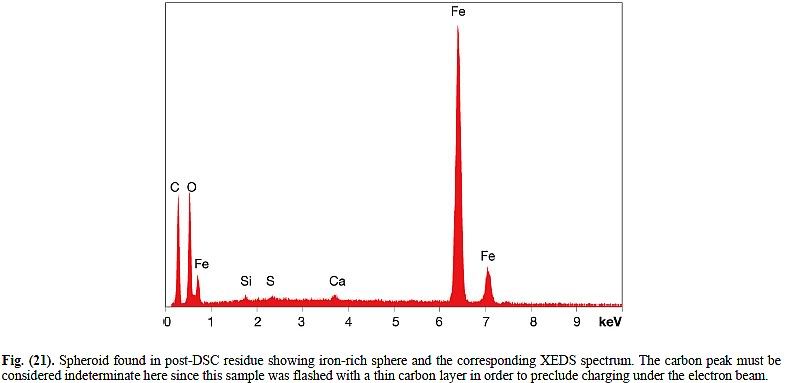
ActiveThermiticMaterial_Fig21_2.jpg

However, there are some formal arguments that shed doubt on this finding:
  • We don't have any idea what the chip that resulted in Fig 21 looked like before its DSC test - no image, no XEDS.
  • We don't know if it is possible or not to find regions within the gray layers before any thermal treatment where Fe:O is higher than average
  • I am not even sure if the 4:1 ratio is by mass or by atom count. If the latter, we are indeed looking at some elemental iron. But if the former (and that is actually what I expect), then 4:1 by mass means 1.15:1 by atomic count - the difference to 1:1 may well be within the margin of error of the "conventional quantitative analysis routine" they employed from the XEDS data, and then we are looking at a tiny sphere of FeO - an iron oxide that may be produced from magnetite in the presence of carbon (graphite). One wonders if this could result from experimental error. We know that the DSC tests were carried out by an absolute DSC beginner, Jeff Farrer, and that they flashed the sample with a thin carbon layer before doing the XEDS.

I wish I had access to an electron microscope or even an XEDS instrument...
 
Last edited:
Mohr said :

Richard, do you think the iron microspheres could have come from the welders during the original construction in 1972-73?

The floors are vacuumed many times during construction. They must be free of dust before any flooring can be laid down. There might be some iron microspheres inside the columns but not anything close to 6% of the weight of the WTC dust.
There is no data on how many iron microspheres are created by welding so this (your) whole argument is pure wishful thinking.

i am abolutley positive, that someone here will try to say the spheres are fly ash from the lightweight concrete but fly ash is not always used and there is no evidence to establish that it was used during the construction of the Twin Towers.

The RJ Lee Group was crystal clear in stating:

iron and lead were melted during the WTC Event, producing spherical metallic particles

But allot of the posters over here at the JREF have a whole chapter on the RJ Lee report in your "Deniers Play Book" which is enough to waste a lot of time in a debate and fog the issues that should be debated - which is all you can do, but then, that's all that you need to do.....isn't it???;)

What none of you can dispute is the molten concrete...cmon dispute it!! Please!

Instead you will change the subject or go away and all of Morh's squires will descend upon me like a pack of rabid dogs.

the melting point of concrete varies between 1800-2500°C. (3272-4532 degrees F.)


http://www.weldcare.co.uk/app10.htm
 
Last edited:
Let him ignite the stuff by heating to ignition in air, as the scientists at LLNL also did, and measure:

1. The ignition temperature -- does it agree with Harrit/Jones et al findings on ignition temps for red/gray chips from different locations?

2. And most important --[ICOLOR="Gray"] does the ignited stuff make many SPHERES RICH IN REDUCED IRON? [/COLORI]

The experimenter (Jim-bo) needs to examine the chip before ignition to make sure it has no spheres , then conduct the ignition test and look again. J/H et al had LOTS of SPHERES RICH IN REDUCED IRON:D, following ignition. If so, provide SEM and XEDS results as Jones/Harrit did for comparison with thier data.

My prediction:
Ignition of this paint will NOT produce SPHERES RICH IN REDUCED IRON

(note: reduced iron means -- elemental iron present, not just iron oxide present in the original paint.);):p

Let the friggin study happen. Millette has light-years more experience than you. Let it happen.
 
Ivan wrote, "There are perhaps tens of possible sources of such iron rich microspheres and even un-intended thermitic reaction might occur during WTC catastrophe in fire zones, e.g., reaction of hot aluminum with iron oxide in rust and/or primer paint containing iron oxide."

Ivan, I sent this on to Jim Millette and asked him if there is a way to distinguish an accidental thermitic reaction from active thermitic materials allegedly in the dust. I am guessing that unignited thermitic material would look way different from the ignited stuff you are talking about here; obvgiously it would be important to make the distinction.

Someone (was it you?) talks about how paint chips are not talked about in the Bentham paper. They are, if memory serves me correctly. Also, remember that Kevin Ryan personally told me that he has both paint chips and thermitic chips, that they look different and behave differently when burned. So it's unfair to assert that he doesn't deal with paint chips at all; he acknowledges their presence but also asserts that he has found thermitic chips.

Chris, my note that thermitic reaction could occur even without any intention of evil conspirators in WTC fire zones was... just a note. Such reactions could be anyway really marginal, as sources of iron-rich microspheres. They can proceed in some considerable extent only when a lot aluminum is in contact/intermixed with a lot of iron oxide at high temperatures. And whereas there was for sure a lot of aluminum in fire zones, there was not so much of iron oxide available for such reaction. Some spontaneous thermitic reaction could occur (just theoretically) only on some surfaces where hot aluminum was in contact with some iron oxide (paints, rust).

Concerning your second paragraph, I see a kind of sustained misunderstanding on your side. I have (we have) never claimed that paint was not considered at all as a possible source of red chips in Bentham paper! But authors compared their chips only with one particular paint from this NY stadium, which is of course silly and without the slightest scientific value. Reasons have been mentioned many times in this thread, but I could repeat them again, if you want. (Also, chosen tests for comparison of "genuine" paint with red chips (flame tests and solubility tests) in Bentham paper were inadequate and insufficient for any meaningful conclusion.)
I don't know what two kinds of chips is Kevin Ryan talking about, since it is still his "top truther secret":cool: I just guess that his red "paint chips" are chips of Tnemec paint (or some other red primer) and alleged "thermitic chips" are chips identical with Bentham chips (a) to (d), aka Laclede paint chips. For me, Kevin Ryan simply keeps (at least) two kinds of paint chips. It's up to him to show me(us), that I am (we are) wrong:cool:
 
Last edited:
Let the friggin study happen. Millette has light-years more experience than you. Let it happen.

Can you relay the message to Jim though brother?? Got to make sure those tests are pure and not funked up!!

you know this message:

The experimenter needs to examine the chip before ignition to make sure it has no spheres , then conduct the ignition test and look again. J/H et al had LOTS of SPHERES RICH IN REDUCED IRON, following ignition. If so, provide SEM and XEDS results as Jones/Harrit did for comparison with thier data.

Thanks man.
 
Last edited:
I've rarely seen someone so scared of a result than SLT.

Why?

I am in awe that because one wants to make certain that tests are not being over looked in anyway, he is portrayed as "scared". The fact that another credentialed professional, has the name of Millettte in a document that charges the offense of fraud, along with the EPA ( we all know what happened there) defiantly raises concern.

Whats to say they wont lower the PH level this time too?
The only way to lay this dog to rest is to have both sides present working side by side.

Yes, that is just an opinion. Nevertheless the opinion is valid.
 
Last edited:
From what I can see, truthers have made NO attempt to eliminate any other potential sources of these microspheres. They've decided it can only be thermite, and since that fits into their beliefs, they are satisfied with it. Debate over.

It's about as far away from the scientific method as one can get.


I don't recall they even showed that any ThermXte actually produces such microspheres in the first place......
 
...
Someone (was it you?) talks about how paint chips are not talked about in the Bentham paper. They are, if memory serves me correctly. Also, remember that Kevin Ryan personally told me that he has both paint chips and thermitic chips, that they look different and behave differently when burned. So it's unfair to assert that he doesn't deal with paint chips at all; he acknowledges their presence but also asserts that he has found thermitic chips.

At the risk of parroting Ivan:

Harrit e.al. mention tests with paint several times in theit paper:
  • Page 17: "The initial objective was to compare the behavior of the red layer with paint when soaked in a strong organic solvent known to soften and dissolve paint. ... In marked contrast, paint chips softened and partly dissolved when similarly soaked in MEK"
  • Page 22: "Several paint samples were also tested [with a hot flame] and in each case, the paint sample was immediately reduced to fragile ashes by the hot flame"
  • Page 27: "We measured the resistivity of the red material (with very little gray adhering to one side) using a Fluke 8842A multimeter in order to compare with ordinary paints"
  • Page 27: "paint samples in the same exposure to MEK solvent became limp and showed significant dissolution"
I am not leaving out any context here. The point is that they don't tell us with as much as one word what paint or paints they used for comparison, and where they got them from. As far as I can tell, none of the authors have ever mentioned "floor joists" or "LaClede standard primer" in any of their published works, so we can be sure that they did not use LaClede standard primer for their comparative test.

Obviously, if chips (a)-(d) are LaClede paint, and their controls were some other paint, they will get different results.

It has been revealed elsewhere that Jones used paint scratched from the BYU football stadium for at least some of his tests. We have not the slightest idea what the compostion and specification of that paint was. But it sure wasn't LaClede standard primer.

We also know that they did some tests with Tnemec Red from WTC columns - and in fact the data we have from those tests - not included in the paper but presented later by SE Jones in Australia - indicates that at least one red-gray chip was Tnemec.
 
Can you relay the message to Jim though brother?? Got to make sure those tests are pure and not funked up!!

you know this message:

The experimenter needs to examine the chip before ignition to make sure it has no spheres , then conduct the ignition test and look again. J/H et al had LOTS of SPHERES RICH IN REDUCED IRON, following ignition. If so, provide SEM and XEDS results as Jones/Harrit did for comparison with thier data.

Thanks man.

Tell you what.

I'll relay the message just as soon as you respond to this.
 
I am in awe that because one wants to make certain that tests are not being over looked in anyway, he is portrayed as "scared". The fact that another credentialed professional, has the name of Millettte in a document that charges the offense of fraud, along with the EPA ( we all know what happened there) defiantly raises concern.

Whats to say they wont lower the PH level this time too?
The only way to lay this dog to rest is to have both sides present working side by side.

Yes, that is just an opinion. Nevertheless the opinion is valid.

The fact that every keystroke you hit is another grasping-at-straws attempt to discredit someone who is inevitably going to reduce the retarded "thermite" narrative to dust is the indication you're scared.

FACT: If what you ask here actually happens, you'll find something else to cling to.
 
"The production of elemental (pure) iron is a chemical extraction and or electrolytic deposition procedure. Iron is not naturally found in its pure, elemental form. To obtain pure iron, its ore must be heated, deslagged, and either injected with oxygen (Bessemer process) or arc melted at elevated temperature to produce low carbon steel. Any fire hot enough to melt iron would typically yield a coalesced mass, not the very small, uniform diameter spheres. Subsequent processing would be necessary to produce the spheres. Alternatively, one could dissolve in acid, treat chemically to remove impurities, and electrolytically extract the pure metal. Subsequent processing again required to produce the small spheres."
"Or produced by the high temperatures of welding..."

Your welding suggestion was already addressed in that post. Read much?

"http://www.journalof911studies.com/articles/WTCHighTemp.pdf
"Moreover, the RJ Lee report provides provocative data regarding the abundance of observed iron-rich spheres. A WTC dust sample acquired at 130 Liberty Street shows a “mean of composition” of “Fe spheres” of 5.87% which is very high compared with “Fe spheres” found in ordinary building dust of only 0.04%. As the report notes, the WTC dust has unusual identifying characteristics – in particular, the WTC dust in this sample has nearly 150 times (5.87/0.04) the amount of iron-rich spheres as ordinary dust (where Fe spheres can arise from micrometeorites, for example)."

http://www.foreignpolicyjournal.com...agazines-science-of-controlled-demolitions/2/"

"Add micrometeorites to the list of expected sources of iron microspheres in buildings. The higher number of these spheres in the WTC dust is due to the background dust samples taken pre-9/11 by RJ Lee from the surfaces of finished buildings with finished floors, walls, ceilings. The collapse of the Towers liberated the micrometeorites, welding and cement iron-rich spheres not captured by the surface sampling of the finished buildings. You would think Jones would note this crucial difference. Also note that these background buildings ordinary dust samples were collected from different buildings, in different cities, before 9/11, proving that these iron spheres are ubiquitous and existed before the collapse of the Towers, without being produced by therm*te demolition."

Again, I have to ask. Read much?

In the quote from my post that you are 'supposedly' addressing, it is clearly stated that micrometeorites are a common reason for iron-rich microspheres in ordinary dust. What is totally unexpected, is to find concentrations 150 times greater than normal.

"But Steven E. Jones, Jeffrey Farrer, Gregory S. Jenkins, Frank Legge, James Gourley, Kevin Ryan, Daniel Farnsworth, and Crockett Grabbe studied the “high-iron, relatively low oxygen spheres” found in the WTC dust and found that they “are unlike spheres gathered from cutting structural steel with an oxyacetylene torch.”
http://www.journalof911studies.com/articles/WTCHighTemp.pdf"
"How are they unlike? Jones does not provide samples or tests of these “unlike spheres gathered from cutting structural steel with an oxyacetylene torch.”
“high-iron, relatively low oxygen spheres” are a type iron oxide, the result of atmospheric corrosion.

All elemental iron turns to iron oxide when exposed to sufficient time.oxygen and water.

If therm*te can produce elemental iron spheres without oxidizing so can micrometeorites, welding and portland cement.

The existence of elemental iron or iron oxide spheres in the WTC dust are not proof of the use of therm*te."

Again, I have to ask. Read much?

As well as Dr. Jones, I list a group of accredited scientists who endorse those test findings.

The significance of iron-rich microspheres is directly related to purity and occurrence.

Prior to the ignition of red chips found in the WTC dust, their contents were analyzed and found "to consist of intimately mixed particles of iron oxide and aluminum embedded in a carbon-rich matrix". There were NO iron-rich microspheres present. "The residue of the ignited red/gray chips included iron-rich spheres, “indicating that a very high temperature reaction had occurred, since the iron-rich product clearly must have been molten to form these shapes.” The chemical signature of the spheres and spheroids “strikingly matches the chemical signature of the spheroids produced by igniting commercial thermite, and also matches the signatures of many of the microspheres found in the WTC dust.”

The existence of iron spheres of high purity would be a clear indication of temperatures high enough to melt iron. Temperatures much higher than those possible in an ordinary fire.

Regarding the nature of office dust;

From the RJ Lee report conclusions;
"Various metals (most notably iron and lead) were melted during the WTC Event, producing spherical metallic particles. Exposure of phases to high heat results in the formation of spherical particles due to surface tension…”
“In addition to the vesicular carbon components, the high heat exposure of the WTC Dust has also created other morphologically specific varieties of particulate matter including spherical metallic, vesicular siliceous and spherical fly ash components. These types of particles are classic examples of high temperature or combustion by-products and are generally absent in typical office dust…”
“Particles of materials that had been modified by exposure to high temperature, such as spherical particles of iron and silicates, are common in WTC Dust because of the fire that accompanied the WTC Event, but are not common in “normal” interior office dust…”


Regarding those who argue the significance of fly ash;

Dr. Steven Jones in an exchange with Dr. Frank Greening said:
"...some time ago, we crushed a concrete sample obtained from the WTC rubble, used magnetic concentration, and looked for iron-rich spheres. There were NONE found."

JREFer Crazy Chainsaw said:
"Frank [Dr. Frank Greening] at that time I did not know that magnetite was removed from fly ash used in concrete by magnetic drum separation. Basically a big barrel filled with magnets that rolls over the fly ash, and picks out the magnetite so it can be sold. Basically the same technique used by Dr. Jones."


MM
 
Chris, my note that thermitic reaction could occur even without any intention of evil conspirators in WTC fire zones was... just a note. Such reactions could be anyway really marginal, as sources of iron-rich microspheres. They can proceed in some considerable extent only when a lot aluminum is in contact/intermixed with a lot of iron oxide at high temperatures. And whereas there was for sure a lot of aluminum in fire zones, there was not so much of iron oxide available for such reaction. Some spontaneous thermitic reaction could occur (just theoretically) only on some surfaces where hot aluminum was in contact with some iron oxide (paints, rust).


I thought it was rather difficult to actually ignite thermite.....and that the elements have to be a fine powder. Can someone show me a themitic reation with rust and hot aluminum


I don't know what two kinds of chips is Kevin Ryan talking about, since it is still his "top truther secret":cool: I just guess that his red "paint chips" are chips of Tnemec paint (or some other red primer) and alleged "thermitic chips" are chips identical with Bentham chips (a) to (d), aka Laclede paint chips. For me, Kevin Ryan simply keeps (at least) two kinds of paint chips. It's up to him to show me(us), that I am (we are) wrong:cool:[/QUOTE]

I will find out for all of us what type of paint they were/are.
 
Last edited:
"Various metals (most notably iron and lead) were melted during the WTC Event, producing spherical metallic particles. Exposure of phases to high heat results in the formation of spherical particles due to surface tension…”
“In addition to the vesicular carbon components, the high heat exposure of the WTC Dust has also created other morphologically specific varieties of particulate matter including spherical metallic, vesicular siliceous and spherical fly ash components. These types of particles are classic examples of high temperature or combustion by-products and are generally absent in typical office dust…”
“Particles of materials that had been modified by exposure to high temperature, such as spherical particles of iron and silicates, are common in WTC Dust because of the fire that accompanied the WTC Event, but are not common in “normal” interior office dust…”

I thought it was common knowledge that there were melted metals in the WTC tragedy?

Can you please point out where anything, at all, was "normal" or "typical" about the WTC tragedy?
 

ISF - Join now!

Every member here is approved by hand. No bots, no spam, just people who care about evidence and honest debate.

Membership is free!

Create your free account

Back
Top Bottom