Continuation The Electric Comet Theory Boogaloo (Part 2)

Status
Not open for further replies.
Sol88: Confirms ignorance of physics by asking what happens to dust escaping comets

So after all your challenges to me you are unwilling or scared to answer these basic questions based on the paperSurface charging and electrostatic dust acceleration at the nucleus of comet 67P during periods of low activity
That is dumb, Soll88 - I told you where to get the answers:
You are asking about Surface charging and electrostatic dust acceleration at the nucleus of comet 67P during periods of low activity
The answers are in Surface charging and electrostatic dust acceleration at the nucleus of comet 67P during periods of low activity :jaw-dropp!

Someone with a blind faith in 10th April 2015: The ignorance, delusions and lies in the Thunderbolts web site, videos, etc. will ignore the paper and ask
What happens to the dust accelerated beyond escape velocity?
To which the answer is obviously that the dust escapes from the comet :eek:!
I would expand on this but a believer in the idiocy of the Thunderbolts cult is just wasting my and everyone's time.

7 October 2015 Sol88: Confirms ignorance of basic physics by asking what happens to dust that escapes comets.

P.S. Now it is 101 days and counting of being afraid of doing simple physics: 25 June 2015 Sol88: Use a impact calculator to calculate the size of the crater on a comet made of rock by the Deep Impact impactor.

Are you going to deny basic facts about Deep Impact: 6 October 2015 Sol88: Please cite the observations that Deep Impact ejecta contained no water or other ices (i.e. where is the ejected rock as expected from hitting a rock!).
 
Last edited:
A related post from another thread about the bad science in the EU 2015 conference that Michael Shermer reported in Scientific American:
...One thing that has never ceased to amaze me is that while there are a great many comments like "I would be very interested to see if actual data from spacecraft journeys really does corroborate Newtonian and Einsteinian ideas about gravity" in that forum (and elsewhere, where EU fans post), I have yet to see any EU fan, and certainly not any "electric theorist", actually take the trouble to collect the data and analyze it.

Independently.

Themselves.

(Sol88, are you reading this?)
The EU crowd have the fantasy that billons of dollars have been sent on collecting data that just supports Newtonian and Einsteinian ideas about gravity. As if a planet or comet or spacecraft knows that it should obey Newtonian gravity when observed by astronomers believing in Newtonian gravity :eek:!
In the real world what happens is that billions of dollars have been spent collecting data that the EU crowd have ignored for 60 years and are continuing to ignore. Where is the EU analysis of the Rosetta mission data, Sol88?
 
And of course, lest we forget, the Deep Impact mission. What came out of a comet, Sol, when they smashed an impactor into it? H2O. Unambiguous. Water. Vapour at 2.7 microns in terms of emission, and around 3.0 microns from absorption from the ejected ice. Unquestionably. Where did it come from? What has the unqualified burke at Thunderdolts got to say about this?
Irrelevant. He's not qualified. And stands to lose too much from eejits like yourself, buying books and DVDs and conference tickets.
IT IS A NON-HYPOTHESIS. Give it up.
 
Last edited:
P.S. for anybody that is interested, I e-mailed Jessica Sunshine, who was the co-investigator on the DI mission, and lead author of the paper that gave those findings.
Her words were that it was "unambiguous" that they'd detected ice. Anybody wants to see the e-mail, just PM me.
 
How real science is done: An update on Comet 67P/C-G’s water-ice cycle
Last week we reported on the daily water-ice cycle of Comet 67P/Churyumov-Gerasimenko that was observed in a specific region of the comet’s neck by Rosetta’s VIRTIS instrument, in September 2014.

Yesterday at the European Planetary Science Congress, animations were shown covering the period 1 August 2014 to 10 February 2015 for two different areas of the nucleus, showing the behaviour of the water-ice over a much longer period.

“We are now able to show that this cycle is common in several regions of the nucleus, depending on the illumination conditions, and hence further demonstrate that the proposed cycle is a general mechanism of water transport from depth to the surface acting on comets,” said Fabrizio Capaccioni, VIRTIS principal investigator. Fabrizio described the results in a press briefing held at EPSC yesterday afternoon.

ETA
Rosetta’s first peek at the comet’s south pole (posted 1 October 2015)
CometWatch 30 September – Far, far away. Posted 2 October 2015.
 
Last edited:
Good Paper???

Great paper!

Pretty much confirmation of this whole thread (The Electric Comet) and most things I banged on about for 7 years :D

I pop in on this thread every few months to marvel at it. This is hilarious.

EU GUY: "The comet is so hyper-charged it generates super-lightning bolts that mill out craters! The Rosetta team ignores this because they're not trained in plasma ideas!"

PEOPLE WHO KNOW E&M: "Everything you have said is wrong."

ACTUAL ROSETTA PLASMA SCIENTIST: "We've been studying the *weak* electrostatic phenomena on comets for 25 years. They're weak, we will see them with our sensitive instruments, and we definitely do not see giant electric arcs"

EU GUY: "Show me the evidence!"

ACTUAL ROSETTA PAPER: "Rosetta has observed weak electrostatic phenomena with our sensitive instruments and definitely not giant electric arcs."

EU GUY: "OMG it's a rosetta paper with ELECTRO in the title! EU wins again!"
 
Can you explain to this completely delusional gullible fool where the dust accelerated past 67P's escape velocity goes?

Where else would it go, but into interplanetary space? But because of the motion of the comet, it will travel along with it.

How fast is the acceleration? What speeds do the dust obtain? Anything like the speeds we observe from the sublimating "ice's" entraining dust?

Most of the dust escapes during the outbursts that we see on the comet. However, in Tom's paper that is not looked at. I guess you could actually read the paper and get that number for yourself.

Now the dust is charged what effects would we expect to see in the dynamically charged areas around the nucleus?

Well I guess dusty plasma effects: the dust acoustic and the dust ion acoustic waves can be generated, and all kinds of other stuff. Here is a short list of papers on dusty plasmas. Actually, I hope to get a postdoc to look into dusty plasmas at 67P/CG.

Could the charged and accelerated dust act as a "coupler" between the diamagnetic cavity and the comets plasma-sphere thereby still allowing the solar wind access to the nucleus in beams of highly energetic particles accelerated thru known plasma processes?

What does that even mean? a "coupler"?
Did you read the paper by Tom Cravens? He explains it very well, the outgassing produces and outward pressure, the solar wind an inward pressure (as seen from the comet). If the outward pressure is large enough, then the solar wind is pushed away from the nucleus, including the frozen in (yes it is frozen in) magnetic field, and thereby creating a magnetic field free region around the comet. Naturally there will be a boundary layer and I think that Charlotte Götz will definitely investigate the boundary in her upcoming paper. In the cavity there will be only cometary ions and dust, because the solar wind is pushed away. I have no idea what you want to "couple" here with the dust between cavity and "plasma sphere". As far as I know, the plasma instruments do not see any solar wind particles in the cavity.
 
Where else would it go, but into interplanetary space? But because of the motion of the comet, it will travel along with it.


Most of the dust escapes during the outbursts that we see on the comet. However, in Tom's paper that is not looked at. I guess you could actually read the paper and get that number for yourself.


Well I guess dusty plasma effects: the dust acoustic and the dust ion acoustic waves can be generated, and all kinds of other stuff. Here is a short list of papers on dusty plasmas. Actually, I hope to get a postdoc to look into dusty plasmas at 67P/CG.


What does that even mean? a "coupler"?
Did you read the paper by Tom Cravens? He explains it very well, the outgassing produces and outward pressure, the solar wind an inward pressure (as seen from the comet). If the outward pressure is large enough, then the solar wind is pushed away from the nucleus, including the frozen in (yes it is frozen in) magnetic field, and thereby creating a magnetic field free region around the comet. Naturally there will be a boundary layer and I think that Charlotte Götz will definitely investigate the boundary in her upcoming paper. In the cavity there will be only cometary ions and dust, because the solar wind is pushed away. I have no idea what you want to "couple" here with the dust between cavity and "plasma sphere". As far as I know, the plasma instruments do not see any solar wind particles in the cavity.

Great :thumbsup::thumbsup::thumbsup: :D Now we are starting to get to the real nuts and bolts of "jet" production.

Where else would it go, but into interplanetary space? But because of the motion of the comet, it will travel along with it.
Are you prepared to go as far as this dusty plasma the comet is generating thru processes described in Surface charging and electrostatic dust acceleration at the nucleus of comet 67P during periods of low activity paper, could be a charge carrying dusty plasma, able to organise the dust into collimated "jets"?

Most of the dust escapes during the outbursts that we see on the comet. However, in Tom's paper that is not looked at
Just gently sort of floats off the comet and drifts along with it? then ay? :rolleyes:

outgassing produces and outward pressure, the solar wind an inward pressure
and back to non existent sublimation and "pressure" in a just explained ELECTRICAL system, why Tusenfem?

Naturally there will be a boundary layer and I think that Charlotte Götz will definitely investigate the boundary in her upcoming paper
Ahhh but that's a very important part of the overall picture, is it not Tusenfem? Could we even be presumptuous and call it a DOUBLE LAYER? Most probably not just one either.


I have no idea what you want to "couple" here with the dust between cavity and "plasma sphere". As far as I know, the plasma instruments do not see any solar wind particles in the cavity.

It allows energy to be stored and released in a focused highly energetic "Jet" able to machine the surface of the comet and produce the dynamic landscape we observe, not sublimation.

Like this
Perihelion_Jet_3D_left-eye-350x283.jpg
FULL SIZE (Credits: ESA/Rosetta/MPS for OSIRIS Team MPS/UPD/LAM/IAA/SSO/INTA/UPM/DASP/IDA)
 
Last edited:
I pop in on this thread every few months to marvel at it. This is hilarious.

EU GUY: "The comet is so hyper-charged it generates super-lightning bolts that mill out craters! The Rosetta team ignores this because they're not trained in plasma ideas!"

PEOPLE WHO KNOW E&M: "Everything you have said is wrong."

ACTUAL ROSETTA PLASMA SCIENTIST: "We've been studying the *weak* electrostatic phenomena on comets for 25 years. They're weak, we will see them with our sensitive instruments, and we definitely do not see giant electric arcs"

EU GUY: "Show me the evidence!"

ACTUAL ROSETTA PAPER: "Rosetta has observed weak electrostatic phenomena with our sensitive instruments and definitely not giant electric arcs."

EU GUY: "OMG it's a rosetta paper with ELECTRO in the title! EU wins again!"

Glad you get a laugh :)

EU GUY: "The comet is so hyper-charged it generates super-lightning bolts that mill out craters! The Rosetta team ignores this because they're not trained in plasma ideas!"

There's your super-lightning bolt milling out a crater
Perihelion_Jet_3D_right-eye-350x283.jpg


but you a quite happy to believe the story that sublimating ice caused it, then well... as long as your happy :D
 
And of course, lest we forget, the Deep Impact mission. What came out of a comet, Sol, when they smashed an impactor into it? H2O. Unambiguous. Water. Vapour at 2.7 microns in terms of emission, and around 3.0 microns from absorption from the ejected ice. Unquestionably. Where did it come from? What has the unqualified burke at Thunderdolts got to say about this?
Irrelevant. He's not qualified. And stands to lose too much from eejits like yourself, buying books and DVDs and conference tickets.
IT IS A NON-HYPOTHESIS. Give it up.


Considering the paper on Surface charging and electrostatic dust acceleration at the nucleus of comet 67P during periods of low activity we are discussing ATM Jonesdavid116, when the impactor vaporised the rock into dust, lots and lots of dust and not much to very little ice, what would we observe?

If all the comets ice is hidden below the surface then the impactor should release it, right?

SWAS operators were puzzled by the lack of increased water vapor from Tempel 1. Post-impact measurements showed the comet was releasing only about 550 pounds of water per second-an emission rate very similar to pre-impact values, and less than seen by SWAS during natural outbursts in the weeks before the impact.

SMA measurements corroborate the SWAS findings. Although the SMA wasn't tuned to frequencies of water emission, which are difficult to observe from the ground due to atmospheric water vapor, it watched for other chemicals such as hydrogen cyanide. SMA astronomers saw little increase in production of gases following the impact. Gas production rates remained so low that they could set only an upper limit on the total.

"All we needed was a factor of three boost from the impact to get a definite detection," said Qi. "We didn't see that."
- See more at: https://www.cfa.harvard.edu/news/2005-23#sthash.yDito9dY.dpuf

Why not JD116, that was deep impacts primary mission?
 
Glad you get a laugh :)


There's your super-lightning bolt milling out a crater [qimg]http://blogs.esa.int/rosetta/files/2015/10/Perihelion_Jet_3D_right-eye-350x283.jpg[/qimg]

but you a quite happy to believe the story that sublimating ice caused it, then well... as long as your happy :D

Can you show other pictures of lightning that look like that, you know with straight lines and all that ?
 
There's your super-lightning bolt milling out a crater

Odd that the "super-lightning bolt" isn't illuminating the comet. Also odd that the "super-lightning bolt" appears to be just the brightest of dozens of similar phenomena, all pointed in different directions.

Also odd that the "super-lightning bolt" doesn't appear to be coming in along the sun line.

Odder is that the "super-lightning bolt" appears to be focusing itself as it approaches the comet; it's very diffuse when far from the comet, but much more concentrated where it's close, almost as if the "super-lightning bolt" was actually just material ejected from the comet, reflecting the sunlight, and diffusing as it drifts away.
 
Why not JD116, that was deep impacts primary mission?

What are you on about now? That is a press release from a few days after the impact! Read the damn paper. "The distribution of water ice in the interior of Comet Tempel 1." http://www.planetary.brown.edu/pdfs/3546.pdf

From the abstract:
"Although ice was not observed on the surface in the impact region, strong absorptions near 3 µm due to water ice are detected in IR measurements of the ejecta from the impact event. Absorptions from water ice occur throughout the IR dataset beginning three seconds after impact through the end of observations, ∼45 min after impact."

They detected H2O vapour emissions at 2.7 microns in the coma, as well as absorptions from H2O ice at ~3 microns. The absorptions were from ice grains! Where did they come from?
These detections were, in the words of the lead author of that paper, "unambiguous". The same spacecraft also saw the same thing at Hartley 2; vapour and ice grains: http://www.sciencemag.org/content/332/6036/1396.full.pdf

To quote the lead author further: "Our instruments are good enough to not only identify the water ice, but constrain the sizes and they are both consistent with laboratory data at the appropriate temperature."

The ice grains at Tempel 1 were also seen by the XMM-Newton space telescope: http://www.aanda.org/articles/aa/pdf/2006/12/aahi281.pdf

The ice at Hartley 2 would have come from the subsurface due to the rather active outgassing at that comet, ie. jets. How are the EU explaining pieces of solid ice emerging from a comet after impacts/ jets? Is the electric woo turning rock into ice?

We've known definitively about H2O vapour in cometary comae for nigh on 30 years, and it was strongly inferred long before that. We have known about surface and subsurface ice for about a decade.
Everybody that is, apart from Thornhill's scientifically challenged acolytes.
 
Can you show other pictures of lightning that look like that, you know with straight lines and all that ?

Ummm....really ...

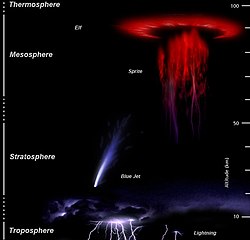
We call them blue jets on Earth but they are just a subset of the greater transient luminous event (TLE) type phenomena.

Comet Jet via sublimation within a pressurised subsurface chamber of highly volatile "ices" ejected thru a nozzle causing them to form collimated appearance to the casual non scientific observer? :D

Perihelion_Jet_3D_left-eye-350x283.jpg


OR

img05.jpg


Are they just a electrical-breakdown phenomena between the charged surface dust and the "boundary layer" to the solar wind?

250px-Upperatmoslight1.jpg


:cool:
 
Last edited:
What are you on about now? That is a press release from a few days after the impact! Read the damn paper. "The distribution of water ice in the interior of Comet Tempel 1." http://www.planetary.brown.edu/pdfs/3546.pdf

From the abstract:

"Although ice was not observed on the surface in the impact region, strong absorptions near 3 µm due to water ice are detected in IR measurements of the ejecta from the impact event. Absorptions from water ice occur throughout the IR dataset beginning three seconds after impact through the end of observations, ∼45 min after impact."

snip

The ice grains at Tempel 1 were also seen by the XMM-Newton space telescope: http://www.aanda.org/articles/aa/pdf/2006/12/aahi281.pdf

The ice at Hartley 2 would have come from the subsurface due to the rather active outgassing at that comet, ie. jets. How are the EU explaining pieces of solid ice emerging from a comet after impacts/ jets? Is the electric woo turning rock into ice?

snip

Please explain why no water ice has been detected on the surface of any other comet we have visited (barring the trivial frost on 9/P) when this is the mechanism at work Comet 67P/C-G’s water-ice cycle

Something all ways made me wonder about water ice on comets anyway. Why would there NOT be ice on a comet if it was indeed a piece of planet or moon that has ice on them anyway, as in the moons of the gas giants? They got ICE hell even Charon now has subsurface ice to explain the detected H20.

So what's the big hang up with "ice/s"??
 
Last edited:
There's your super-lightning bolt milling out a crater [qimg]http://blogs.esa.int/rosetta/files/2015/10/Perihelion_Jet_3D_right-eye-350x283.jpg[/qimg]

but you a quite happy to believe the story that sublimating ice caused it, then well... as long as your happy :D

Riiight. That's all well and good, except for the rather inconvenient fact that the jets at Hartley 2 were shown to be composed of CO2, and the temperature data for the most active area of the comet showed it to be slightly lower than its surroundings. Not to mention that at neither at Hartley 2 nor 67P, has there been any indication of any electrical activity.
 
So what's the big hang up with "ice/s"??

How the hell would ice survive on the surface of a comet, in any quantity, once it is warmed above the sublimation temperature?
The contention from the EU is that there is no ice BENEATH the surface. The results at Tempel 1 and Hartley 2 show that there most definitely IS. Get it?
Probe hits area where no surface ice is seen. Next thing you know there are grains of ice being detected in the ejecta plume. Ergo, there is ice below the surface. Unambiguously.
At Hartley 2 the chunks of ice (and there were some bloody big ones) were blown off of the comet from jets of mainly CO2. CO2 would no more survive on the surface than H2O. The areas where the jets were strongest was in sunlight. Therefore both the CO2 vapour and the ice chunks came from BELOW the surface.
 
Glad you get a laugh :)


There's your super-lightning bolt milling out a crater [qimg]http://blogs.esa.int/rosetta/files/2015/10/Perihelion_Jet_3D_right-eye-350x283.jpg[/qimg]

but you a quite happy to believe the story that sublimating ice caused it, then well... as long as your happy :D

Have you actually ever SEEN electrical discharges?
Because that in no way even resembles one.

Not to mention the fact that you keep glossing over the fact that the vacuum of space would not give any glowing discharge because:
1: There is nothing to stop a charged particle from moving once it forms so there is no isolator to overcome.
2: There is nothing to be excited by fast moving electrons causing the glow of a lightning bolt.

That is a clear example of an expanding jet of gas being illuminated by an outside source.
 
The story just continues, doesn't it? You just search on keywords, and just write down nonsense, and we have to correct it for the others who are reading this. Nor for you, Sol88, because you won't listen to anything that is being said anyway.

Are you prepared to go as far as this dusty plasma the comet is generating thru processes described in "Surface charging and electrostatic dust acceleration at the nucleus of comet 67P during periods of low activity paper", could be a charge carrying dusty plasma, able to organise the dust into collimated "jets"?

The dusty plasma is not just created by what Tom investigated. The dust comes out with the big outbursts of which you show pictures. If it would only be coming off the comet with electrostatic levitation, then we would not see a dust tail, because the production rate would be way too little.

What is a "charge carrying dusty plasma"? Care to give a definition of this term of yours?

A plasma is a gas consiting of neutrals, ions and electrons, and has to fulfil some criteria to be called a plasma. There is WAYYY more neutral gas than ions (a factor 10^6 !!). If there is dust, then the electrons will stick to the dust creating a plasma which consists of ions, electrons and negatively charged dust, but in the end is still neutral when you add up all the charge carriers.

The dust is MUCH MUCH heavier than the ions and electrons and thus is less mobile, it reacts much slower to electromagnetic fields because of its inertia. So the answer is NO, the dust will not be collimated by the plasma.

And again, do not forget that the bursts you see in your pictures are so bright because they are so big and thick, and the brightness is caused by line-of-sight integration of the photons reflected by the dust.

Just gently sort of floats off the comet and drifts along with it? then ay?

Did I say anything about "gently floating off the comet"? I thnk not! Stop twisitng my words, or I will report you.

For the rest, just learn how physics works, if something comes off a moving body in space what does it do?

and back to non existent sublimation and "pressure" in a just explained ELECTRICAL system, why Tusenfem?

You will never get it, will you? Tom talks about DUST, I talk about GAS, I do hope you know the difference between the two.
The gas comes off the comet, it is measured e.g. by MIRO, it has a velocity with which it leaves the comet, and thus it has a pressure! pointed away from the comet. If for some reason the outgassing increases, e.g. the popping of a pocket beneath the surface, more pressurized gas is coming out, increasing the outward pressure.

Our numerical models of comets work very very well (see e.g. Koenders et al. or Rubin et al. in the last few years) and the match the observations of RPC very well. But hey, who cares about observations of plasma instruments, when you can look at pretty pictures?

Ahhh but that's a very important part of the overall picture, is it not Tusenfem? Could we even be presumptuous and call it a DOUBLE LAYER? Most probably not just one either.

It can well be that a double layer can be formed on the boundary, but ... do you know the strength of a double layer and the thickness of a double layer? Do you think that a "boundary layer double layer" which would be a "non-current carrying double layer" would have great energetic impact or anything - generating lightning strikes, or do you think that it just separates two regions of different plasma? I know what I would favour scientifically.

tusenfem said:
I have no idea what you want to "couple" here with the dust between cavity and "plasma sphere". As far as I know, the plasma instruments do not see any solar wind particles in the cavity.
It allows energy to be stored and released in a focused highly energetic "Jet" able to machine the surface of the comet and produce the dynamic landscape we observe, not sublimation.

But the jet is going away from the comet, there is nothing going toward the comet!!! Dust cannot "store" energy that can be released as "jets". The dust is embedded in a very conducting plasma, NOT as clouds on earth separated by a insulator (the atmosphere) from the Earth's surface. So there is no way that there can be a "break down of the isulator" (as in lightning) in space, because the plasma surrounding the dust will quickly equilibrate any large scale potential drops that arise.

Ask your buddies at thunderdolts to present a model here of this "EDM-ing of the surface" (now suddenly because of dust in the plasma), how is the big potential drop needed for a discharge created, and why does the plasma that surrounds the magical dust not do anything about this potential drop?

I will not hold my breath for an EU explanation.
 
Status
Not open for further replies.

ISF - Join now!

Every member here is approved by hand. No bots, no spam, just people who care about evidence and honest debate.

Membership is free!

Create your free account

Back
Top Bottom