The General Theory of Stellar Metamorphosis

http://vixra.org/pdf/1704.0238v1.pdf

In this hypothesis it is reasoned that cores of dead, destroyed worlds (that possibly had life like us on them) can be found on the ground. They are meteorites.

So not only are they rocks falling from the sky (as rejected by people in the past), but that those rocks are sometimes pieces of the cores of dead, destroyed worlds.


Is the name of your hypothesis based on the Superman origin story? Is the rest of your cosmology also inspired by comic books?
 
Is the name of your hypothesis based on the Superman origin story? Is the rest of your cosmology also inspired by comic books?

No. It is based on the idea of world's being destroyed. Shrapnel from impact events enters other stars as meteors. We can also observe pieces of destroyed old stars, they are called moons and asteroids.

It is not a cosmology, cosmology is for people who ignore observations. It is a theory of star evolution, in which it combines "stars" with "planets" as the two were never mutually exclusive.

Scientists have always had it wrong, they assumed stars to be mutually exclusive of planets. Yet they are exactly the same objects, only some are hotter, more massive and younger than the others.

We can tell how evolved a star is by observing it. Calling it a "planet" continues to prevent all astronomers understanding the stars.

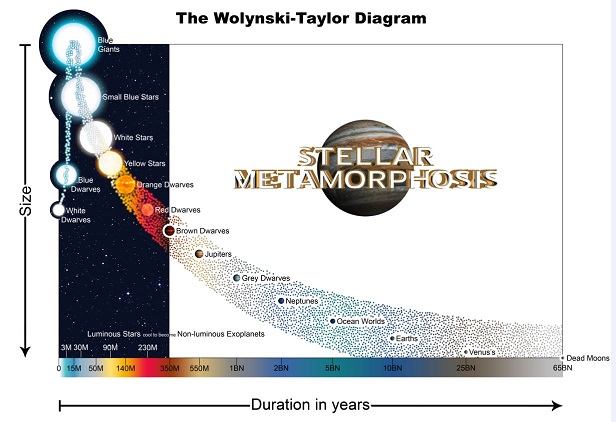
Here is a graph that places their evolutionary path.

snip.JPG


It is very easy to understand.
 
Those would be peer reviewed papers. At least his peers.

Peer review is not necessary. I have the internet now so I can show people the discovery without the rubber stamp of approval from academics.

Not only that, but it has been read by many people now. The main paper has 3,003 Unique I.P. downloads. http://vixra.org/abs/1303.0157

The secondary paper (the closest to the original, of course the original work is hand written and in my notebooks) has 907 unique I.P. downloads.

What is great about this is that I cannot be censored by academics. They have no power over me to take my papers down or prevent publication. People are learning that stars are hot young planets, they were never mutually exclusive, and there is nothing the "experts" can do about it.
 
jeffreyw: Ignorant fantasy about meteors from worlds being destroyed

...It is very easy to understand.
Yes it is very easy to understand - you have an:
23 May 2017 jeffreyw: Ignorant fantasy about meteors from worlds being destroyed based on the planets are stars delusion.
The fact that there are billions or trillions of comets, asteroids, and meteoroids says that the idea is both ignorant and a fantasy.

23 May 2017 jeffreyw: His lying cartoon pops up yet again.
Planets are not stars. They form alongside stars, e.g. the measured age of the Earth matches that of the Sun. They have different masses. They have different compositions. There are billions of more planets, comets, asteroids, and meteoroids than stars.
The only "truth" in the cartoon is that there is a "Taylor" who is ignorant enough to believe in this delusion.
 
Last edited:
jeffreyw: The fantasy that people reading PDFs means that his delusions are supported

Peer review is not necessary.
23 May 2017 jeffreyw: The fantasy that people reading PDFs means that his delusions are supported.
Anyone with a high school level education will read the delusion that planets are stars and laugh out loud.

23 May 2017 jeffreyw: The "censored by academics" paranoia displayed so often by cranks .
If you had a viable idea then it could pass peer review and be published.
 
Last edited:
23 May 2017 jeffreyw: The fantasy that people reading PDFs means that his delusions are supported.
Anyone with a high school level education will read the delusion that planets are stars and laugh out loud.

23 May 2017 jeffreyw: The "censored by academics" paranoia displayed so often by cranks .
If you had a viable idea then it could pass peer review and be published.

I see.

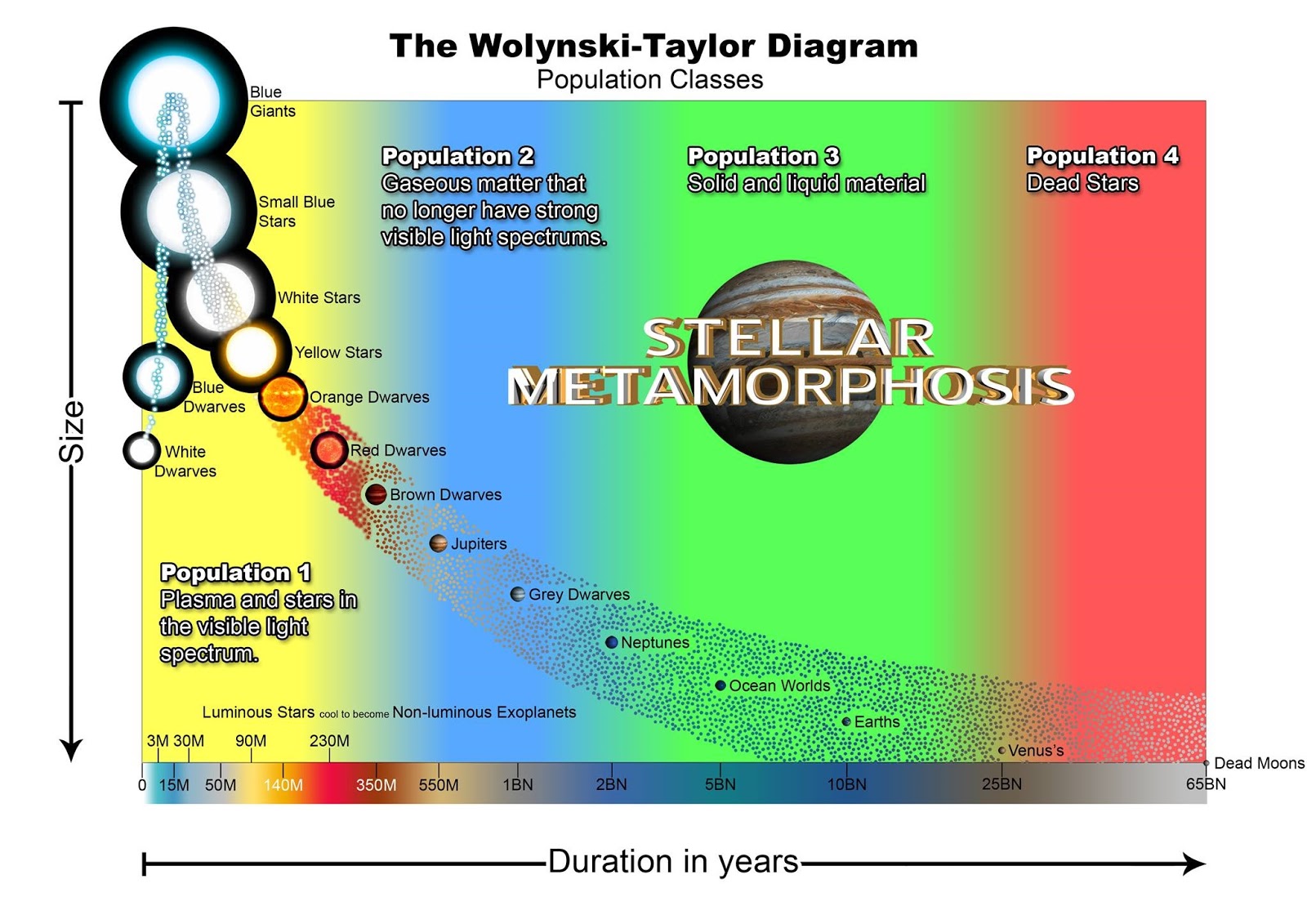
On another note I have reclassified the populations of stars based on their physical properties, on much larger timescales not allowed by the establishment dogma. Here is the reclassification in a simple, easy to read and understand graph.

Wolynski-Taylor%2BDiagram%2BStellar%2BPopulations.jpg


For those who don't know, Baade was the original classifier of stars based on their locations in a galaxy.

Populations.jpg


In this method, there is nothing really differentiating the stars except for where they are located in a galaxy. This is really bad reasoning for a multitude of reasons. One of those reasons is that old stars do not shine. Of course back in Baade's time all stars had spectrums, even the old ones, as per the spectroscopy paradigm that ruled astronomy. Frankly, none of the astronomers of the time KNEW of the older stars, so they assumed without evidence that all stars old/young shined. Their classification showed their absence of understanding as they classified the evolving/dead stars in our solar system as "planets".

It is a really simple fix. Unfortunately it murders the credibility of all astronomers/astrophysicists and geologists.
 
jeffreyw: Adding more fantasies to a delusion does not make less delusional

I see. ...
23 May 2017 jeffreyw: Adding more fantasies in a cartoon to a delusion does not make less delusional.

23 May 2017 jeffreyw: Labeling science as "establishment dogma" just emphasizes the depth of your denial of the real world.

23 May 2017 jeffreyw: A lying cartoon about Walter Baade's work who defined Population I and II stars.
These populations are based on the amount of metals (all elements except hydrogen and helium) in the stars, not their position. This classification is nothing to do with a delusion that planets are stars.

Stellar population
Walter Baade found two general groups:
  • Population I which are metal rich.
  • Population II which are metal poor.
There is a hypothetical Population III (extremely metal poor stars).
Young stars have high metallicity so Population I stars are more abundant in star forming regions, e.g. the arms and bulge of spiral galaxies. The Sun is an example of a Pop I star that is well outside the center of the Milky Way.
Old stars have low metallicity so Population II stars are more abundant in stable regions, e.g. galaxy halos and globular clusters.

 
Last edited:
23 May 2017 jeffreyw: Adding more fantasies in a cartoon to a delusion does not make less delusional.

23 May 2017 jeffreyw: Labeling science as "establishment dogma" just emphasizes the depth of your denial of the real world.

23 May 2017 jeffreyw: A lying cartoon about Walter Baade's work who defined Population I and II stars.
These populations are based on the amount of metals (all elements except hydrogen and helium) in the stars, not their position. This classification is nothing to do with a delusion that planets are stars.

Stellar population
Walter Baade found two general groups:
  • Population I which are metal rich.
  • Population II which are metal poor.
There is a hypothetical Population III (extremely metal poor stars).
Young stars have high metallicity so Population I stars are more abundant in star forming regions, e.g. the arms and bulge of spiral galaxies. The Sun is an example of a Pop I star that is well outside the center of the Milky Way.
Old stars have low metallicity so Population II stars are more abundant in stable regions, e.g. galaxy halos and globular clusters.

Those "metal" distinctions were made after their locations were determined. The stars' metal content was not determined to initially classify the stars. Not only that, but metal rich stars are very, very old, they are mostly solid with iron cores, so they have that backwards too. They tried to classify stars based on their spectrums only, which is not only bad, but statistically incomplete as outlined in this paper:

Planet Formation Theories in the Age of Statistically Insignificant Data

http://vixra.org/pdf/1610.0026v1.pdf

In short, Baade's classification method concerning the old/young stars was based on essentially ZERO data concerning stars, as not one single older star was considered for his method of classification.

In this paper I show that establishment has started to use more vague terms to cover their lack of understanding of stellar evolution (planet formation).

Ultracool Dwarf Stars vs. Red Dwarfs vs. Brown Dwarfs, OGLE-2016-BLG-1195L in Stellar Metamorphosis

http://vixra.org/pdf/1705.0114v1.pdf

It is the end for establishment's dogma of stars being mutually exclusive of planets. What is most ironic is that they will be their own demise with all the "exoplanet" data they receive. Not only that but the JWST will bring back data in huge amounts concerning the ignored gap in planetary systems, a 1600 Kelvin gap at that, due to the telescope being a very strong infrared observational tool.

The 1,600 Kelvin gap in astrophysics

http://vixra.org/pdf/1611.0360v1.pdf
 
Last edited:
jeffreyw: Repeats ignorance about Population I and II stars

...The stars' metal content was not determined to initially classify the stars.
23 May 2017 jeffreyw: Repeats ignorance about Population I and II stars.
That is wrong. The metal content of the stars was measured. Then they were split into Population I and II.
 
jeffreyw: A delusion of stars being "mostly solid with iron cores"

Not only that, but metal rich stars are very, very old, they are mostly solid with iron cores,
23 May 2017 jeffreyw: A delusion of stars being "mostly solid with iron cores".
No main sequence star has a significant amount of iron. The Sun's photosphere has 0.16% Fe by mass.
Most stars such as the Sun have temperatures above the boiling point of iron at the [photosphere and increasing with depth to millions of degrees at the core.
 
jeffreyw: Links to another ignorant and deluded crank PDF on vixra

Planet Formation Theories in the Age of Statistically Insignificant Data
23 May 2017 jeffreyw: Links to another ignorant and deluded crank PDF on vixra
A delusion that planets are stars does not invalidate the statistical analysis of stars. The physical fact is that we measure the metals in stars and see two populations regardless of that delusion.
 
Last edited:
jeffreyw: A crank PDF with demands does not mean anything

In this paper I show that establishment ...
23 May 2017 jeffreyw: A crank PDF demanding that astronomers should not classify stars does not mean anything.
It is very rational. For example: Dwarf stars exist. Some of them are much cooler then others. Astronomers label these stars ultra-cool dwarfs to distinguish then from normal dwarfs :eye-poppi.
 
jeffreyw: A crank PDF being paranoid about a "1,600 Kelvin gap"

The 1,600 Kelvin gap in astrophysics
23 May 2017 jeffreyw: A crank PDF being paranoid about a "1,600 Kelvin gap".
This is an paranoid idea that astronomers are ignoring data because we have not yet found exoplanets around stars with temperatures between 540 K and 2100 K. Why is he not also paranoid about the 105 K gap between the second and third hottest stars with exoplanets (2100 and 2205 K)? Ditto for the third and fourth hottest stars with exoplanets.

The only good thing in the PDF is a screenshot (no link!) of the Open Exoplanet Catalogue
 
In short, Baade's classification method concerning the old/young stars was based on essentially ZERO data concerning stars, as not one single older star was considered for his method of classification.
In short a lie because Walter Baade examined many stars of various ages from young to old.
Walter Baade
He worked at Mount Wilson Observatory from 1931 to 1958.[2] There, during World War II, he took advantage of wartime blackout conditions (which reduced light pollution), to resolve stars in the center of the Andromeda galaxy for the first time. These observations led him to define distinct "populations" for stars (Population I and Population II).
Stellar population
In 1944, Walter Baade categorized groups of stars within the Milky Way from their spectra. Two main divisions were defined as Population I and II, with another division known as Population III added in 1978.
That "Milky Way" bit is wrong about Baade.
The Resolution of Messier 32, NGC 205, and the Central Region of the Andromeda Nebula by W. Badde, 1944 which discuses type I and type II stars is about the center of the Andromeda galaxy. It was Oort as early as 1926 who recognized the 2 type of stars within the Milky Way.
 
Last edited:
It is amazing how easy it is to understand something when you do not have to account for all the facts and can ignore the laws of nature.

Sounds about as much understanding one can get out of the claims (other than some research project on compulsive behavior).
 
I see.

On another note I have reclassified the populations of stars based on their physical properties, on much larger timescales not allowed by the establishment dogma. Here is the reclassification in a simple, easy to read and understand graph.

Well, made up data is the easiest to work with and re-graph any way you like.
 
It is amazing how easy it is to understand something when you do not have to account for all the facts and can ignore the laws of nature.

Well speaking of ignoring the laws of nature. Establishment dogma states that stars remain hot and bright for their entire lives, contradicting the conservation of energy.

To them, a dead star is extremely energetic (white dwarfs). Yet, in this theory dead stars have lost their energy due to radiating it all away. Actual dead stars are objects that look like Mercury. They are the ancient dead cores of long dead stars, and the 100% guaranteed do NOT radiate strongly in the visible light spectrum.

Not only that but they also ignore the conservation of mass, the most fundamental physical law in nature. To them, stars remain massive their whole lives, regardless if they are directly observed to be losing mass as they cool and die. This means evolved stars should be much less massive than young ones.

These two basic laws, conservation of mass and conservation of energy are ignored. This means 100% of all accepted peer reviewed theories of stellar evolution are false.

The fact is that they have labeled older stars as "planets" and have gotten away with it for a very long time. They have been wrong in their assumptions, so naturally all the logic that is based on those assumptions is also false.

It is very easy to see their blind spot.

Just look for evolutionary models of Uranus, Neptune, Earth, Saturn, Jupiter, etc. They do not exist. You would think objects that have mass and radiate in EM frequencies outside of the visible spectrum would have models to predict their future radiative output, but nope. Not a single paper exists in any scientific journal that predicts the evolutionary sequence of those objects.

Not only that but no models exist either predicting the strength of their magnetic field output as they evolve. Why is this? It is because everything is under the paradigm of all the objects are related to the Sun. Yet, they are NOT related to the Sun. They are all independent structures. They are all stars in varying stages of evolution and are all vastly OLDER than the Sun.

This is of course outlined in the theory in a series of papers that is growing more rapidly with all the "exoplanet" data that is rolling in. They are just looking at evolved/evolving/dead stars. That is what an exoplanet is! So here we are.
 
23 May 2017 jeffreyw: A crank PDF being paranoid about a "1,600 Kelvin gap".
This is an paranoid idea that astronomers are ignoring data because we have not yet found exoplanets around stars with temperatures between 540 K and 2100 K. Why is he not also paranoid about the 105 K gap between the second and third hottest stars with exoplanets (2100 and 2205 K)? Ditto for the third and fourth hottest stars with exoplanets.

The only good thing in the PDF is a screenshot (no link!) of the Open Exoplanet Catalogue

Where are they? Where are the objects orbiting stars with temperatures between 540 K and 2100 K?

They are ignored. It is predicted that there are thousands of them hiding in the Kepler data. Not only that, but there are actually millions of them. L, T and Y type "dwarf" stars are hosts to millions of Earth like objects, but none are listed. Coincidence? Fact is they have no way of classifying them. Their borders bleed into one another. So instead of defining what is obvious (stars cool becoming planets), they have invented a new term "ultracool dwarf" to shield critics from the delineation problem that plagues astronomy.
 

ISF - Join now!

Every member here is approved by hand. No bots, no spam, just people who care about evidence and honest debate.

Membership is free!

Create your free account

Back
Top Bottom