Mackey, you are simply incorrect about the floor trusses being the only cross-bracing for the core columns. Look here, for instance:
peaceproject.com/graphics/postcards/CA2-huge.jpg
(add needed h t t p and w's)
Please retract your error, or lose credibility.
Fighting words indeed. None of this idiocy is necessary, if you are sincere. I won't back away from a friendly debate.
I note your image was taken during construction -- and is of extremely low quality. Please answer these questions first:
1) Which cross-bracing elements are you referring to in your picture?
2) What evidence do you have that they were permanent, rather than temporary bracing needed for construction?
3) What material are those elements made of? Your photo is in sepiatone and appears to be photocopied.
4) How are these elements attached to the columns?
After that, perhaps we can talk about credibility.
And you really should read my entire critique of Ross's paper. Your quote of me, out of context, only points out that Ross treated the problem one-dimensionally, assumed the columns would compress to failure, and that he is assuming columns are pinned on both ends.
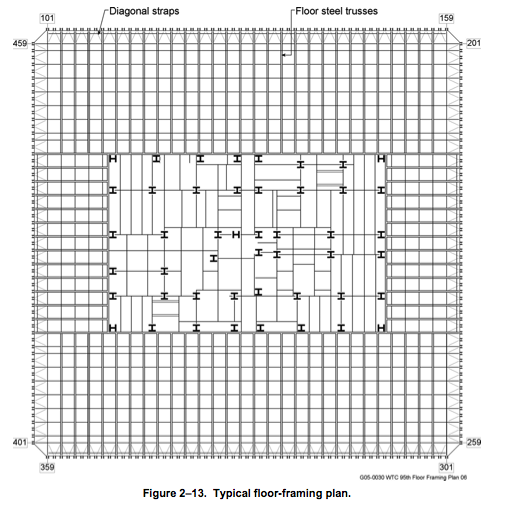
As NIST has recently clarified, the actual collapse mechanism was highly three-dimensional in nature, with the columns being twisted into the interior, pulled in by sagging floor trusses at each floor.
If there are such huge cross-braces as you claim, these braces would be part of the load-bearing structure. Funny that not even Ross accounts energy to break them, as he would have to do, if they were real.

 Now you can see why the tread was (correctly) moved