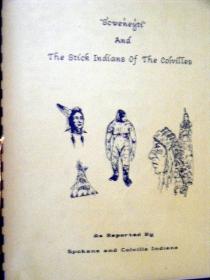
So I've been somewhat absent from the board of late with a combination of real life and computer issues. Before that though, the bigfooter pamphlet that MOTS referenced, "They Walked Among Us" - Scweneyti And The Stick Indians Of The Colvilles, got me into a bit of an internet investigation that resulted in what I thought were some interesting results. I have not yet decided how interesting the results actually are as I haven't been able to give them the amount of attention I would like to.
The document that MOTS shared with us is a piece that carries the scholarly subheading "Bigfoot: The Interaction of Unknown Hominids with American Indians as reported to Dr. Ed Fusch, Anthropologist, 1992."
It is in fact a very brief piece in which Fusch makes a concerted effort to dress a small bit of pseudo-science as disciplined research. He interviews an extremely small number of people and references many unfounded claims without the slightest reservation. Fusch puts gobs of salad dressing on a miniscule amount of salad. Nevertheless, I did my best to verify the pertinent information and found some interesting results. First of all, Fusch details that this Scweneyti that is featured is regarded by the Colvilles as being a singular entity; Cain, the firstborn son of biblical Adam and Eve. For the murder of his younger brother "sentenced by God to forever wander and roam about the Earth until Doomsday, that he could be heard but never seen, and was never again to commit murder."
This Morman connection to the bigfoot mythology has been detailed before, such as in this post by member Atomicmysterymonster:
http://www.internationalskeptics.com/forums/showthread.php?postid=3124892#post3124892
In looking into the culture and traditions of the Colville Indians the first thing I sought was to consult the language. Though the Colvilles are in fact a combination of various separate tribes, their common language was Salish. Here is a diagram of pre-contact Salishan language distribution:
http://upload.wikimedia.org/wikipedia/commons/d/d0/Salishan_langs.png
Searching out Salish language resources I found this site:
http://salishworld.com/
Here, as I've done before with other indigenous languages, I consulted a Salish dictionary for terms that might correlate to bigfoot. Here is the dictionary:
http://salishworld.com/Salish_Dictionary.htm
http://salishworld.com/Selish Dictionary_online.pdf
To my immediate surprise, unlike previous cases, I found an entry for 'bigfoot' which is listed as 'Scwene' as in the Scweneyti that Fusch discusses. I had honestly expected to find no such reference. When I made this thread I seriously doubted that any native groups put any traditional claim to the bigfoot mythology. Further examining the dictionary I checked for various terms such as 'giant', 'monster', 'gorilla', 'monkey', 'wild man', and other terms which might help me find some linguistic connections. 'Monkey' came up as 'monqi' and 'gorilla' came out as translating to 'big monkey'. Nothing was very helpful. I tried then to further understand how the Colvilles regard bigfoot and found this recent tribal newsletter referencing Fusch's work fifteen years prior:
http://tribune.colvilletribes.com/archives/2005/october2005/default.htm
Here is Fusch's site referencing the bigfoot figure erected by the tribe:
http://www.prospectored.com/bigfoot.htm
I also found this a listing for a book entitled 'Legends of Scwene' but was unable to find any information on its contents:
http://store.peoplescenter.net/legends-of-scwene.html
At this point I find myself in a bit of a muddle. I haven't been able to give the matter the attention I would like to and maybe if I did I could clear it up quick. Where it stands now is that...
1) The Colvilles are a tribe created from intervention of Anglo-Americans.
2) The Colvilles have traditions regarding bigfoot but they are biblical in their origins.
3) I do not have enough information on legends regarding 'Scwene'.
4) Salishan is a widely dispersed group of languages well beyond the territory of the Colvilles. A Salish language resource seemingly outside of bigfoot proponent influence has a specific entry for the creature.
5) I have been trying to consult language resources for various other indigenous groups who's territory is within areas traditionally associated with bigfoot and have found nothing. A major factor in this is the sad fact that many of the languages I seek to consult are extinct, nearly extinct, and/or very poorly documented.
I would very much appreciate the assitance of some of the members who've contributed previously with research in this thread as I find my own research to be limited and lacking.
What is bigfoot to the Salish?