
Merged Discussion of femr's video data analysis

One thing said one way: There is no vertical release point.

This is not a rope breaking under tension or a sudden brittle fracture. The hypothesis is multi-hinge buckling of vertical columns. That phenomenon begins with primarily horizontal motion and progresses into vertical motion (going as the sine and cosine of the hinge angles, respectively), but the horizontal and vertical motion share the very same initial instant. Neither can occur without the other.

If anything could be called a release point, it's the point where the hinges of the buckle break, but that happens well after vertical drop is underway. (And most likely happens at different times for different columns in the wall.) The vertical release point is a myth of your own invention.

NIST timed the beginning of vertical motion ("the instant the roofline began to descend"), which would occur with the beginning of buckling, which also includes horizontal motion. If their vertical motion figures were inaccurate due to simultaneous horizontal motion and perspective effects, that might affect the shape of the time versus displacement curve in the earliest moments of Stage 1 (with import yet to be shown), but it does not affect the time span of the overall event.

They didn't time the collapse from "several minutes earlier" because the wall did not collapse several minutes earlier. I don't really know what else to say about that.

Respectfully,
Myriad


Columns can bend, columns can buckle. A buckle can be thought of as 2 or more bends folding in opposite directions, no?

A single bend is what we have been calling a hinge (?)

Is this a fair, simple way to see a buckle geometrically?

If so, a hinge can be seen as not shortening the effective length of a column, whereas buckling can be seen as a shortening of the effective length of a column.

Any objections to this general distinction between hinge and buckle?

This Bazant image should do:

bazant1.jpg


>>>>>>>>>>>

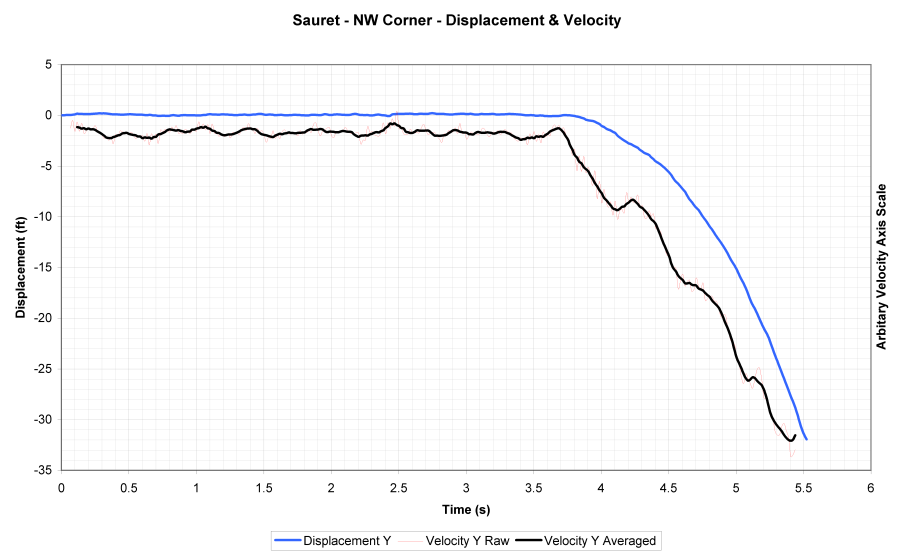
Recall that my earlier example of a "release event" was also using femr data along the NW corner of WTC1 during the (in)famous tilt and collapse initiation sequence. Femr's velocity graph:

joltgraph.jpeg


My earlier advice was to look within the yellow region to find the release event, or corner column failure event for the NW corner.

Also recall that supposedly the WTC1 north wall experienced one of your famous "hinges" so we'd expect the velocity to not make such an extreme transition over a few frames.......but it does.


I was posting this about 1 year ago...being ignored as usual.
 
Last edited:
Femr's velocity graph:

joltgraph.jpeg
I regenerated that graph with some labels (as I had originally included lots of info about it in textual form at the911forum. Folk here had great difficulty reading a graph without labels actually on the image)...
 
Thanks for the labels. Carlitos would never have forgiven you. Lazy Femr!

The expression "release event" is when the velocity clearly begins to take off. Slope of the velocity curve is acceleration. Notice how just after "release" the slope of the velocity curve remains pretty much the same until the first "jolt" (meaning velocity reduction).

There is a clear transition in slope of the velocity curve in the yellow region. That has a simple explanation as the "beginning of falling" or the release moment, the moment of column failure. There is nothing gradual about it.


"Failure" is a nice, general word. "Failure" can happen through buckling or simple displacement of column ends at a welded or bolted connector.

The velocity transition tells us when it fails or "gives", but not how.
 
Last edited:
The expression "release event" is when the velocity clearly begins to take off.
...
That has a simple explanation as the "beginning of falling" or the release moment
Indeed, and with reference to WTC7...

...note I have placed it as early as could possibly be justified by the derived velocity plot, and yet it is still ~1s after the NIST T0.
 
You've also been claiming that NIST's average acceleration figure for the entire north upper curtain wall collapse is too low because their placement of "t0" when the buckling began is too early, because they were fooled by horizontal motion. If the horizontal motion that "fooled them" into thinking buckling was underway actually is part of the buckling then that chain of inference falls apart.
That's indeed what I've been trying to explain in a previous post.

I've made this schematic drawing to illustrate how I interpret the video that MT posted (link only, because it's a huge animated gif).

The video:

http://img836.imageshack.us/img836/949/precolldeform.gif

My graph:

WTC7-failure-mode.gif


It represents WTC7 as viewed from the west.

The explanation of that drawing was already given back in the thread:

The WTC7 case is to me clearer since I saw the stabilized video you previously posted. It seems to me that the building's south side failed first, causing an horizontal movement in the north side as the building bent towards the south, and a curved one in the south side with a greater vertical component. The façade then arrested the horizontal component of the movement somehow (the why is still a bit of a mystery to me), and the north wall had to catch up with the downwards movement as the rest pulled from it, which would probably cause the peak in the downwards acceleration visible in the north side.

As an additional note, the early vertical motion of the northwest corner in that case is negligible. I've represented the tilting with a pivot point in the north façade, but if the pivoting is in the core instead, that corner can even ascend.
 
That's indeed what I've been trying to explain in a previous post.
So you disagree with Myriad when he says...
horizontal and vertical motion share the very same initial instant.

You are also extending scope. NIST define *start of global collapse* as the first point of development of East penthouse deformation, their global T=0. They also define the start of the North facade descent at another T=0 later on, which I have, of course, been discussing.

You are also ignoring the complex oscillation and twisting motion which began far in advance of release, in favour of a particularly speculative stick-figure personal viewpoint.

Doesn't look much like NISTS...
604072600.jpg


Hadn't you better make sure your disgram matches *bits* of the NIST description ? ...

After the exterior facade began to fall downward at 6.9 s, the north face developed a line or “kink” near the end of the core at Column 76. As shown in Figure 5-205, the northeast corner began to displace to the north at about 8.8 s

Yours is-a goin' south...


Feel free to add your answers for the questions I've asked Myriad. This one would be useful from you...

Could you tell me why you don't think that the instant the roofline began to descend ocurred at the 170s, 174s, 179s or 181s marks please ?
http://femr2.ucoz.com/_ph/7/821833103.png

I'll make sure I remind Myriad to do so, so they won't get lost in the noise ;)
 
Last edited:
So you disagree with Myriad when he says...
horizontal and vertical motion share the very same initial instant.
No I don't, with respect to the center of gravity.


Doesn't look much like NISTS...
[qimg]http://femr2.ucoz.com/_ph/7/2/604072600.jpg[/qimg]
Which in turn doesn't match the videos. But it matches this description:

In Stage 1, the descent was slow and the acceleration was less than that of gravity. This stage corresponds to the initial buckling of the exterior columns in the lower stories of the north face. By 1.75 s, the north face had descended approximately 2.2 m (7 ft).

In Stage 2, the north face descended at gravitational acceleration, as the buckled columns provided negligible support to the upper portion of the north face. This free fall drop continued for approximately 8 stories or 32.0 m (105 ft), the distance traveled between times t = 1.75 s and t = 4.0 s.

In Stage 3, the acceleration decreased somewhat as the upper portion of the north face encountered increased resistance from the collapsed structure and the debris pile below. Between 4.0 s and 5.4 s, the north face corner fell an additional 39.6 m (130 ft).
​


Hadn't you better make sure your disgram matches *bits* of the NIST description ? ...
See above.


Your is-a goin' south...
A perspective issue, probably. It can happen if the movement is prominently in the southeast direction.


Could you tell me why you don't think that the instant the roofline began to descend ocurred at the 170s, 174s, 179s or 181s marks please ?
Because the north side does not reflect the whole movement.
 
That's indeed what I've been trying to explain in a previous post.
So you disagree with Myriad when he says...
horizontal and vertical motion share the very same initial instant.
No, I don't think pgimeno is disagreeing with Myriad. Both of them have a solid technical background, so they know that the derivatives of sine and cosine are rather different in the vicinity of zero.

As for why femr2 is expressing amazement at what Myriad and pgimeno have said: My best guess (based on femr2's posting history and what he has written about T0) is that he does not understand the relevance of those derivatives.
 
No I don't, with respect to the center of gravity.
But as you know, we're not discussing the center of gravity. We're discussing the *beginning of vertical motion/release point/T=0* of the North facade.

As I just reminded you, NIST have a T=0 for global descent, which they place at the start of the East penthouse descent.

They also have a T=0 for descent of the North facade, which is the point in question.

Changing the scope to suit isn't a good idea.

But it matches this description
Based upon what ? That image ? I have the NIST animations if you want a trace of their movement... ? Really ?

A perspective issue, probably.
:) It's clear early motion of the NW corner has a significant northward component. The NE corner is similar, but t'other way...that's south btw.

It can happen if the movement is prominently in the southeast direction.
You need to spend more time with the video information before you make comments like this. It can happen if... ? :rolleyes:

Because the north side does not reflect the whole movement.
Again, we are discussing the North facade, however much you may want to drift the discussion elsewhere to avoid problems with statements yourself and Myriad have made recently.

NISTs North facade T=0 is specifically for the North face, not the building. Their global T=0 started earlier. About 6.9s earlier.

Don't worry, I'll keep track, make sure we're all on the same page ;)
 
No, I don't think pgimeno is disagreeing with Myriad.
He changed the context from North face to center of gravity. Convenient.

Both of them have a solid technical background, so they know that the derivatives of sine and cosine are rather different in the vicinity of zero.
You're wandering into a spherical cow. Don't worry, I'll keep track of the scope of dialogue between each poster and I myself. Thanks.

As for why femr2 is expressing amazement at what Myriad and pgimeno have said: My best guess (based on femr2's posting history and what he has written about T0) is that he does not understand the relevance of those derivatives.
I think you should consider we're talking about the North facade, not a single column. We're talking about detectable scales of motion minutes before release. We're talking about motion that can be scrubbed through on video over-and-over-and-over again, until it's clear what the motion actually is. And Myriad is suggesting (at this time, until he, er, clarifies ;) ) ...

the horizontal and vertical motion share the very same initial instant
...and...
the beginning of vertical motion ("the instant the roofline began to descend"), which would occur with the beginning of buckling

I hope he'll get around to answering my questions soon (the list is getting quite long already)...
 
But as you know, we're not discussing the center of gravity. We're discussing the *beginning of vertical motion/release point/T=0* of the North facade.
One would say you don't want to understand how the building collapsed, then, only how the north façade descended. Sounds pretty absurd to me to ignore some observables and focus on a part of the building which is influenced by such observables.

But the best part is, even if the initial vertical movement is negligible to the point that the noise is bigger than the movement, the release point NIST chose is possibly more accurate than yours.
 
One would say you don't want to understand how the building collapsed, then, only how the north façade descended.
No, we can discuss global structure behaviour, but you were shifting the context to try and validate your assertions.

Sounds pretty absurd to me to ignore some observables and focus on a part of the building which is influenced by such observables.
I don't ignore observables. We can go into lots of detail using the other views once I have extracted data from them of course. I've watched that clip many times of course, so I'm fully aware of the N->S type movements once descent is well under way.

Such behaviours are not a quantifiable part of trace data from the Dan Rather viewpoint (which is a good thing), for determination of T=0 for the North facade.

But the best part is, even if the initial vertical movement is negligible to the point that the noise is bigger than the movement, the release point NIST chose is possibly more accurate than yours.
Pointless hand-wave. You have access to all the data from both sides. I disagree, of course, for reasons made blindingly obvious. By all means make your case. Probably ? Don't commit yourself now, will you.
 
Pardon me, just taking a leaf from Oystein's book.

#000063bookmark
You are making an indirect note of W.D.Clinger's logic error ? (with omission of measured in the second operator)

Why ? T'was a misapplication of modus tollensWP, though that was bolted on by Oystein if I recall.

Such leafing is not going to be on-topic at any point. I suggest simply making a browser bookmark instead.
 
I've made this schematic drawing to illustrate how I interpret the video that MT posted (link only, because it's a huge animated gif).

The video:

http://img836.imageshack.us/img836/949/precolldeform.gif

My graph:

[qimg]http://www.formauri.es/personal/pgimeno/xfiles/11-s/WTC7-failure-mode.gif[/qimg]

It represents WTC7 as viewed from the west.
Tracing the motion doesn't agree with your personal interpretation...

...which is a trace of the NW corner using a larger copy of this stabilised view...
Animated GIF

As you can see, even though it's obviously affected by the NW viewpoint, the Southward motion is rather well behaved, gradual, and doesn't match your stick animation.
 
Separated Vertical and Horizontal motion graph for the stabilised WTC7 viewpoint...


Early wobbles are artefacts from initial shaky stabilisation.
 
Doesn't look much like NISTS...
[qimg]http://femr2.ucoz.com/_ph/7/2/604072600.jpg[/qimg]

Hadn't you better make sure your disgram matches *bits* of the NIST description ? ...

I see you're still using the wrong model. That's the collapse model without impact damage, you know, the one that looks least like the actual collapse.
 
You are making an indirect note of W.D.Clinger's logic error ? (with omission of measured in the second operator)
The logic error was Major_Tom's. Had his word "measured" been intended to qualify his argument so far as to bring it within the realm of logic, he'd have had no argument left at all.

Why ? T'was a misapplication of modus tollensWP, though that was bolted on by Oystein if I recall.
As Oystein explained, Major_Tom's premises were those of modus tollensWP, but Major_Tom drew exactly the wrong conclusion. That's the sense in which Major_Tom was misapplying modus tollens.

I don't think anyone has accused Major_Tom of actually understanding the rule of logic he was botching so badly, let alone that its traditional Latin name is modus tollens.

Such leafing is not going to be on-topic at any point. I suggest simply making a browser bookmark instead.
If Major_Tom's logic error is not on-topic in this thread, then the argument in which Major_Tom made that error was not on-topic either.

Yet he made that argument in this thread, and both Oystein and I responded with correct and cogent criticism of Major_Tom's logic. It's hypocritical of you to dismiss our criticism as "not going to be on-topic at any point" unless you are also willing to say that Major_Tom's argument will not be on-topic at any point.

Before you treat us to another verse of Poor Poor Pitiful MeWP, I'll acknowledge that you might have intended for your "not going to be on-topic at any point" to apply only to 000063's mention of his own bookmark, not to criticism of Major_Tom's logic. If so, then your remark about 000063's bookmark was at least as off-topic as his.
 
Tracing the motion doesn't agree with your personal interpretation...
I don't see how your graph proves that.


...which is a trace of the NW corner using a larger copy of this stabilised view...
Another unitless graph? :rolleyes:

I'd be more interested in the SW one.


As you can see, even though it's obviously affected by the NW viewpoint, the Southward motion is rather well behaved, gradual, and doesn't match your stick animation.
No, I don't see that. Your graph kind of proves that for the latter movement, not for the earlier one which is the focus of my interpretation. The well-behaved movement is expectable after the façade arrested the horizontal component. Near zero, there's an anomaly that supports my view.
 
Last edited:
The logic error was Major_Tom's. Had his word "measured" been intended to qualify his argument so far as to bring it within the realm of logic, he'd have had no argument left at all.
Dear me...

You highlighted two statements from MT...
How could you not have noticed that these accelerations are outside the range of known demolitions for years?
...and...
Even though measured demolitions do not come close to g accelerations, little facts like that don't seem to penetrate the fog.
..and YOU responded, stating...
If your highlighted statements are indeed facts, then the collapse of WTC7 was not a demolition.


these accelerations are outside the range of known demolitions
AND
(measured) demolitions do not come close to g accelerations
do NOT IMPLY
the collapse of WTC7 was not a demolition


Your conclusion is in error, regardless of *ifs* and buts.

I'll acknowledge that you might have intended for your "not going to be on-topic at any point" to apply only to 000063's mention of his own bookmark
Acknowledge away, as yes, littering the thread with *bookmarks* is not a practice I'll be encouraging in the slightest, and I bet you wish he hadn't eh ;)

If so, then your remark about 000063's bookmark was at least as off-topic as his.
Indeed, but to stop recurrance, something has to be said. Call it a nudge :)

I agree that elements of this discussion drift off topic.

Call that another nudge.
 

ISF - Join now!

Every member here is approved by hand. No bots, no spam, just people who care about evidence and honest debate.

Membership is free!

Create your free account

Back
Top Bottom