Split Thread Discussion of cascade failure initiation at WTC1 and WTC2

JSanderO

Illuminator
Joined
Mar 12, 2013
Messages
3,232
Location
nyc
Ozzie,

2270 makes good sense... especially people who fade from the "scene" having gotten a few answers and seeing the handwriting on the wall.

I find myself in a slightly different position because I AM intellectually curious about precisely what happened... the details.. something which does not interest you.

My approach has been to engage with people on the topic (forums) which forces me to increase my understanding and has even allowed me to sort of come to my own conception of what happened.

I came upon what I called... vertical avalanche which Tom called ROOSD on my own and felt it was confirmed that I was not crazy when I found others including you who arrived at the same place. But that didn't get to how the thing triggered.... no interest to you... and perhaps we can't even know for the absence of data.

But then I turned to 7 a little less than a year ago and found there was really only NIST col 79 and AE911T's nonsensical non mechanism of 81 columns over 8 floors destroyed in one instant. So I am bouncing this off of anyone who can help me understand it. But getting little help and understand why at/from this forum.
 
But then I turned to 7 a little less than a year ago and found there was really only NIST col 79 and AE911T's nonsensical non mechanism of 81 columns over 8 floors destroyed in one instant. So I am bouncing this off of anyone who can help me understand it. But getting little help and understand why at/from this forum.

Any explanation of the collapse of WTC 7 has to include failure of column 79, as it was a main support for the east mechanical penthouse, which fell through the roof ~6 seconds before the west penthouse, followed by the curtain wall. NIST has one explanation, but I understand there are other, non-conspiracy engineering explanations put forward by such as ARUP.

As a non-engineer, I have no dog in the fight between these. AFAICS, it'll be very difficult to definitely choose one over the other, as there is no deciding piece of evidence like the bowing of the columns of WTC 1 and 2 which led to the rejection of the "pancaking floors" model of the collapse initiation.

Any discussion as to the respective merits of various science/engineering explanations for the collapse of WTC 7 doesn't belong in the Conspiracy section, but in the Science section of JREF. Perhaps you should start a thread there.
 
... But then I turned to 7 a little less than a year ago and found there was really only NIST col 79 and AE911T's nonsensical non mechanism of 81 columns over 8 floors destroyed in one instant. So I am bouncing this off of anyone who can help me understand it. But getting little help and understand why at/from this forum.
Fire destroyed WTC 7. Many buildings have been totaled, never used again due to ordinary office fires. WTC 4 gone, it was crushed, but 911 truth ignores it, but essentially claims steel can't be "crushed", or fail, or what.
WTC 5, gone, totaled by fire, WTC 7 totaled by fire too. WTC 6, totaled by fire.

When will you turn to 3, 4, 5, 6? Pentagon? Shankesville? Are you sticking with your LIHOP?

Have you figured out thermite yet? Did you know Jones made up the thermite theory 5 years after 911 with no evidence?
Was it from thermite? Can't tell.
You can't tell after 11 years?
 
Ozzie,

2270 makes good sense...
Must do - I wrote it. :blush: Meanwhile remember this is dusting off some points of interest but even including the word "dust" may not leave these posts here in this thread. But I takes me chances and presses on...
... especially people who fade from the "scene" having gotten a few answers and seeing the handwriting on the wall...
...Agreed naturally.
I find myself in a slightly different position because I AM intellectually curious about precisely what happened... the details.. something which does not interest you...
A point where your understanding is different to mine. The logic issues are that I am not interested in details which are irrelevant or not significant. I have my own very comprehensive understanding of the processes of failure which probably accumulated to initiation of collapse for the Twin Towers. Core failures and perimeter failures the two that matter. I am interested in those. I've engaged in discussion about them. In years past I have engaged in detailed discussion of the three dimensions plus time complexities if the cascade failure mechanisms of the "initiation". That was for the benefit of "genuine truthers" back in 2008-9-?? A long time since I've seen anyone take on that level of complexity - I just started to deal with it whilst pointing out to Tony Sz some limits on one of his arguments. That last year IIRC. We don't see intelligent genuine truthers any more and most discussion here is around Bazantian abstractions. I am interested in the "both sides get it wrong" arguments about perimeter inward bowing and the focus on floor joist sagging as the sole cause. I don't particularly care which came first - perimeter or core. And have seen a lot of people argue that one or the other - perimeter or core - went first. I have never seen anyone explain why the difference matters. And that is the "key area" of interest to me - why does the difference matter? Bottom line is I'm not much interested in details which I have not already worked through for myself or are either irrelevant or insignificant in the setting of some made out claim.
...My approach has been to engage with people on the topic (forums) which forces me to increase my understanding and has even allowed me to sort of come to my own conception of what happened...
I fully respect that position. Adding my caution that if you dare to question NIST or Bazant on this forum...:boxedin:
...I came upon what I called... vertical avalanche which Tom called ROOSD on my own and felt it was confirmed that I was not crazy when I found others including you who arrived at the same place....
Easy to see but a lot of people still get lost between the Bazantian style academic abstractions and the observable "what really happened". The differences obvious - the only surprise being the amount of effort put into the apologetics supporting the "Authorities".
... But that didn't get to how the thing triggered.... no interest to you... and perhaps we can't even know for the absence of data...
Not my position. I understand what components probably made up initiation. I'm not bothered about which bit went first until somebody shows me why it makes any difference. M_T continues to misrepresent my position as you are well aware. I could even define the two reasons why the difference - between core led and perimeter led - could make a difference. But I am not about to spoon feed answers to people like M_T and his procedural clones from the debunker side who do not even accept the basic protocols of discussion.
...But then I turned to 7 a little less than a year ago and found there was really only NIST col 79 and AE911T's nonsensical non mechanism of 81 columns over 8 floors destroyed in one instant. So I am bouncing this off of anyone who can help me understand it. But getting little help and understand why at/from this forum.
An admirable goal provided that you can ignore the noise. But I doubt you will get a lot of assistance.

Remember the main reason the truth movement turned to WTC7 discussion. They had essentially lost the argument for CD at the twin towers. More accurately stated there never was an argument for CD...but that nuance of pedantry probably lost here.

So truthers had lost on WTC1 and WTC2 CD claims - essentially because there was so much evidence in full view against CD and for so called "natural" collapse - collapse resulting from impact damage plus unfought fire collapse and no need for CD assistance.

Along comes WTC7 where nearly all the evidence is hidden inside the building. A natural setting for a truther style so called "argument" which follows their classic pattern "This anomaly happened at WTC 7; we cannot explain it; therefore it was CD; you debunkers prove it wrong".

And we debunkers duly take up the challenge. Ignoring the false logic which includes, respectively in sequence:
1) Single anomaly bereft of any hypothesis;
2) Argument from incredulity;
3) Quantum leap speculation with several errors of logic sequence;
4a) Reversal of burden of proof plus
4b)...requirement to prove a negative which is
4c)...probably the first of a series of goal post shifts.

(And that sequence is "truther logic in a nutshell for dummies" - begging the oxymoron of "truther logic" ;))
 
Last edited:
I don't particularly care which came first - perimeter or core. And have seen a lot of people argue that one or the other - perimeter or core - went first. I have never seen anyone explain why the difference matters. And t

I suspect that it doesn't matter terribly much... but for me it is the conclusion of seeing the destruction in reverse.. back to the cause.

I suppose also that if the collapse can be shown to be initiated in the core... it would lend to support that it could have been a CD..ie placing devices inside the core.. The IB simply does not look like it could be caued by an explosion...

The core collapse first scenario seems to support the notion that the core experienced a weakening over time...something that heating up steel and connections would do... and the axial strength then was completely gone.... the floors above the non performing core were then hanging from the hat truss which over loaded the facade and instantly buckled it.. probably aligned with the location of the outriggers... not at the corners of the tower... and I believe the IB was opposite the core not at the corners.

The truss sag thing does not ring true to me... Is it supposed to have been going on all around the core almost uniformly? I simply can't see how that was working over the foot print... color me dumb. Or did it only happen in a few places and ????

Also it seems to make sense that the fires were driven into the north tower by wind... the fuel dispersed into the plan through the core... and the antenna DID move down before the show started and that looks like the core had failed directly under the strongest part of the hat truss. Those top 3 floors just below the roof at the center of the core were the strongest and most well braced portion of the core... That they clearly let go FIRST suggests that the core BELOW them had crapped out.

My PDF is too large to attach. send me your email addy if you are interested.
 
Last edited:
Ozzie,

2270 makes good sense... especially people who fade from the "scene" having gotten a few answers and seeing the handwriting on the wall.

I find myself in a slightly different position because I AM intellectually curious about precisely what happened... the details.. something which does not interest you.

My approach has been to engage with people on the topic (forums) which forces me to increase my understanding and has even allowed me to sort of come to my own conception of what happened.

I came upon what I called... vertical avalanche which Tom called ROOSD on my own and felt it was confirmed that I was not crazy when I found others including you who arrived at the same place. But that didn't get to how the thing triggered.... no interest to you... and perhaps we can't even know for the absence of data.

But then I turned to 7 a little less than a year ago and found there was really only NIST col 79 and AE911T's nonsensical non mechanism of 81 columns over 8 floors destroyed in one instant. So I am bouncing this off of anyone who can help me understand it. But getting little help and understand why at/from this forum.
Try my YouTube video and see if it helps answer questions about Building 7 and freefall:
http://www.youtube.com/watch?v=2MER5PhIDt0&playnext=1&list=PLDD5BD81A636031A5&feature=results_video
 
The truss sag thing does not ring true to me... Is it supposed to have been going on all around the core almost uniformly? I simply can't see how that was working over the foot print... color me dumb. Or did it only happen in a few places and ????

Do you believe that uniformity of truss sag around the core is necessary for collapse? Have you asked a structural engineer about this?

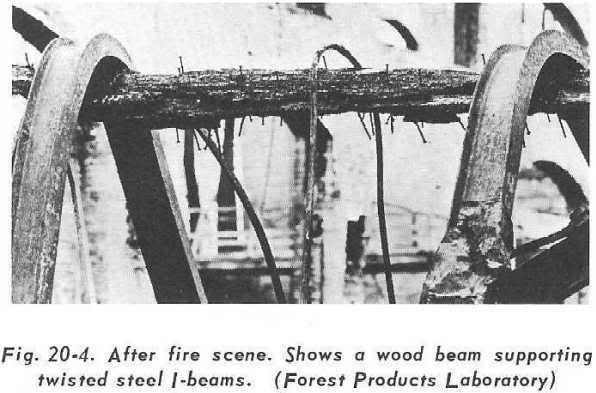
Here's some pictures of truss sag in fires.
 

Attachments

  • Minnesota Fire-bent steel.jpg
    Minnesota Fire-bent steel.jpg
    91.5 KB · Views: 4
  • Steel and Wood in Fire (Color).jpg
    Steel and Wood in Fire (Color).jpg
    133 KB · Views: 4
  • Fire Damaged Steel.JPG
    Fire Damaged Steel.JPG
    42.3 KB · Views: 3
  • Steel and Wood in Fire (Color) 2.jpg
    Steel and Wood in Fire (Color) 2.jpg
    17.1 KB · Views: 97
...The truss sag thing does not ring true to me... Is it supposed to have been going on all around the core almost uniformly? I simply can't see how that was working over the foot print... color me dumb. Or did it only happen in a few places and ????...
Take care that you are not creating a strawman for yourself. I mean the assumption that joist/truss sag had to be all round the tower. Actually it only needed to start in one place and the rest would topple like dominoes or like a zip fastener pulling apart from one end...but I'm getting ahead of myself. I commented on this scenario in my previous post. But the key comment was probably lost in my long paragraph. Here is the bit that matters. Go back and read the earlier post if you want context:
In years past I have engaged in detailed discussion of the three dimensions plus time complexities if the cascade failure mechanisms of the "initiation"....A long time since I've seen anyone take on that level of complexity...
The debate over Twin Towers initiation has been mostly overlaid with assumptions about "uniformity"; approximations which are either one dimensional or pseudo static AND limited understanding of load redistribution especially as a dynamic process. The process was dynamic - had to be. It wasn't uniform with everything failing at once - couldn't be. So we need to comprehend the sort of complexities involved as failure spread rapidly across the impact and fire zone. I will try to isolate a couple of them. There are many more.

So I will try to explain the sort of process - without any attempt to make it fit exactly column for column on what really happened - just illustrations of the sort of mechanisms.

Let's start by taking it that a floor joist sags and starts to pull in a perimeter column. (Even that is not accurate - it would be several floor joists over several columns...but stay with the simple for now.) (also look at the current thread "Challenge: Demonstrate Sagging floor Trusses Pulling in Perimeter Columns" - it does some calculation based analysis of the simple first stage I am about to present.)

As the column is bent inwards it still has the vertical column load on top of it - the load it was designed to carry ( Overlooking, again for simplicity, all the live/dead/wind load variances which may or may not have applied at the actual time.) As the column starts bowing inward from the joist sag pull in the vertical load moves from axial to eccentric to off the line of column..to...(leave the thought there...) And as that happens the column becomes unstable and at some stage stops acting like a column and starts acting like a bent strut. Which "bent strut" cannot support the original load and two consequences:
1) The applied load is far to much for the bent strut and it continues to bend of its own weakness without needing the truss/joist pull in force (Historically a lot of discussion has missed that point.); AND
2) The downwards load is still there. It is more than our column now a bent strut can carry so the surplus load is still there - it has to redistribute - has to be carried by something else.

The obvious thing to happen is that the surplus load goes to the adjacent columns. Which raises several new complications:
A) Which columns does it go to and how much to each?
B) Is it only the next column either side? OR Several? If so how far does it spread?
C) Meanwhile if heat induced sag started this column bending what about the next columns either side? The fire could not be so focussed that it affects one joist and misses the adjacent ones.
D) If we try to conceptualise the load shedding to adjacent columns how much goes where will depend on the rigidity/flexibility of the tower framework - both above and below this point of failure.

AND what I have described for one column failing is happening at different stages of progress for all the adjacent columns.

Getting complicated isn't it?

And I've only scanned across the immediate vicinity. What about weakening of core? Weakening on the other side of the tower? Transfers via the hat truss? All affected by flexibility of the whole relevant portions of the tower structure.

So let's stop there with the difficulties and focus on another aspect...dynamics.

This analogy will either work for you or it wont. Let's see - using analogies is always risky on Internet forums.

Take a common "zip" fastener which holds both sides of your track suit top/cardigan/raincoat...whatever. If it is closed it is hard to pull apart. The material will tear first and you wont be strong enough to achieve that by unaided arm muscle power. Now cut the bottom off the zip - pull the two bottom sides starting at the bottom and the zip will peel apart tooth by tooth from the bottom (the wrong way round but that's not a big point.) Each tooth in sequence has to withstand your total applied force and cannot do it. So the whole fastener opens up tooth by tooth. If you don't like that analogy try thinking about a line of dominoes toppling in sequence...I wont explain that one further.

Either is analogous to what happens in a cascade failure of the WTC1-2 type on 9/11. With some exceptions in details naturally.

If a dozen or more columns on one side of the building are failing at nearly the same time--nearly the same stage of sequence - it is easy to imagine/visualise but very hard to maths quantify. And I'm not trying to match the "which column went first..second...third..." of the actual collapse. Merely illustrate some principles.

Now your possibly self imposed strawman of "uniformity" wouldn't happen in a real cascade collapse. Nor would uniformity of fire. Cascade starts at the weakest point, drops load which then triggers the next weak point which is now the weakest which then triggers the next weak point which is now the weakest which then triggers the next weak point which is now the weakest--- repeat that loop till it is all falling downwards.

and visualise it as something starting at one place - one column...one group of columns - and the failure racing along the row of columns - round the corner but..

By that stage core collapse and other factors will also have come into play (presuming that core didn't start the whole thing :rolleyes: - which wouldn't change the principle involved - start at one place rapidly progress to the nearest neighbour then the next...etc. No uniformity. Uniformity not needed and not possible - remember the zip? Or the dominoes - they don't all fall at once.)

I know that you comprehend that "fire heated steel becomes weak" so I wont address that aspect. Redwood has posted examples. Beachnut has a favourite picture he posts regularly and my personal example is the collapse of Coventry Cathedral during WWII.

That much should be enough to point you in a direction. Let's see if it helps.

BTW the nearest parallel I am aware of would be Major_Tom's research into the zone collapse aspects of ROOSD - he took the details a lot further than I ever did with my 2007-8 efforts. His material is published you know where. Otherwise not a lot of attempts to explain the dynamics as I said earlier.

Let me know if this post helps.

And did I refer to 'Dust Studies' often enough? HINT start your own thread JSanderO

NOTE: I've PM'ed a Mod to request this series of posts be transferred to its own thread. Otherwise AAH awaits by my reading.

 
Last edited:
... The truss sag thing does not ring true to me... ...

onemeridiansag.jpg

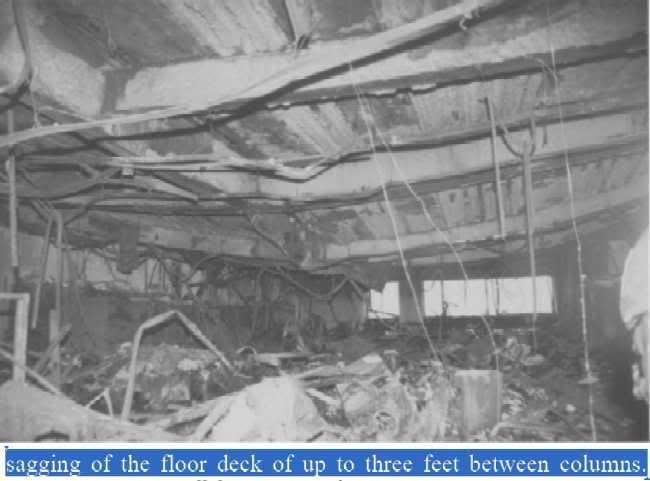
Ordinary office fires with no high speed airliner impact and 66,000 pounds of jet fuel starting fires on multiple floors, just an office fire which totaled the building. One Meridian Plaza, never used again - totaled by ordinary office fires, not some great event - the fire was fought, not like WTC 7 not fought fires, or the WTC towers never fought fires.

Sage of 3 feet, in an office fire, first time? lol, fire does not like steel; wait, I mean steel does not like fire. Tarzan like fire.

woodsteelfire.jpg

Just like 911 truth, bringing thermite to an office fire. Office fires on 911 had the heat energy of over 2,500 tons of thermite before collapse.
 
Take care that you are not creating a strawman for yourself. I mean the assumption that joist/truss sag had to be all round the tower. Actually it only needed to start in one place and the rest would topple like dominoes or like a zip fastener pulling apart from one end...but I'm getting ahead of myself. I commented on this scenario in my previous post. But the key comment was probably lost in my long paragraph.

Let's start by taking it that a floor joist sags and starts to pull in a perimeter column. (Even that is not accurate - it would be several floor joists over several columns...but stay with the simple for now.) (also look at the current thread "Challenge: Demonstrate Sagging floor Trusses Pulling in Perimeter Columns" - it does some calculation based analysis of the simple first stage I am about to present.)

........................

As the column is bent inwards it still has the vertical column load on top of it - the load it was designed to carry ( Overlooking, again for simplicity, all the live/dead/wind load variances which may or may not have applied at the actual time.) As the column starts bowing inward from the joist sag pull in the vertical load moves from axial to eccentric to off the line of column..to...(leave the thought there...) And as that happens the column becomes unstable and at some stage stops acting like a column and starts acting like a bent strut. Which "bent strut" cannot support the original load and two consequences:
1) The applied load is far to much for the bent strut and it continues to bend of its own weakness without needing the truss/joist pull in force (Historically a lot of discussion has missed that point.); AND
2) The downwards load is still there. It is more than our column now a bent strut can carry so the surplus load is still there - it has to redistribute - has to be carried by something else.

The obvious thing to happen is that the surplus load goes to the adjacent columns. Which raises several new complications:
A) Which columns does it go to and how much to each?
B) Is it only the next column either side? OR Several? If so how far does it spread?
C) Meanwhile if heat induced sag started this column bending what about the next columns either side? The fire could not be so focussed that it affects one joist and misses the adjacent ones.
D) If we try to conceptualise the load shedding to adjacent columns how much goes where will depend on the rigidity/flexibility of the tower framework - both above and below this point of failure.

AND what I have described for one column failing is happening at different stages of progress for all the adjacent columns.

Getting complicated isn't it?

And I've only scanned across the immediate vicinity. What about weakening of core? Weakening on the other side of the tower? Transfers via the hat truss? All affected by flexibility of the whole relevant portions of the tower structure.

So let's stop there with the difficulties and focus on another aspect...dynamics.

This analogy will either work for you or it wont. Let's see - using analogies is always risky on Internet forums.

...................

If a dozen or more columns on one side of the building are failing at nearly the same time--nearly the same stage of sequence - it is easy to imagine/visualise but very hard to maths quantify. And I'm not trying to match the "which column went first..second...third..." of the actual collapse. Merely illustrate some principles.

Now your possibly self imposed strawman of "uniformity" wouldn't happen in a real cascade collapse. Nor would uniformity of fire.

...............

And did I refer to 'Dust Studies' often enough? HINT start your own thread JSanderO

NOTE: I've PM'ed a Mod to request this series of posts be transferred to its own thread. Otherwise AAH awaits by my reading.

I agree that this should be moved to a new thread, as we have drifted far from the original topic. Interesting discussion, though.:)
 
I agree that this should be moved to a new thread, as we have drifted far from the original topic. Interesting discussion, though.:)
Which is why I PMed the Mod.

JSanderO is used to a more relaxed forum - off-topic stuff here gets AAH'ed

I've been having fun - a long time since I did any of the complicated explaining stuff. Nobody interested these days. Both sides have long been fixed in their positions. Complete with all the errors of oversimplification. :rolleyes:


PS err...."DUST" :o
 
Last edited:
Do you believe that uniformity of truss sag around the core is necessary for collapse? Have you asked a structural engineer about this?

Here's some pictures of truss sag in fires.

No I don't... But I would like YOU to explain how 6 or maybe 10 sagged trussed would fail the entire perimeter over 200 lin feet.

So connect the dots... some trusses sag and pull in the handful of trusses and then................................. fill in the blanks
 
Last edited:
No I don't... But I would like YOU to explain how 6 or maybe 10 sagged trussed would fail the entire perimeter over 200 lin feet.

So connect the dots... some trusses sag and pull in the a handful of trusses and then................................. fill in the blanks
I'm offended JSanderO.

The blanks have already been filled in by my post. I gave you an extended explanation ...now you insist that Redwood has to do it. Mine not good enough? How do you know that he wont cheat and read my explanation?

@Redwood. My post has no royalty charges. Feel free to "cut and paste". And I have no objection if you come up with a different and more plausible explanation of a cascade failure. :D

PS If you have a better analogy than either "dominoes" or "zip fasteners" I would like to see it. ;)
 
Let's start by taking it that a floor joist sags and starts to pull in a perimeter column. (Even that is not accurate - it would be several floor joists over several columns...but stay with the simple for now.) (also look at the current thread "Challenge: Demonstrate Sagging floor Trusses Pulling in Perimeter Columns" - it does some calculation based analysis of the simple first stage I am about to present.)

As the column is bent inwards it still has the vertical column load on top of it - the load it was designed to carry ( Overlooking, again for simplicity, all the live/dead/wind load variances which may or may not have applied at the actual time.)

Your problem here is that these were three story tall panels, staggered in the facade with connections to ever other column.... with floors above and below... the so called pull in... there is no way jose that a hand full of sagging joists will pull a 40' section more or less of the face 54" within one story height.

YES the sagging floors could be and would be exerting an inward impulse because the were attached on to the SIDE of the facade panel... sort how a cantilever pulls ... But the inward bowing was BUCKLING from imposed loads from above... likely the outriggers of the hat truss... which just happen to align with the IB section. The cantilever of the floor simply directed the buckling inward.

You know this...
 
Originally Posted by Redwood
Do you believe that uniformity of truss sag around the core is necessary for collapse? Have you asked a structural engineer about this?

Here's some pictures of truss sag in fires.


No I don't... But I would like YOU to explain how 6 or maybe 10 sagged trussed would fail the entire perimeter over 200 lin feet.

So connect the dots... some trusses sag and pull in the handful of trusses and then................................. fill in the blanks

FWIW: Keep in mind that I abjure any claim to expertise in structural engineering. I'm a retired industrial chemist, and while I worked with chemical engineers, mechanical engineers, and electrical engineers, I never worked with structural engineers. So you're getting the off-the-cuff opinion of a scientifically trained non-engineer. Remember what I wrote about seeking the opinion of a structural engineer.

As one floor truss, sags, it exerts an inward force on the columns it's attached to. Eventually, the column can't support its/their load. The load is distributed to the rest of the columns, more to the adjacent ones. Now neither the original truss or column is supporting the load of the building.

Trusses adjacent to the original sag more, exerting more pull on their columns, leading to inability to support their loads. Rinse, repeat, and eventually you get to the point where the inability of one last column to support its load leads to a final redistribution to its neighbor, which is immediately pushed past its failure point, and from there, all hell breaks loose.

IIRC, there was once discussion in one of these threads about engineering students constructing a support for a ~200 lb. weight from 1 lb. of balsa wood as an exercise. Apparently, it can be done. Last step in the exercise was to cut one element of support. Usually, the structure simply sits there while stresses and strains build up. The structure often fails with startling suddenness. But as I've written, I am not a structural engineer, and I have never done this. I believe there's a YouTube video somewhere of something like this.
 
Your problem here...
Not my problem. I suspect after reading the remainder of your post that you meant "the problem".
... is that these were three story tall panels, staggered in the facade with connections to ever other column.... with floors above and below... the so called pull in... there is no way jose that a hand full of sagging joists will pull a 40' section more or less of the face 54" within one story height.
Which is close to what I said AND points to the error that most other debaters of this issue have made. It wasn't simply catenary pull in causing the whole 54" IB. The geometry doesn't work.
...YES the sagging floors could be and would be exerting an inward impulse because the were attached on to the SIDE of the facade panel... sort how a cantilever pulls ... But the inward bowing was BUCKLING from imposed loads from above... likely the outriggers of the hat truss... which just happen to align with the IB section. The cantilever of the floor simply directed the buckling inward....
Broadly correct - I won't get pedantic over words.
...You know this...
Yes - otherwise I wouldn't stick my chin out by explaining it.
thumbup.gif
 
Last edited:
Your problem here is that these were three story tall panels, staggered in the facade with connections to ever other column.... with floors above and below... the so called pull in... there is no way jose that a hand full of sagging joists will pull a 40' section more or less of the face 54" within one story height.

YES the sagging floors could be and would be exerting an inward impulse because the were attached on to the SIDE of the facade panel... sort how a cantilever pulls ... But the inward bowing was BUCKLING from imposed loads from above... likely the outriggers of the hat truss... which just happen to align with the IB section. The cantilever of the floor simply directed the buckling inward.

You know this...

Hmmm... so incredulity trumps models?
 
Hmmm... so incredulity trumps models?
Actually no. He is not using incredulity - he is mostly agreeing with me but his writing style is a bit hard to decode.

The key points IMO are:
there is no way jose that a hand full of sagging joists will pull a 40' section more or less of the face 54" within one story height.
Two factors and he is correct on both.
sagging floors could be and would be exerting an inward impulse
- it should be "force" not "impulse" but the concept is correct.
...the inward bowing was BUCKLING from imposed loads from above...
Correct interpretation of what I suggested as most probable. And the point which has almost always been missed by truthers and debunkers alike.

The references to the hat trusses and cantilevers are dubious and unclear. But they are signs of thinking not simple incredulity.
 
Your problem here is that these were three story tall panels, staggered in the facade with connections to ever other column.... with floors above and below... the so called pull in... there is no way jose that a hand full of sagging joists will pull a 40' section more or less of the face 54" within one story height.

YES the sagging floors could be and would be exerting an inward impulse because the were attached on to the SIDE of the facade panel... sort how a cantilever pulls ... But the inward bowing was BUCKLING from imposed loads from above... likely the outriggers of the hat truss... which just happen to align with the IB section. The cantilever of the floor simply directed the buckling inward.

You know this...

The shell is not a facade, it is 50 percent of the gravity load, and essentially 100 percent of the lateral support. Facade? The shell, floor system and core are a system making the WTC towers the strong structures.

Dust, thermite, thread? Millette found no thermite because there was no thermite used; can't believe you joined Gages fantasy fraud. How is Balsamo? Bet you can't call him by your favorite JREF pet name. Dust.

At least the fake paper is supported by StormFront, but neoNAZIs are so darn dense, it is amazing they have a web site which supports the Harrit stuff. Is Harrit a neoNAZI, or just dumb?
http://www.stormfront.org/forum/t788084-2/
 
Last edited:

ISF - Join now!

Every member here is approved by hand. No bots, no spam, just people who care about evidence and honest debate.

Membership is free!

Create your free account

Back
Top Bottom