• Quick note - the problem with Youtube videos not embedding on the forum appears to have been fixed, thanks to ZiprHead. If you do still see problems let me know.

Was there a reason to expect a powerful jolt in the towers?

pgimeno

Illuminator
Joined
Feb 18, 2009
Messages
3,694
Location
Spain
Since Tony Szamboti made his paper "The Missing Jolt" public, he has moved the goalposts somewhat, to the point of asserting the necessity for a powerful jolt even in a more realistic situation than the one he proposed in said paper.

Mainly, he has asserted that axial column-to-column impact was unavoidable. I didn't see any clear flaw in his reasoning.

The intention of this thread is to focus the discussion not on the paper's starting assumption of rigid blocks, but on the question of whether a powerful, measurable jolt was expectable in the actual situation and whether there was / why there wasn't one.

This has been discussed in other threads, and I admit to my initial confusion as to the contents of the paper (due to having forgotten about its actual contents and focusing on Tony's latter claims). So, given that my ideas are now hopefully clearer, and that what I was discussing all that time was not the paper's contents but what is to be the topic of this thread, I wanted a more specific discussion on the subject. It keeps confusing me to see every so often the claim that a macroscopic jolt was not possible, since it isn't accompanied by any reasoned explanation as to why. I hope this thread will help put this issue to rest once and for all.

Clearly, after the fall of several floors, the tilt of the top block was enough for the columns to be out of alignment. The question is, when not all columns had failed yet, and one side of the core had fallen the height of one story while the opposite side of the building still managed to hold it enough to make it pivot, whether it was expected that an axial column-on-column impact happened.

I've received several answers to this question. I remember the posters, but I'd have a hard time finding the posts right now. Newton's Bit said that unless the impact was perfectly square, which is basically discarded, the border-on-border impacts (don't remember the exact terms he used) would not oppose nearly as much resistance because of the reduced impact surface. I agree, but I objected that the bent web would provide an additional surface for impact. I didn't get an answer as to whether that objection held any water, so I'm still unsure about it. Here's an example of a column bent that way:

http://www.sharpprintinginc.com/911/images/photoalbum/3/hh.jpg

Special emphasis in the "Fractured end near the 100th floor level". The bent web would provide a greater surface to squarely impact the bottom surviving part of the column. Detailed view here:

http://www.sharpprintinginc.com/911/images/photoalbum/13/fig_3_12__h.JPG

Note the "three elbows" structure of the failure, except that the bottom "elbow" is actually a broken connection in this case. Unfortunately, we don't have any core columns from the impact area belonging to the side that failed first.

Grizzly Bear has shown a pretty convincing picture of WTC2 showing how the building's tilt induced a rotation over a pivot higher than the impact zone, causing a displacement backwards that would be a plausible explanation for the misalignment. He also provided another picture for WTC1 that I could not interpret as a potential cause of misalignment.

Ozeco41 has said that there never was an opportunity for a big jolt, but it's not clear to me whether in every occasion he mentioned it, he referred to the assumptions in Szamboti's paper or not. To my knowledge, he has never explained how they would be avoided at the point in the process outlined above.

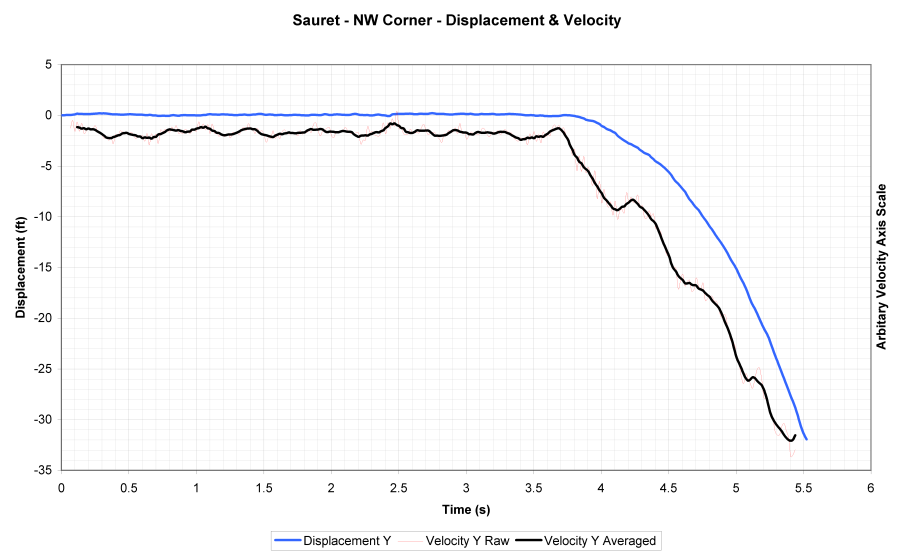
Worth mentioning is that, regardless of whether Tony's paper had a wrong assumption to start with, it contains measurements that he later claimed should have shown a jolt. I disagree, for a number of reasons, mainly related to the data acquisition and treatment methods he used. But I still think that the overall idea that a jolt should be present (even if not of a magnitude big enough to be shown in his data) has merit.
 
Clearly, after the fall of several floors, the tilt of the top block was enough for the columns to be out of alignment. The question is, when not all columns had failed yet, and one side of the core had fallen the height of one story while the opposite side of the building still managed to hold it enough to make it pivot, whether it was expected that an axial column-on-column impact happened.

Was there ever a point at which the upper section had tilted enough to have one side of the core of either tower, to have moved down 3 meters?
 
Once the top is moving down there has to be more than enough misalignment of column ends that there would be no jolt or even column ends impacting one another.
 
Was there ever a point at which the upper section had tilted enough to have one side of the core of either tower, to have moved down 3 meters?
If the question does not answer itself, I'm not understanding your point.

At some point it had to. Isn't that bleeding obvious? Am I missing something?
 
Once the top is moving down there has to be more than enough misalignment of column ends that there would be no jolt or even column ends impacting one another.
How do you define "moving down"? I define it as downward movement of the center of mass, and that's measurable by the movement of the roofline, since the driving energy causing movement of said roofline is gravity.
 
If the question does not answer itself, I'm not understanding your point.

At some point it had to. Isn't that bleeding obvious? Am I missing something?

Your quote which I used indicates that this time is while the core is still intact enough to allow pivoting, thus before the entire upper section is moving downwards.

Once the entire mass is moving downwards all columns must have failed.
Was part of the core down by three meters before the entire upper section was moving downwards?
 
How do you define "moving down"? I define it as downward movement of the center of mass, and that's measurable by the movement of the roofline, since the driving energy causing movement of said roofline is gravity.

Depends where the pivot is. Limit case is pivot on a line of columns opposite end of the core from the side tilted down. At that point the CoM does have downward vector but the pivot by definition isn't moving down . in fact only after pivot line moves beyond the center of the core would the CoM have a downward velocity vector.
 
Seems to me if that top section moves literally straight down it means that columns were "disappeared".. or their strength was destroyed.. or a combination of the two.

If there is any tilt or lateral movement... even 1" or less... the end to end bearing has been effectively destroyed and there would be no jolt... perhaps web/flange crippling.

The jolt concept requires space between the impacting things where one (the moving) has its motion appreciably slowed - the jolt. Not happenin'
 
Your quote which I used indicates that this time is while the core is still intact enough to allow pivoting, thus before the entire upper section is moving downwards.

Once the entire mass is moving downwards all columns must have failed.
Was part of the core down by three meters before the entire upper section was moving downwards?
Judging by some pictures I've seen posted, I'd say it took a while for the opposite side to start falling, and by that time the fall distance was already several floors high. This is a rough estimation off my recollection, which may well be inaccurate, but before I verify it I'd like to know what's the importance of that. My recollection is based on this image that Ozeco has posted several times:

ArrowedROOSD.jpg


But in either case, the roofline, which is the measurable feature (specifically the corner), would still move downwards and register a jolt if the columns impacted on each other, whether the opposite side had failed or not. Does your question matter for determining whether the columns were aligned by that time?
 
Judging by some pictures I've seen posted, I'd say it took a while for the opposite side to start falling, and by that time the fall distance was already several floors high. This is a rough estimation off my recollection, which may well be inaccurate, but before I verify it I'd like to know what's the importance of that. My recollection is based on this image that Ozeco has posted several times:

[qimg]http://conleys.com.au/webpics/ArrowedROOSD.jpg[/qimg]

But in either case, the roofline, which is the measurable feature (specifically the corner), would still move downwards and register a jolt if the columns impacted on each other, whether the opposite side had failed or not. Does your question matter for determining whether the columns were aligned by that time?

OK that answers my question.

So we have a progressive failure of columns as the upper structure tilts. Where is the supposed massive jolt then? Only a few columns are failing at a time. The tilt even means some columns are in tension for a while until pivot line reachs them

I simply cannot envision where these massive jolts are supposed to come from.

Lack of jolt means no separation between upper/lower column ends thus no explosive removal of a section of columns.
 
OK that answers my question.

So we have a progressive failure of columns as the upper structure tilts. Where is the supposed massive jolt then? Only a few columns are failing at a time. The tilt even means some columns are in tension for a while until pivot line reachs them

I simply cannot envision where these massive jolts are supposed to come from.

Lack of jolt means no separation between upper/lower column ends thus no explosive removal of a section of columns.
Well, for some definition of "massive". I used the word "powerful". My expectation was at most one row of columns worth of axial impacts.

Here's the diagram I drew to explain where and how I would expect jolts:

anim0003b.png


The impacts would be elbow on elbow, as the columns shortened.

One way to picture it is, if you hold a sheet of paper vertically (representing the part of the column that buckles and develops hinges, which are assumed to oppose negligible resistance) and start to lower your upper hand vertically, closer and closer to the other, the sheet will bend, but eventually your hands (representing the still intact part of the columns) will touch each other.
 
The exterior columns buckled and failed over multiple floors. Why would you expect the core column failure to be restricted to one floor.

I would expect an S bend in the slender axis of the columns over multiple floors.
 
Grizzly Bear has shown a pretty convincing picture of WTC2 showing how the building's tilt induced a rotation over a pivot higher than the impact zone, causing a displacement backwards that would be a plausible explanation for the misalignment. He also provided another picture for WTC1 that I could not interpret as a potential cause of misalignment.
Meh... my use of WTC 2 mostly has to do with the fact that the effects of the displacement are magnified by the lower failure point, the large section in motion, and much more asymmetric damage at the failure floor.

WTC 1 reasonably had many of the same reasons, but a different failure pattern that was nearly dead-center in the building... that meant different motion vectors and the smaller upper section gave less of a visible tilt. If I still feel up to it I'll do a better version of this:

3MaTMYd.jpg


which doesn't exactly display my best photoshop skills ever... :thumbsup:
 
One other major diff between WTC1 & 2 is that one was hit on the long side of the core while the other was hit on the short side.

While the building itself was square in footprint, the core was rectangular.
 
Well, for some definition of "massive". I used the word "powerful". My expectation was at most one row of columns worth of axial impacts.

Here's the diagram I drew to explain where and how I would expect jolts:

[qimg]http://www.formauri.es/personal/pgimeno/xfiles/11-s/wtc-impact/anim0003b.png[/qimg]

The impacts would be elbow on elbow, as the columns shortened.

One way to picture it is, if you hold a sheet of paper vertically (representing the part of the column that buckles and develops hinges, which are assumed to oppose negligible resistance) and start to lower your upper hand vertically, closer and closer to the other, the sheet will bend, but eventually your hands (representing the still intact part of the columns) will touch each other.
Real world there was nothing to prevent lateral motion of either top or lower column sections. In fact the very rotation causing the tilt puts a lateral component of force on the knees.

Stand on a ladder centered and in line with the rails. All force is straight down.
Now lean to one side. If the wall that the ladder is against is slippery, it will move laterally.

In addition, although winds were light the building would be reacting to it.

Having upper and lower knees meet is in short, an idealized situation not reflective of the real world conditions.
 
The exterior columns buckled and failed over multiple floors. Why would you expect the core column failure to be restricted to one floor.

I would expect an S bend in the slender axis of the columns over multiple floors.
I expected the horizontal members to hold them in alignment.
 
Meh... my use of WTC 2 mostly has to do with the fact that the effects of the displacement are magnified by the lower failure point, the large section in motion, and much more asymmetric damage at the failure floor.

WTC 1 reasonably had many of the same reasons, but a different failure pattern that was nearly dead-center in the building... that meant different motion vectors and the smaller upper section gave less of a visible tilt. If I still feel up to it I'll do a better version of this:

[qimg]http://i.imgur.com/3MaTMYd.jpg[/qimg]

which doesn't exactly display my best photoshop skills ever... :thumbsup:
Thanks, yes I remember that drawing and I could not make much of it, to be honest. I'm not denying there was pivoting, but if it was significantly smaller, I wonder if it would be nearly enough to cause misalignment.
 
Real world there was nothing to prevent lateral motion of either top or lower column sections. In fact the very rotation causing the tilt puts a lateral component of force on the knees.

Stand on a ladder centered and in line with the rails. All force is straight down.
Now lean to one side. If the wall that the ladder is against is slippery, it will move laterally.

In addition, although winds were light the building would be reacting to it.

Having upper and lower knees meet is in short, an idealized situation not reflective of the real world conditions.
Hm, inertia? It was a huge mass.

I don't expect wind to be a significant factor in such a short fall.
 
The impacts would be elbow on elbow, as the columns shortened.

It always struck me that these 'elbows' or 'knuckles' are more theoretical than real. What are the odds on column connections surviving the formation of a 180° bend in the column body? If they did, what are the odds the fold would occur half way along the section, allowing for a relatively clean contact? I think Dave Rogers produced a diagram of a 'messy fold', but can't find it easily.
 
Ozeco41 has said that there never was an opportunity for a big jolt,...
Correct. And I have explained why on multiple occasions - most recently in the thread WTC Twin Towers - Ozeco41 accepts a Jango Challenge to explain "Initiation"
but it's not clear to me whether in every occasion he mentioned it, he referred to the assumptions in Szamboti's paper or not.
My reasoning is always zero based - addressing the real event. So I would not allow myself to become trapped within a Szamboti frame of reference (or NIST, or Bazant...). Since 2007 - second week of Internet posting - I have adopted the policy of NEVER relying on the reasoning of "authorities" - originally that was NIST but I take the same line with FEMA, Bazant and any others - my reasons explained many times. Whether I relate any specific statement to other party's claims - Szamboti's, NIST's, Bazant's or others is situation specific. I try to avoid confusions over whether or not NIST was right - the usual need is to determine what happened 9/11 2001 - not whether NIST (or Bazant or Szamboti) explained it correctly. Unless my purpose is specifically to show where NIST (Bazant. Szamboti) were in error - when I will explicitly identify their errors. I tend to be blunt when identifying errors by any of those authorities.

To my knowledge, he has never explained how they would be avoided at the point in the process outlined above.
I've grown tired of explaining the process set rigorously in full context. I cannot guarantee to explain aspects which are related in someone else's partial or false context. In this instance if you specifically identify which "point in the process" you are referring to I can confirm if I have or have nor explained it in your context. I certainly have set my own context explicitly AND explained the relevant issues sufficient to attract reasoned discussion. The ONLY counter discussion in that recent thread was a dishonest personal attack by one member who was determined to complicate simple issues in order to confuse the "explain for laymen" setting and dishonestly nit pick one of my valid claims.
 
Last edited:
Thanks, yes I remember that drawing and I could not make much of it, to be honest. I'm not denying there was pivoting, but if it was significantly smaller, I wonder if it would be nearly enough to cause misalignment.

At face value it would sound counter-intuitive but it was enough. You have consider the scale of the buildings along with the visible movement of the buildings you see on video.

For the most part, even for WTC 2, where the macro-scale of the tilt was plainly visible the "meta details" still can't be grasped simply from the video. The bending of the columns I marked off in the WTC 2 graphic were barely discernible at the video resolution available to the extent that it merited some graphic indications to show more clearly. As I recall, not only was WTC 1 less dramatic in the macro scale movement, but alot of the video footage was taken from afar, limiting the options considerably.

Either way, I'll do a better graphic this week then
 
It always struck me that these 'elbows' or 'knuckles' are more theoretical than real. What are the odds on column connections surviving the formation of a 180° bend in the column body? If they did, what are the odds the fold would occur half way along the section, allowing for a relatively clean contact? I think Dave Rogers produced a diagram of a 'messy fold', but can't find it easily.
Have you seen the images I linked to in the OP?

In that case, the bend spanned two floors
 
Have you seen the images I linked to in the OP?

In that case, the bend spanned two floors

There is very little 'bend' and no 'elbow' there. The bodies of the columns ripped and connections also broke.
 
In this instance if you specifically identify which "point in the process" you are referring to I can confirm if I have or have nor explained it in your context.
Please read the thread. I outlined it quite clearly in the OP, and every other poster seems to have gotten it. JDH asked for a clarification and I gave it, which maybe you can benefit from. If you need further clarifications I'll be happy to provide them.

I certainly have set my own context explicitly AND explained the relevant issues sufficient to attract reasoned discussion. The ONLY counter discussion in that recent thread was a dishonest personal attack by one member who was determined to complicate simple issues in order to confuse the "explain for laymen" setting and dishonestly nit pick one of my valid claims.
I haven't seen such thing happen. I challenged your claim:

That claim still has the status of bare assertion. I've explained why, several times, even using diagrams. You never addressed my arguments, and instead you have merely repeated your assertion without providing any proof.

And that is the main point of disagreement.

You provide no mechanism for the misalignment of the columns that is necessary for the ends to miss in the way you claim, because if they don't misalign, an impact is sure to happen sooner or later. I provided a collapse mechanism that allows for the top to rotate as seen, and yet have impacts. That was discussed in the section of the thread I linked Georgio to.

It certainly constitutes a counter-discussion. Is that a personal attack too?

Your reply was:
It is a sequencing error - I've been calling it an "anachronism" for years. For the Top Block to be falling/dropping/moving to a lower level the column ends have already missed. Same story for "tilt" causing or preventing impacts. By the time you have tilt the opportunity for impacts is past history. Too late. False sequence. "Anachronism" if you will allow me to use that term.
That claim still has the status of bare assertion.1 I've explained why, several times, even using diagrams.2 You never addressed my arguments,3 and instead you have merely repeated your assertion without providing any proof.4
And that is the main point of disagreement.5
Good move. If "that is the main point of disagreement" lets resolve the differences.
I've bolded and underscored the point of the claim. (And set aside for now the complications of the supplementary issue of the "tilt" scenario" - is is a specific sub-set of the main scenario.)
You did not quote my supporting comment:
The Top Block cannot be moving downwards AND at the same time the columns still in line.
...which IMO says the same thing.

Remember the setting we are discussing is this stage for WTC1 - David Chandler's graph. The period of the collapse when T Sz claims there should have been a "big Jolt":
chandler_graph.jpg

The Top Block has started to move bodilly downwards - it is accelerating at this time. There is no "big Jolt" and the movemnt does not cease.


Now you state:
1 "That claim still has the status of bare assertion." Well I disagree - I've lost count of (a) The number of times over recent years I've explained it AND (b) The number of times I've referred to it as "bleedingly obvious" because it should be self evident on a moments thought. BUT let's take a rain check on that - if we resolve the difference it becomes a moot point.

2 "I've explained why, several times, even using diagrams." I cannot recall any such explanation. Please link me to two of your "several" explanations which show how column ends can still be in line and not missing whilst the Top Block is moving downwards in that stage of the collapse.

3 "You never addressed my arguments," I don't recall any valid arguments - see "2" above - If you link them I will address them.

4 "...and instead you have merely repeated your assertion without providing any proof." Respond to 2 and 3 and we can take it from there.

So you claim I am wrong to assert "For the Top Block to be falling/dropping/moving to a lower level the column ends have already missed." OR the alternate version "The Top Block cannot be moving downwards AND at the same time the columns still in line."

OK - prove me wrong - show how a column can still be in line whilst the Top Block is falling as we know it did fall.

Then - on your next point:
You provide no mechanism for the misalignment of the columns that is necessary for the ends to miss in the way you claim, because if they don't misalign, an impact is sure to happen sooner or later. I provided a collapse mechanism that allows for the top to rotate as seen, and yet have impacts. That was discussed in the section of the thread I linked Georgio to.
I have referred to the existence of a mechanism many times and identified several possibilities. Try the logic working from known fact rather than unknown.

The known fact - subject to resolving the previous difference - is that the ends missed or bypassed. Therefore we know that there was a mechanism. We know of several - IIRC three identified in detail in "that other thread" - BUT we do not need to know which mechanism for which column to know that there was a mechanism.

to which I replied this:

You did not quote my supporting comment:
The Top Block cannot be moving downwards AND at the same time the columns still in line.
...which IMO says the same thing.
Yes, same thing, and same error.


Remember the setting we are discussing is this stage for WTC1 - David Chandler's graph. The period of the collapse when T Sz claims there should have been a "big Jolt":
chandler_graph.jpg

The Top Block has started to move bodilly downwards - it is accelerating at this time. There is no "big Jolt" and the movemnt does not cease.
Correct. Here's an alternative graph by ferm2:


(click for larger version).


2 "I've explained why, several times, even using diagrams." I cannot recall any such explanation. Please link me to two of your "several" explanations which show how column ends can still be in line and not missing whilst the Top Block is moving downwards in that stage of the collapse.

crushcolumn.gif

No "gap" for anything to fall thorough and "impact".
Is that animation supposed to explain why the "missing jolt" is missing?

I think it proves the contrary. The animation stops right at the point where the top and bottom "elbows" are about to impact. Perhaps with a reduced jolt due to the angle, but probably still noticeable.

In the animation, the top and the bottom ends never lose alignment, and since matter can't interpenetrate, they will meet sooner or later as gravity exerts its action. Your explanation about the ends having already missed at that point leaves that detail unexplained. In the WTC, thanks to the core's girders, the ends probably didn't lose alignment either, so if anything, that diagram shows that the jolt should happen.
One example. Your response was to just repeat your assertion.
I don't agree on this either. See your gif again, and imagine how the process continues past the end of it. When the two "elbows" of the column collide, there will be some force transmitted upwards from the elbow through the remaining part of the column to the structure above. That's not what I call bypassing. They will eventually collide after the top falls for some distance, probably somewhere between half a floor and one floor high.

Not too different from what happens in this failed demolition, in which the upper parts of the (I assume) cut columns resist enough as to not only cause a jolt, but to completely decelerate the building to the point of arrest: http://www.youtube.com/watch?v=Sa6z41EOt4o
Another example (in the case of the failed demolition I refer to, the impacts are column-on-floor, not column-on-column, as I clarify in a latter message).


So you claim I am wrong to assert "For the Top Block to be falling/dropping/moving to a lower level the column ends have already missed." OR the alternate version "The Top Block cannot be moving downwards AND at the same time the columns still in line."

OK - prove me wrong - show how a column can still be in line whilst the Top Block is falling as we know it did fall.
I do so in the quoted sections above.


Now let me go back to another message from a different thread, where you do define "fall" (I hope you agree now that you didn't define it in the message that Georgio linked above, as I claimed, even though you said later that I was wrong on that):

Your use of "falling" differs from my consistent usage in these pages. My apology that I didn’t think it necessary to once again define the term. I have consistently referred to Top Block BODILY falling for the past x years and forgot that members tend to reason post by post rather than follow argument. So mea culpa for leaving what I meant by "falling" not explicitly named on this occasion. All of Top Block - bodily falling.
Which you refine later:
Yes. My stage of "falling" is past that point. Look at the 4 sec point in this clip.

That is where "falling" - "Bodily falling" - all of it moving downwards - becomes unambiguous.
So you're fast-forwarding to a point in time where the center of gravity has already moved down. I agree that at that point the columns are no longer in alignment, BUT I don't agree that that's where the top block starts falling.

The main "driving force" causing the buckling of columns is PE. In a sense, it can be said that the columns buckle because there is conversion of PE into KE. Therefore the buckling of columns must be an indication that the center of gravity is moving down. Therefore I can't accept your "T=0" instant of the top block beginning to fall as starting at 4s - it starts when the columns begin the fatal buckling phase, at about 1s into that video.

You said earlier that our definitions of falling were basically the same. I hope it's clear now why I don't think so. Falling means the CoG displaces down non-negligibly, and that happens as the columns buckle
Post which is, again, free of any kinds of personal attacks, yet you never addressed it.

In fact, after a careful review of that thread I fail to find any personal attack towards you in it. The only one I could find where there was something resembling a personal attack was this post:
I truly enjoy all the effort incompetents who apparently lack any functional knowledge of physics and it's applications and so try to make one thing they sort of know, kind of, to
be a way determine that truth is wrong even though it clearly is not. On the other hand, it keeps them out of other types of mischief.!!!!!:D:D:D
which is obviously not directed at you. Was that thread the one you were referring to, at all?

If there was a poster who used personal attacks against you, that would be against Rule 12 of the Membership Agreement. In that case, please report it as such. That's a better idea than complaining about them the way you're doing here, in my opinion.
 
There is very little 'bend' and no 'elbow' there. The bodies of the columns ripped and connections also broke.
I clearly see two "elbows". In the location where the third one should have been (floor 98) there was a connection.

I'm unclear whether the end opposite to the connection (the one at floor 100) was ripped or cut. If it ripped off then maybe it was not an "elbow". But the one at floor 99 clearly is.

But whether or not there were "elbows" still misses the point that however the columns deformed, the still intact parts would meet again if they remained aligned.

An argument can perhaps be made that the girders would not have enough strength to hold the columns at their respective connections to said girders. If that's the case, then waypastvne's argument of multi-floor column failure would effectively provide a mechanism for misalignment. I don't know if that's the case or not. I doubt it.
 
Hm, inertia? It was a huge mass.

I don't expect wind to be a significant factor in such a short fall.

The entire upper section was a huge mass. The individual columns not so much.

However,,,,You also seem to have missed the point, the tilted section of column above is supposedly still attached to the lower section. That puts a lateral component of force on the knee.
 
The entire upper section was a huge mass. The individual columns not so much.

However,,,,You also seem to have missed the point, the tilted section of column above is supposedly still attached to the lower section. That puts a lateral component of force on the knee.

Do you mean something like this?

lateral-force-on-knee.png


Wouldn't the girders prevent lateral movement at their connections to the column? Please see my reply to GlennB above.
 
Do you mean something like this?

[qimg]http://www.formauri.es/personal/pgimeno/xfiles/11-s/lateral-force-on-knee.png[/qimg]
The gravity vector however, is not axially onto the column if the upper part of the column is tilted.

Wouldn't the girders prevent lateral movement at their connections to the column? Please see my reply to GlennB above.

Damaged, heated girders? Absolutely nothing on the impact/fire floors is in pristine condition.
 
The gravity vector however, is not axially onto the column if the upper part of the column is tilted.
Correct. I don't see how that favours misalignment, though; if at all, it can be said to favour alignment. I've calculated an angle of 4.7° for a pivoting over the wall and falling 12 feet in a scenario like this:

Code:
      PIVOT
        v                      CORE
  PIVOT>|---------------|--|---|-|---|--|---------------|
        |               |  |   | |   |  |               |
  NORTH |         COLS  |  |   | |   |  | COLS          | SOUTH
   WALL |         501-  |  |   | |   |  | 1001-         | WALL
        |         508   |  |   | |   |  | 1008          |
        |---------------|--|---|-|---|--|---------------|

Focusing only on these parts and ignoring the rest:

Code:
      PIVOT
        v
  PIVOT>|-------------------------------|...
        |                               |
  NORTH |144"                           | COLS
   WALL |                           144"| 1001-
        |                               | 1008
        |-------------------------------|...
                   ~1760"

the calculation estimates the tilt angle of the top in these conditions:

Code:
      PIVOT
        v
  PIVOT>|---___
        |      ---__  ~1760"
  NORTH |           ---___             A
   WALL |144"             ---___       v
        |                       ----___|
        |-------------------------------|...
                   ~1760"               ^
                                        B

For the record, I also estimated the horizontal distance between points A (where the column of the tilted top ends) and B (where the column of the bottom block is assumed to stay all the time) and got 5.9". It's a simple right triangle calculation solvable using Pythagoras' theorem. Imprecision in the 1760" estimation has a very small impact on the 5.9" length, so I'd say 5.9±0.1" is fair, and similarly 4.8±0.1° tilt.

I'm not saying these were the exact conditions of the building after the fall. In fact this whole thread's purpose is to explore the reasons why they were not like that.


Damaged, heated girders? Absolutely nothing on the impact/fire floors is in pristine condition.
Yes, that's an argument favouring misalignment. I don't see it as a definitive one.
 
Im not sure this is the correct place to ask (and I'm sure it's been asked before) ... and I admit at this point I have only a passing interest ... BUT ... is there ANY other building constructed in the style of the old twin towers ... with the structural members all on the outside perimeter like that?
 
Im not sure this is the correct place to ask (and I'm sure it's been asked before) ... and I admit at this point I have only a passing interest ... BUT ... is there ANY other building constructed in the style of the old twin towers ... with the structural members all on the outside perimeter like that?

No - if you mean the identical structural system... long span bar trusses
 
Correct. I don't see how that favours misalignment, though; if at all, it can be said to favour alignment.


.

How does a changing (its not a static condition) force vector favour alingment?

Think of a stand alone 4x4 wooden column unattached to a base. Now place a plywood platform on top and load it with a few sandbags. Still stands and balances.

Now push up on one side of the plywood platform thus tilting it. The column will tilt indicating a change in force vector at the junction.

Now envision the condition if its a steel column that is overloaded due to redistribution of loads and heating of the column. If two knees form as in the illustration in above posts the top knee gets pushed laterally and continues to see that through its time of settling.
 
Im not sure this is the correct place to ask (and I'm sure it's been asked before) ... and I admit at this point I have only a passing interest ... BUT ... is there ANY other building constructed in the style of the old twin towers ... with the structural members all on the outside perimeter like that?

The 'structural members' were not all on the outside. The core columns bore the larger part of the weight.
 
The 'structural members' were not all on the outside. The core columns bore the larger part of the weight.

Good catch.

A structure with all columns on the perimeter is very common in wood frame homes and garages.

The core only bore greater gravity load because it supported its own mass as well.
The long span trusses transfered half their load to the core and half to the perimeter.
 
The 'structural members' were not all on the outside. The core columns bore the larger part of the weight.

That's incorrect...

The core had 47 columns... with 24 at the perimeter and 23 were inside the core. The core had a lot of penetrations for shafts... elevators, stairs, mech risers/ ducts. There were bathrooms, corridor/elevator lobbies, mech closets and some office uses.

The 23 columns in the core's center carried very light loads... certainly compared with the 24 perimeter columns and the 4 corner columns of the core carried the most loads by far.

The facade and the 24 perimeter columns carried to office use floor loads They divided the loads but the facade carried about 20% more of the office floor loads than the cores perimeter.
 
Good catch.

A structure with all columns on the perimeter is very common in wood frame homes and garages.

The core only bore greater gravity load because it supported its own mass as well.
The long span trusses transfered half their load to the core and half to the perimeter.

incorrect.

The actual weight of the face columns was greater than the core columns and they ALSO carried the weight of the columns above

The ratio of the facade SUPPORT and the core's perimeter SUPPORT was about 23% difference... facade carried more!

Of course there were SOME floor loads inside the core.... but they were not that great.
 

Attachments

Last edited:
incorrect.

The actual weight of the face columns was greater than the core columns and they ALSO carried the weight of the columns above

Er, the core columns also carried the weight of the core columns above.

The ratio of the facade SUPPORT and the core's perimeter SUPPORT was about 23% difference... facade carried more!

Core:facade gravity-bearing ratio was around 55:45, from memory. You seem to have added the core perimeter to the building perimeter in your calculations, or something :confused:. The core is the entire core for these calculations
 
Glenn... the floor area inside the core was small... it can only add a few percentage points...
 
Support a platform on two opposite sides. Load the platform. How does one manage to convince the load to preferentially choose one side over the other. Is the load somehow cantilevered?

wrt the open office space area between core and perimeter.
 
Last edited:

Back
Top Bottom