
NYCEMT86
Graduate Poster

- Joined
- Jul 14, 2007
- Messages
- 1,091
After having to define this for RedIbis at the Truthers: what if you are wrong? thread. I figured I might as well go through this with all the truthers on this forum to better understand the fire at the WTC 7.
I am going to refer to the NFPA 921: Guide for Fire and Explosion Investigations 3rd Edition.
Smoldering Fires:
Definition: Smoldering - Combustion without flame, usually with incandescence and smoke. (REF: NPFA 921, Ch 1.3.110)
Smoldering is a relatively slow combustion process that occurs between oxygen in the air and a solid fuel. No flame is present, however the presence of very hot materials is on the surface of which combustion is proceeding. The surface undergoes glowing and charring. The glowing is indicative of a temperature in excess of 1000°C. A smoldering or glowing condition can occur at any point in the fire with the controlling factor being ventilation.
Smoldering during the initial state of the fire:
All structures, objects, and open areas for the most part, have a fuel and an oxygen source available, and in many locations within, the fuel and oxygen are in the ideal proportion to begin reacting. Even though everything is ready, the combustion process cannot begin until some source of heat triggers the process. Because this process is slow, not much air (oxygen) is required, even when the surrounding environment is at a relatively low temperature. The hotter the environment, the less oxygen it takes to sustain smoldering. The replacement of air takes place naturally as the air cycles.
During the smoldering process the oxygen and fuel are not in correct proportions, thus its by-products are the result of incomplete burning. High levels of carbon monoxide (CO) are produced. More than 10% of the fuel mass is converted to CO. The smoke from this type fire tends to condense on walls, windows and other cooler surfaces. These deposits of pyrolysis products will be widely distributed and the colors vary in shades of brown. The appearance can be sticky or wet, thick or dry, or dried and resinous.
Smoldering combustion will continue because of the very high temperatures at the oxidizing surface. As long as these temperatures remain high, the process can continue even in oxygen depleted atmospheres where the oxygen levels are as low as approximately 5%. In post-fire conditions, after the fire department extinguishes the fire with water, hidden areas where the water doesn’t reach can still smolder until the water penetrates it or until the fuel source is consumed.
Diffusion Flame:
A Diffusion Flame is defined as a combustion process in which the fuel gas and oxygen are transported into the reaction zone due to concentration differences.
The vast majority of un-wanted and un-controlled fires are diffusion flames.
During a flaming fire, conditions may exist that decrease the oxygen level below 16%. This causes the combustion process to slow, the flames subside and the temperature begins to decrease.
What is visible in this picture?
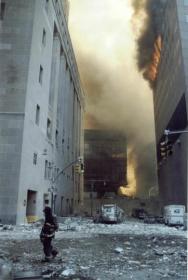
Could it be flames?
I hope this has helped.
I am going to refer to the NFPA 921: Guide for Fire and Explosion Investigations 3rd Edition.
Smoldering Fires:
Definition: Smoldering - Combustion without flame, usually with incandescence and smoke. (REF: NPFA 921, Ch 1.3.110)
Smoldering is a relatively slow combustion process that occurs between oxygen in the air and a solid fuel. No flame is present, however the presence of very hot materials is on the surface of which combustion is proceeding. The surface undergoes glowing and charring. The glowing is indicative of a temperature in excess of 1000°C. A smoldering or glowing condition can occur at any point in the fire with the controlling factor being ventilation.
Smoldering during the initial state of the fire:
All structures, objects, and open areas for the most part, have a fuel and an oxygen source available, and in many locations within, the fuel and oxygen are in the ideal proportion to begin reacting. Even though everything is ready, the combustion process cannot begin until some source of heat triggers the process. Because this process is slow, not much air (oxygen) is required, even when the surrounding environment is at a relatively low temperature. The hotter the environment, the less oxygen it takes to sustain smoldering. The replacement of air takes place naturally as the air cycles.
During the smoldering process the oxygen and fuel are not in correct proportions, thus its by-products are the result of incomplete burning. High levels of carbon monoxide (CO) are produced. More than 10% of the fuel mass is converted to CO. The smoke from this type fire tends to condense on walls, windows and other cooler surfaces. These deposits of pyrolysis products will be widely distributed and the colors vary in shades of brown. The appearance can be sticky or wet, thick or dry, or dried and resinous.
Smoldering combustion will continue because of the very high temperatures at the oxidizing surface. As long as these temperatures remain high, the process can continue even in oxygen depleted atmospheres where the oxygen levels are as low as approximately 5%. In post-fire conditions, after the fire department extinguishes the fire with water, hidden areas where the water doesn’t reach can still smolder until the water penetrates it or until the fuel source is consumed.
Diffusion Flame:
A Diffusion Flame is defined as a combustion process in which the fuel gas and oxygen are transported into the reaction zone due to concentration differences.
The vast majority of un-wanted and un-controlled fires are diffusion flames.
During a flaming fire, conditions may exist that decrease the oxygen level below 16%. This causes the combustion process to slow, the flames subside and the temperature begins to decrease.
What is visible in this picture?
Could it be flames?
I hope this has helped.


