Cont: The One Covid-19 Science and Medicine Thread Part 5

Hey hey! Looks like Robert Malone is at war with the rest of the anti-vaxx Covid cranks.

Gorski writes about how Robert Malone is now reaping the backlash for his claim to have invented the mRNA vaccine as the anti-vaxxers have finally rubbed their two brain cells together and worked out that it makes Malone a mass murderer.

You do love to see it.

Link


The Trump dilemma! You can't win them all. If you take credit for the vaccines, you risk losing the antivaxxers.
Anti-science is hard sometimes. :)
 
Correction:
To The Atheist, unless it's his own family, only disease that affects the market economy is of concern. Disease that affects people's health but doesn't lead to sick leave, i.e. time off from making money for rich people, is the only one of no concern.
 
How is it not relevant? Data takes time. The virus is still here.

Here's a recent article in Harvard Business Manager, Germany - Long Covid and the Economy - There Is Money in Prevention


I don't think The Atheist understands why it's called Long Covid!

Long COVID (LC) occurs after at least 10% of severe acute respiratory syndrome coronavirus 2 (SARS-CoV-2) infections, yet its etiology remains poorly understood. We used ‘omic” assays and serology to deeply characterize the global and SARS-CoV-2-specific immunity in the blood of individuals with clear LC and non-LC clinical trajectories, 8 months postinfection. We found that LC individuals exhibited systemic inflammation and immune dysregulation. This was evidenced by global differences in T cell subset distribution implying ongoing immune responses, as well as by sex-specific perturbations in cytolytic subsets. LC individuals displayed increased frequencies of CD4+ T cells poised to migrate to inflamed tissues and exhausted SARS-CoV-2-specific CD8+ T cells, higher levels of SARS-CoV-2 antibodies and a mis-coordination between their SARS-CoV-2-specific T and B cell responses. Our analysis suggested an improper crosstalk between the cellular and humoral adaptive immunity in LC, which can lead to immune dysregulation, inflammation and clinical symptoms associated with this debilitating condition.
Long COVID manifests with T cell dysregulation, inflammation and an uncoordinated adaptive immune response to SARS-CoV-2 (Nature Immunology, Jan 11, 2024)


The "sex-specific perturbations in cytolytic subsets" are important in this context because more women than men are diagnosed with Long Covid. This fact has been used by some people (e.g. Swedish Hanne Kjöller) to back up their claim that Long Covid is a mass psychogenic illness.
However, it is a well-known fact that:
Sex differences in immune responses result in differential susceptibility of males and females to autoimmune diseases, malignancies and infectious diseases, as well as affecting the outcome of vaccination.
Sex differences in immune responses (Nature Reviews, Immunology, Aug 22, 2016)
 
Then I'm not sure you understand what Long Covid is.

I'm not certain anyone does, so I certainly don't claim to. For starters, nobody has any idea of how many people are actually suffering from it. I see various measures mentioned, from "more than 6 weeks" to people still crook after years.

Why would, say erectile dysfunction, or anosmia, or even a 10% drop in aerobic capacity lead to work or school absenteeism?

A 10% drop in aerobic capacity definitely would in lots of manual occupations, and the 1000 employees in the study I worked on are largely manual workers. Erectile dysfunction doesn't bother me at all and I certainly wouldn't call it long covid.


You don't think erectile dysfunction or anosmia affect peoples lives?

Sure, but buy some viagra and learn not smell. I was comparing long covid to ME/CFS, which are allegedly debilitating diseases. ED and anosmia are nothings and if they're being counted as long covid, I'll rest my case.

I find Steenk's anecdotes pretty typical - people are sick for a few months. That's to be expected, and happens after 'flu and other diseases but they end and if they're not ongoing, they're not relevant. I'm sure they're unpleasant, but they're not life-changing.

Here's a recent article in Harvard Business Manager, Germany - Long Covid and the Economy - There Is Money in Prevention

:dl:

Quoting yourself as evidence. Love it.
Edited by Agatha: 
Edited to remove personalisation


Many assumptions, little hard evidence.
 
Last edited by a moderator:
I'm not certain anyone does, so I certainly don't claim to. For starters, nobody has any idea of how many people are actually suffering from it. I see various measures mentioned, from "more than 6 weeks" to people still crook after years.

Until we have agreed upon biomarkers, that's the best we can do. I'd note we don't know how many people have lots of diseases.

A 10% drop in aerobic capacity definitely would in lots of manual occupations, and the 1000 employees in the study I worked on are largely manual workers.

I'm doubtful there's many occupations outside professional sportsman where a 10% drop in aerobic capacity would lead to people going on sick leave, but I'm open to learn, so please share any evidence?

Sure, but buy some viagra and learn not smell.

Doesn't change whether they have long covid or not, does it?

I was comparing long covid to ME/CFS, which are allegedly debilitating diseases. ED and anosmia are nothings and if they're being counted as long covid, I'll rest my case.

Ansomia certainly is, as the rate is very high. A few studies have included ED.


I find Steenk's anecdotes pretty typical - people are sick for a few months. That's to be expected, and happens after 'flu and other diseases but they end and if they're not ongoing, they're not relevant. I'm sure they're unpleasant, but they're not life-changing.

Yes, post-viral syndrome happens - but at *nothing like* the rate we're seeing Long Covid. A rate that seems exceeded by only two other viruses - MERS and SARS. I say that with the proviso that we're learning a lot at present, and it's seeming increasingly likely many other issues may in fact be post-viral in nature, including so called "burnout" (may in fact be long flu) as well as so-called "diseases of ageing" like Parkinson's and Alzheimer's.

Quoting yourself as evidence. Love it.
Edited by Agatha: 
Edited to match moderated quote

The sections where I'm cited aren't really relevant to the discussion.

Here's another for you -

New data shows long Covid is keeping as many as 4 million people out of work
 
Last edited by a moderator:
I don't think The Atheist understands why it's called Long Covid!


The "sex-specific perturbations in cytolytic subsets" are important in this context because more women than men are diagnosed with Long Covid. This fact has been used by some people (e.g. Swedish Hanne Kjöller) to back up their claim that Long Covid is a mass psychogenic illness.
However, it is a well-known fact that:

This is common in regard to fibromyalgia too:

"It isn't real because it only affects women."

"One in eight sufferers are male."

"They don't count mumble mumble mumble real men mumble mumble."

As a 'real man' I'm more than happy to punch out people that say that to me.

Edited to add: These days I find that "Choose your next words very carefully." works just as well.

Thanks to whoever it was that came up with that phrase, I suspect it was Larry Niven.
 
Last edited:
Here's a recent (last month) study comparing Influenza and Covid-19 Sequalae.

Long-term outcomes following hospital admission for COVID-19 versus seasonal influenza: a cohort study
https://www.thelancet.com/journals/laninf/article/PIIS1473-3099(23)00684-9/fulltext

For this cohort study we used the health-care databases of the US Department of Veterans Affairs to analyse data from 81 280 participants admitted to hospital for COVID-19 between March 1, 2020, and June 30, 2022, and 10 985 participants admitted to hospital for seasonal influenza between Oct 1, 2015, and Feb 28, 2019. Participants were followed up for up to 18 months to comparatively evaluate risks and burdens of death, a prespecified set of 94 individual health outcomes, ten organ systems, overall burden across all organ systems, readmission, and admission to intensive care.

What I found surprising is that the morbidity of both Covid-19 and Flu was higher in the post acute timer period than the during the acute phase.

Although COVID-19 had a comparatively higher burden of health loss than seasonal influenza in both the acute and post-acute phase, both COVID-19 and seasonal influenza had a higher burden of health loss in the post-acute phase of infection compared to their respective acute phases, suggesting that hospital admission for either COVID-19 or seasonal influenza has a greater long-term impact on health than the immediately manifested health effects during the acute phase.

Some obvious limitations listed:

This study has several limitations. The study population predominantly comprised older white males and thus might not represent the general population admitted to hospital for COVID-19 and seasonal influenza, which could limit the generalisability of the findings. We evaluated risks in people admitted to hospital for COVID-19 versus those admitted to hospital for seasonal influenza; the results should not be extrapolated to those with milder infection that did not necessitate hospital admission.
 
New articles from Center for Infectious Disease Research and Policy (CIDRAP):

Emergency department visits for illnesses involving all three major respiratory viruses declined last week, but the US Centers for Disease Control and Prevention (CDC) said today that changes in holiday-related health seeking behavior may have played a role in the downward trend.
In its latest data updates today, the CDC said the bigger picture reveals that levels remain elevated or increasing across the country for flu, COVID, and respiratory syncytial virus (RSV) and that it will continue to closely track the indicators.
Though hospital occupancy remains stable, some areas are reporting local strain on facilities, fueled partly by recent increases in respiratory illnesses, the CDC noted in its latest respiratory virus snapshothttps://www.cdc.gov/respiratory-viruses/data-research/dashboard/hospital-occupancy.html.
US respiratory virus levels remain high amid possible post-holiday spike (CIDRAP, Jan 12, 2024)

A large staggered cohort study from primary care patients in the UK, Spain, and Estonia finds that COVID-19 vaccination consistently reduced the risk of long-COVID symptoms. The study is published in The Lancet Respiratory Medicine.
More evidence vaccination reduces risk of long COVID (CIDRAP, Jan 12, 2024)

Among children hospitalized for severe respiratory infections in Brazil, those who had COVID-19 were at highest risk for in-hospital death within 30 days, with underlying medical conditions a risk factor for all viral strains, finds a study published today in Pediatrics.
Federal University of Minas Gerais researchers analyzed data from the Brazilian national epidemiologic surveillance system to compare the outcomes of 235,829 children and adolescents aged 0 to 17 years hospitalized with respiratory infections from February 2020 to February 2023 in Brazil.
"The emergence of severe acute respiratory syndrome coronavirus 2 (SARS-CoV-2) in 2020 has had an evident impact on the epidemiology of acute respiratory infections worldwide, underscoring the importance of data that directly compare the burden of SARS-CoV-2 infection and other viral etiologies," the study authors wrote.
6.5% risk of death from COVID, 2.3% for flu

Risk of death 3 times higher in Brazilian kids with COVID-19 than with other respiratory viruses, study finds (CIDRAP, Jan 12, 2024)

In "No Time to Quit," Dr. Osterholm and Chris Dall discuss the JN.1 variant, Paxlovid uptake, and COVID-19 vaccine disinformation. Dr. Osterholm also provides an update on influenza and RSV transmission and shares the latest "This Week in Public Health History" segment.
No Time to Quit podcast (CIDRAP, Jan 11, 2024 - 55:42 min.)
 

2 years old and therefore irrelevant.

The data is from January 2022, with is right in the biggest peak by far of covid, when 4 million official new cases were listed every day. Given that "long covid" seems to include people who are still crook after 6 weeks, it's no surprise there were 4 million off work.

As I said to Dann, if you want to make a case for how many people are actually affected in the long term - and let's make it a genuine long term like 6 months or more - then tell me how many people are off work now due to long covid.

I'm guessing it's **** all, but sufficient to panic those who want everyone to panic.

Covid is clearly at the stage where the enormous majority of people don't care and are treating it like any other virus. The idea that the world should continue in pandemic mode is naive and stupid and only organisations holding their hand out for money are trying to keep it at pandemic status.
 
Given that "long covid" seems to include people who are still crook after 6 weeks, it's no surprise there were 4 million off work

The WHO definition, and that used by the Household Pulse survey cited in that link, is 3 months, not 6 weeks.

As I said to Dann, if you want to make a case for how many people are actually affected in the long term - and let's make it a genuine long term like 6 months or more - then tell me how many people are off work now due to long covid.

Sure, like being off work for 3 months isn't a burden to individuals or society at all, so let's try 6 months. If that has too many sufferers, shall we try 1 year or 2 years instead?

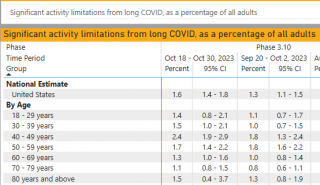
The Household Pulse survey's most recent data (US, October 2023) has more than 1 in 20 adults currently suffering Long Covid 1.6% of all adults in the country having "significant activity limitations" due to Long Covid.

And that's just the people who acknowledge having had covid - only 57% of the population, when we know it's much higher. There are likely many people with long covid who do not know it. I meet them all the time.

 
Sure, like being off work for 3 months isn't a burden to individuals or society at all,...

I like the goalpost move there. We've gone from people having long covid to them all being off work for 3 months. Nowhere do you show any numbers to support sick leave statistics, so find them and let's have a look and see how many people were off work with covid/long covid for 3 months.

... so let's try 6 months. If that has too many sufferers, shall we try 1 year or 2 years instead?

6 months is fine - as long as we're not including soft cocks and anosmia as symptoms that matter a damn.

The Household Pulse survey's most recent data (US, October 2023) has more than 1 in 20 adults currently suffering Long Covid 1.6% of all adults in the country having "significant activity limitations" due to Long Covid.

Self-described.

Doesn't add anything to the discussion from what I read.

If you ever find some reliable information on sick leave taken I'm keen to look at it.
 
It is hilarious to see The Atheist complain about a survey being based on self-described data.
Just a couple of days ago, he wrote this:
I said many months ago I was disturbed by the similarity between long covid and ME/CFS, a disease with only symptoms that no test can identify. As time has gone on, I'm sure the two diseases are in fact the same thing.


In a thread in Science, Mathematics, Medicine, and Technology, it is entirely irrelevant what The Atheist believes since he has already filled several threads with his obviously biased views in his attempts to minimize the pandemic. He doesn't actually "want to start exploring "long covid"", which is the reason why he writes Long Covid as "long covid." On the issue of Long Covid, it is thus no surprise that he would "believe the numbers have been wildly overstated."

That Atheist's claim that no test can identify ME/CFS is false:
A new blood test is highly accurate at diagnosing chronic fatigue syndrome, offering for the first time an objective way to identify the sometimes disabling condition that is estimated to affect up to 2.5 million people in the U.S.
A University of Oxford-led research team compared test results among 61 people with chronic fatigue syndrome, 21 people with multiple sclerosis, and 16 people who had no known health problems. They found that the new test is 91% accurate, according to findings published in the journal Advanced Science. The test can also differentiate between mild, moderate, and severe cases of the illness 84% of the time.
Scientists develop blood test for Chronic Fatigue Syndrome (Sep 11, 2023)


The Atheist's post doesn't have one single reference to actual facts, and it is obvious that his only interest in the theme of Long Covid is to dismiss it as an actual physiological ailment, so there is really no reason whatsoever to do anything other with the post than ignore this new attempt to minimize the pandemic.


We also have Planigale's post about diagnosing Long Covid:
FWIW my personal experience of assessing patients with long covid is most have a syndrome that is either due to mitochondrial dysfunction or autonomic neuropathy (the two aren't mutually exclusive). I slightly favour autonomic neuropathy as the predominant lesion in most people I have assessed, but except in a research situation we don't have the tests to distinguish the two in routine clinical practice*. To some extent it is irrelevant because we don't have treatments for either syndrome.

*The consequence of either are quite similar, decreased muscle efficiency, i.e. muscles do less work than you would expect for delivered oxygen.


The Atheist has ignored my post about blood tests to diagnose chronic fatigue syndrome, Planigale's post about doctors diagnosing Long Covid, and The Atheist has now dismissed a survey because it was based onself-described Long Covid patients.
I think it's time that The Atheist tells us exactly what it takes to prove that Long Covid exists as a physiological disease. At least, he should provide us with the evidence that makes him assume that assume that it is all in the head and not an actual physiological disease.

He has been busy moving the goalposts since he started the discussion about Long Covid on Jan 10 in post 248: "I want to start exploring "long covid""
It is obvious that he never wanted any such thing. He wanted to deny the existence of Long Covid and probably assumed that it would be easier for him to get away with it since he has done such a poor job of denynig that we are in the middle of an ongoing pandemic.

I'm keen to look at it.
Yeah, right!
 
Last edited:
If you ever find some reliable information on sick leave taken I'm keen to look at it.

I don't know if I'm that interested in a discussion with someone who thinks illness is irrelevant unless it's so disabling it stops you working for at least 6 months.

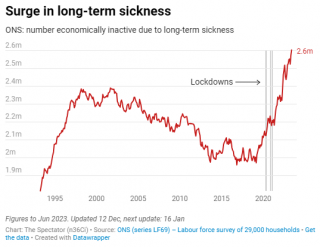
Here's some data from the UK however. Note that the UK's response to this is to make it harder to qualify, so ongoing statistics will not be comparable. Similar has happened elsewhere.

The #letitrip types are trying to blame it on "lockdown", the never ending curse and cause of everything bad in the world.

 
I don't know if I'm that interested in a discussion with someone who thinks illness is irrelevant unless it's so disabling it stops you working for at least 6 months.


That is one the goalposts The Atheist has shifted since he (re)started the discussion about Long Covid:
Claims around the number of long covid cases aren't borne out by reality. We're surrounded by claims that somewhere between 3 and 20% of covid cases result in long covid, yet if that were the case, we'd be seeing vast increases in sick leave and absenteeism, along with corresponding pressure on health systems, because pretty well everyone has had covid.


Vast increases just aren't enough when they are documented.
I assume that The Atheist will now come up with a creative definition of vast.
 
Apparently, it's not just something Long Covid patients imagine. It's not just in their heads, it's also in their bodies:

People with long COVID are likely to have immune cells showing signs of chronic inflammation and other unusual characteristics, according to a new study by scientists at the Gladstone Institutes and the University of California San Francisco (UCSF). Their findings, which appear in Nature Immunology, support the hypothesis that long COVID may involve a low-level viral persistence.

“Not every person with long COVID had these pro-inflammatory cells, but we only saw them in the long COVID group,” said Kailin Yin, PhD, postdoctoral fellow in the Roan lab and co-first author of the study. “It underscores the idea that there isn’t just one uniform thing that characterizes all individuals with long COVID.”
Omics Study Suggests Long COVID Involves Viral Persistence (Jan 12, 2024)


But you can't expect people with a few of these pro-inflammatory cells to stay home from work, can you? That's not what we pay our taxes for!
 
Full disclosure:

I was one of the first victims of Long Covid, I contracted Covid first week of March 2020 (we hosted a Malaysian couch surfer who'd literally just been in Wuhan, as well as visitors from the UK, US, and Southern Austria - where there was also a massive outbreak. Yay)

I had a relatively mild acute case, but within a few weeks it was clear there was something seriously wrong. No underlying conditions, previously very fit and healthy.

I could essentially do nothing for nearly 2 years. I had to shut down three businesses I was involved with, lay off employees, quit karate training and coaching, everything. It eventually also led to the loss of my marriage, something I've seen happen repeatedly with Long Covid (as it does with many chronic diseases)

I improved around January 2022. I don't know why or how but I'm pretty much back to normal except I can't eat some foods any more - massive GERD attacks. Legumes seem to be the main trigger, which is not particularly helpful given I'm a vegetarian ... :(

My eldest son, who turns 18 in a couple of months, got Covid in Dec 2021. He's been ill ever since, unable to even attend school since. We eventually found out there is one single distance education high school in Sweden, and got him enrolled. (home schooling is illegal here). He's getting by, but it's basically work 2-3 days, sleep 3-4 days.

For 2 years every time he had a blood test the health centre would call in a panic and tell us to take him to emergency, as he was measuring significant blood clotting. We eventually learned about the LC - POTS connection and found a specialist cardiologist and made contact. He's since - like many with Long Covid - been diagnosed with POTS and is on heart and blood pressure medicine. Without this, when he stands his feet go almost black from blood pooling within a couple of minutes. His heart rate can randomly hit 180 sitting at his desk.

He's not even 18 yet, all of his plans for his future have been destroyed by this virus. The school he attends remotely has been absolutely swamped by requests by kids who are too ill to attend normal schools. They've been desperately trying to get meetings with both the Swedish Health Department and Education department for assistance, but nobody is listening.

Kids don't get sick from Covid. Not in Sweden.

Sure.

 
Preprint and very small group:
Conclusions Our study showed that in this small sample, vaccination improved the health or resulted in no change to the health of most participants, though few experienced worsening. Vaccination was associated with increased SARS-CoV-2 Spike protein-specific IgG and T cell expansion in most individuals with Long COVID. Symptom improvement was observed in those with baseline elevated sIL-6R, while elevated interferon and neuropeptide levels were associated with a lack of improvement.
Impact of COVID-19 vaccination on symptoms and immune phenotypes in vaccine-naïve individuals with Long COVID (medRxiv, Jan 12, 2024)


It would be interesting to know if there were any differences between the groups pre-vax, cf. Planigale's distinction between patients with mitochondrial dysfunction and autonomic neuropathy.
 
People with LC show abnormalities in muscle structure:

It's estimated around 3% of people in the UK experience long COVID – persistent, long-lasting symptoms after a COVID-19 infection.
Long COVID encompasses a range of health problems that can begin after even a mild COVID infection. Some of these symptoms include extreme fatigue, shortness of breath, muscle aches and loss of smell.
For around 50% of long COVID sufferers, their symptoms also fit criteria for a diagnosis of myalgic encephalomyelitis (ME), a neuro-immune disease characterised by depleted energy, muscle weakness and pain, cognitive dysfunction and dysautonomia (which affects blood pressure and heart rate).
A cardinal feature of ME is "post-exertional malaise" (PEM). This refers to a worsening of symptoms that takes place around 24-48 hours after any form of exertion – whether that's physical, cognitive or emotional. PEM may take days or weeks to subside.
PEM remains one of the most debilitating yet least understood features of both ME and long COVID. But new research may point to a probable explanation for why physical activity in particular worsens long COVID symptoms. The study found that people with long COVID exhibit alterations in their muscle structure.
People With Long COVID Show Abnormalities in Muscle Structure (ScienceAlert, Jan 13, 2024)
 
dann People with LC show abnormalities in muscle structure:

Quote:
It's estimated around 3% of people in the UK experience long COVID – persistent, long-lasting symptoms after a COVID-19 infection.
...

You started school AFTER you stopped ******** in your pants, but that doesn't mean that you started school BECAUSE you stopped ******** in your pants.

Edited by Agatha: 
Edited for rule 10. Please do not mask or disguuise swear words (eg by replacing characters) in the public sections of the forum. Type all such words out in full, and if they are not allowed then the auto-censor will remove them.
 
Last edited by a moderator:
Here's some data from the UK however. Note that the UK's response to this is to make it harder to qualify, so ongoing statistics will not be comparable. Similar has happened elsewhere.

Ok, that's a start - ONS are reliable.

It doesn't show what I'm after but it does at least show some actual numbers. Next would be who they are and why they're not working, that's a significant percentage of Poms.

Full disclosure:

Thanks - that makes your position much more understandable.

I don't doubt some cases of long-lasting effects happen - they happen with other viruses as well and I personally know a guy of 50 who's so debilitated by post-covid infection problems that he's spent many months in hospital long after his covid infection finished. I doubt he'll live more than another few years and he was also fit and healthy previously.

The only part I doubt is the extent of it.
 

ISF - Join now!

Every member here is approved by hand. No bots, no spam, just people who care about evidence and honest debate.

Membership is free!

Create your free account

Back
Top Bottom