Cont: The One Covid-19 Science and Medicine Thread Part 5

What COVID-19 can do to the brain:

The COVID-19 virus can infect dopamine neurons in the brain and make cells lose the ability to grow. The finding may shed light on neurological symptoms of COVID, like brain fog, according to a team led by Dr. Shuibing Chen (@ChenShuibing) of @WCMSurgery.
https://bit.ly/47yH69n
Weill Cornell Medicine (X, Jan 17, 2024)


A new study reported that SARS-CoV-2, the virus that causes COVID, can infect dopamine neurons in the brain and trigger senescence—when a cell loses the ability to grow and divide. The researchers from Weill Cornell Medicine, Memorial Sloan Kettering Cancer Center and Columbia University Vagelos College of Physicians and Surgeons suggest that further research on this finding may shed light on the neurological symptoms associated with long COVID such as brain fog, lethargy and depression.

The findings, published in Cell Stem Cell on Jan. 17, show that dopamine neurons infected with SARS-CoV-2 stop working and send out chemical signals that cause inflammation. Normally, these neurons produce dopamine, a neurotransmitter that plays a role in feelings of pleasure, motivation, memory, sleep and movement. Damage to these neurons is also connected to Parkinson’s disease.
SARS-CoV-2 Can Infect Dopamine Neurons Causing Senescence (Weill Cornell Medicine, Jan 17, 2024)


Highlights
• hPSC-derived DA neurons are susceptible to SARS-CoV-2 infection
• SARS-CoV-2 infection of DA neurons triggers cellular senescence response
• Several FDA-approved drugs were identified to rescue senescence of DA neurons
• Cellular senescence was found in substantia nigra tissues of COVID-19 patients

Summary
COVID-19 patients commonly present with signs of central nervous system and/or peripheral nervous system dysfunction. Here, we show that midbrain dopamine (DA) neurons derived from human pluripotent stem cells (hPSCs) are selectively susceptible and permissive to severe acute respiratory syndrome coronavirus 2 (SARS-CoV-2) infection.
SARS-CoV-2 infection of DA neurons triggers an inflammatory and cellular senescence response. High-throughput screening in hPSC-derived DA neurons identified several FDA-approved drugs that can rescue the cellular senescence phenotype by preventing SARS-CoV-2 infection. We also identified the inflammatory and cellular senescence signature and low levels of SARS-CoV-2 transcripts in human substantia nigra tissue of COVID-19 patients. Furthermore, we observed reduced numbers of neuromelanin+ and tyrosine-hydroxylase (TH)+ DA neurons and fibers in a cohort of severe COVID-19 patients.
Our findings demonstrate that hPSC-derived DA neurons are susceptible to SARS-CoV-2, identify candidate neuroprotective drugs for COVID-19 patients, and suggest the need for careful, long-term monitoring of neurological problems in COVID-19 patients.
SARS-CoV-2 infection causes dopaminergic neuron senescence (Cell, Jan 17, 2024)


Studie afslører en ny senfølge (BT.dk, Jan 19, 2024)
 
Out today in @ScienceMagazine
"In patients with long COVID, the complement system no longer returns to its basal state but remains activated and, thus, also damages healthy body cells.
Patients with active Long Covid disease also had elevated blood levels, indicating damage to various body cells, including red blood cells, platelets, and blood vessels."
Danielle Beckman (X, Jan 19, 2024)
Immune damage in Long Covid (Science, Jan 18, 2024)

Our data suggest that active Long Covid is accompanied by a blood protein signature marked by increased complement activation and thromboinflammation, including activated platelets and markers of red blood cell lysis. Tissue injury may also be complement-mediated and, in turn, activate the complement system. Moreover, complement activation may be driven by antigen–antibody complexes, involving autoantibodies and antibodies against herpesviruses, as well as cross-talk with a dysregulated coagulation system. In addition to offering a basis for new diagnostic solutions, our work provides support for clinical research on complement modulators for patients suffering from Long Covid.
Persistent complement dysregulation with signs of thromboinflammation in active Long Covid (Science, Jan 19, 2024)
 
Eric Topol has a rundown on current Long Covid here:

https://erictopol.substack.com/p/lighting-up-long-covid

Good article covering multiple reports and areas such as CFS and neurological effects. This is one re vaccination:

Substantial Protection by Vaccination
There are new reports on the protection vs Long Covid afforded by vaccination, both in adults and children. A 3-country study from the UK, Spain and Estonia (with 4 cohorts) of more than 10 million vaccinated and 10 million unvaccinated reinforced the magnitude of protection from previous studies of 40% reduction, with the mRNA vaccines doing about 15% better than the AstraZeneca vaccine. Of note, the protection vs Long Covid was especially notable in people who were not at risk of severe Covid. Recall, the national study in Sweden published last November found an overall 58% vaccination protection, which varied according to number of doses (1-21%, 2-59%, 3-73%).
 
I had a relatively mild acute case, but within a few weeks it was clear there was something seriously wrong. No underlying conditions, previously very fit and healthy.

I could essentially do nothing for nearly 2 years. I had to shut down three businesses I was involved with, lay off employees, quit karate training and coaching, everything. It eventually also led to the loss of my marriage, something I've seen happen repeatedly with Long Covid (as it does with many chronic diseases)


Long COVID will take your health, your wealth — then it will come for your marriage (ABC.net.au, Dec 26, 2023)
 

From the link:

... perhaps 200 million people have developed long COVID ...

ABC ABCing. Hyperbolic nonsense.

Also from the link:

There's no reliable data on how prevalent long COVID is in Australia...

In other words, we have no idea, so let's pull a number out of someone's arse and run with it. Suits your style perfectly to quote total, self-admitted bollocks like that.
_________________

Meanwhile, the uber-scary JN-1 variant is waning everywhere and in a total lack of surprise, articles about pressure on hospitals and sudden rises in deaths have been almost completely absent. I know this because if there had been articles like that, a certain poster would have been spamming them across the thread and all he came up with was four (?) medical institutions in America that re-activated masking.

Get used to it - there are going to be waves, and as suggested a couple of weeks ago, the waves will continue to be less harmful.

Get your vaccine, take paxlovid if needed, otherwise, do as everyone is doing and ignore it.
 
From the link:


ABC ABCing. Hyperbolic nonsense.

Also from the link:


In other words, we have no idea, so let's pull a number out of someone's arse and run with it. Suits your style perfectly to quote total, self-admitted bollocks like that.
_________________

Meanwhile, the uber-scary JN-1 variant is waning everywhere and in a total lack of surprise, articles about pressure on hospitals and sudden rises in deaths have been almost completely absent. I know this because if there had been articles like that, a certain poster would have been spamming them across the thread and all he came up with was four (?) medical institutions in America that re-activated masking.

Get used to it - there are going to be waves, and as suggested a couple of weeks ago, the waves will continue to be less harmful.

Get your vaccine, take paxlovid if needed, otherwise, do as everyone is doing and ignore it.

If you will quote something, please do not take it out of context. Here is the whole sentence. It gives an entirely different meaning to what you imply it does. So your conclusion does not follow from the facts you present. The short answer is that many people have suffered from long COVID. It does not matter how badly you got infected, what matters is how often you get infected. If you have had COVID-19, take precautions against getting it again.
Edit. Getting long COVID does have serious consequences.

There's no reliable data on how prevalent long COVID is in Australia, though a Victorian health survey recently found 14 per cent of respondents met long COVID criteria and numerous other studies suggest it occurs in 10-20 per cent of infections, with risk increasing significantly with each reinfection.
 
Last edited:
If you will quote something, please do not take it out of context.

It's not.

They have no idea and follow it up with unsupported evidence and a wild-arse guess.

The only fact that matters is nobody can say with any kind of accuracy what the number is, and what criteria the numbers they dream up are based on.
 
It's not.

They have no idea and follow it up with unsupported evidence and a wild-arse guess.

The only fact that matters is nobody can say with any kind of accuracy what the number is, and what criteria the numbers they dream up are based on.

It does not take much googling to find out that long Covid is a serious problem. Yes, various articles give different %. The smallest number I could find was 5%. But that could be because Covid is so new. I only hope your argument is not that because different articles give different % the real answer is 0%, because that is what your post implies.

Just do not get COVID-19 several times. Long COVID-19 could knock you out for months.


Samples
https://www.aihw.gov.au/reports/covid-19/long-covid-in-australia-a-review-of-the-literature/summary

https://www.clinicallabs.com.au/about-us/patient-media-releases/long-covid-patient/
 
It does not take much googling to find out that long Covid is a serious problem. Yes, various articles give different %. The smallest number I could find was 5%.

What definition of "long covid" is being used? What severity of symptoms are counted?

But that could be because Covid is so new. I only hope your argument is not that because different articles give different % the real answer is 0%, because that is what your post implies.

I know for a fact there are cases. I'm equally certain the problem has been wildly overstated by both some parts of the media and some people in this thread.

Just do not get COVID-19 several times. Long COVID-19 could knock you out for months.

Can you point to the evidence that shows multiple infections are more likely to result in long covid?

I don't know, but it's interesting that the anecdotes in this thread - and the single case I know of - all resulted from their first infection.
 
Pretending that there have been only anecdotes about Long Covid in this thread is disingenuous.
As for, "I'm equally certain ..."
Certainty is so easy to come by once people no longer bother looking at facts.
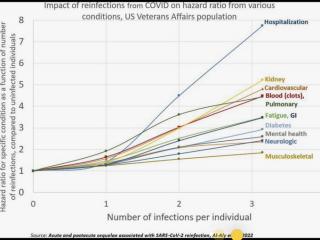
People infected multiple times with COVID-19 are more likely to develop long COVID, and most never fully recover from the condition. Those are two of the most striking findings of a comprehensive new 3-year research study of 138,000 veterans.

Second Infection Hikes Long COVID Risk: Expert Q&A (Medscape, Nov 6, 2023)
 
Last edited:
Certainty is so easy to come by once people no longer bother looking at facts.

Nice work - you post two links, both to the same study, which has an average age of 62.

That is not even slightly representative of the general population, and best of all, American veterans have a staggering obesity rate of 80%!

Good cherry-picking; worthless as evidence for the real world. We've known for years that morbidly obese people are far more likely to develop severe problems from viral diseases, so of course you ignore that and try to use it as evidence for the general population.

Genius.
 
I know for a fact there are cases. I'm equally certain the problem has been wildly overstated by both some parts of the media and some people in this thread.

There are literally hundreds of studies on this now. The low end is 10%. The high end is - well, effectively everyone.

Can you point to the evidence that shows multiple infections are more likely to result in long covid?

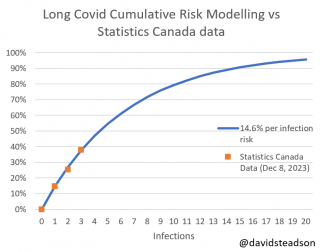
Unless the risk of LC goes to zero on a reinfection, then the cumulative risk must increase. We know it doesn't go to zero, since the majority of ne LC case now incurred it on a reinfection. The question is whether risk decreases, increases, or is roughly independent per infection.

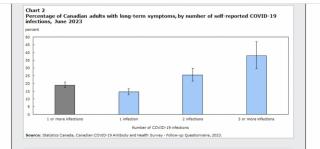
A recent Stats Canada study indicates it may be independent. There definition and analysis put the risk at just under 15% per infection.


https://t.co/RHYHSegeJu

Plug that in to cumulative risk modeling, and it matches very well.


The VA database studies (with all it's caveats) have found similar.


I don't know, but it's interesting that the anecdotes in this thread - and the single case I know of - all resulted from their first infection.

My son's was a second infection. The majority of cases nowadays are reinfections, for obvious reasons. Vaccination appears to decrease risk significantly however, as does early Paxlovid treatment.
 
Nice work - you post two links, both to the same study, which has an average age of 62.
That is not even slightly representative of the general population, and best of all, American veterans have a staggering obesity rate of 80%!
Good cherry-picking; worthless as evidence for the real world. We've known for years that morbidly obese people are far more likely to develop severe problems from viral diseases, so of course you ignore that and try to use it as evidence for the general population.
Genius.


One link was to the study. The other link to an article about the study. I don't expect some people to be able to read a study.
The USA has a staggering obesity rate of 41% "among those 60 and over, 41.0%."
That the average age is 62 shouldn't put The Atheist off since he usually claims that the vast majority of C19 deaths are in 80+.
There were 138,818 and 5,985,227 participants in the COVID-19 and noninfected control groups, respectively. The COVID-19 group had a mean age of 60.91 years (s.d.: 15.96), and 11.41% of participants were female. The control group had a mean age of 62.82 years (s.d.: 16.84), and 9.93% of participants were female.
Postacute sequelae of COVID-19 at 2 years (Nature, Aug 21, 2023)


It is not as if they took a group of fat old veterans and postulated that the result would be the same in a group of skinny teenagers or even in a group of Americans the same age with the average percentage of obesity, but The Atheist has a way of finding entirely irrelevant objections to all studies that don't support his ideas. (And not one single properly executed study does.)

Genius!
 
There are literally hundreds of studies on this now. The low end is 10%. The high end is - well, effectively everyone.

Unless the risk of LC goes to zero on a reinfection, then the cumulative risk must increase. We know it doesn't go to zero, since the majority of ne LC case now incurred it on a reinfection. The question is whether risk decreases, increases, or is roughly independent per infection.

Yep, pretty much everyone has had covid 1 or more times. CDC seropositivity data is well over 90% and 99% for kids. Given those studies, there's something going on that seems quite odd. The percent of people currently experiencing long covid has been dropping. From 7.4% 6/22 to 6.0% 6/23. About 1/4 of these have LC that significantly impacts life's activities, around 1.8% to 1.5% This doesn't make sense if re-infections are multiplying LC risk anywhere near what is reported.

https://www.cdc.gov/mmwr/volumes/72/wr/mm7232a3.htm

And oddly, the graphs in this report indicate little change in the percentage that report any prior long covid, currently active or not.

https://www.cdc.gov/mmwr/volumes/72/wr/mm7232a3.htm?s_cid=mm7232a3_w

????
 
Classic example of misinformation.

The low end is 10%?

Odd how CDC reports a falling 6%.

The fact the numbers reduced by 20% in such a short time definitely indicates the rate is decreasing and people are getting better.

Ran across this crap study that purports to elucidate long covid prevalence.

Long COVID prevalence and impact on quality of life 2 years after acute COVID-19
https://www.nature.com/articles/s41598-023-36995-4

The "study" shows prevalence of one or more long covid symptoms over 50% for each of the time periods after infection of 6 mo., 12 mo., and 24 mo.

Really?

Oh, wait. It's from a survey and only small numbers returned the survey. With smaller numbers for each of the subsequent mailings.

Among the 5,252 individuals, 900 responded to the first online survey, and 241 responded to the second online survey. Overall, 150 respondents completed all three surveys

So 3% total responded by the time they did the 24 mo. survey. And from that they believe that the respondents are even vaguely representative.

To be fair they did mention this in the "limitations" as the last item.

Furthermore, individuals exhibiting long COVID symptoms may have participated more actively in the survey, leading to a relatively high incidence of long COVID among respondents.

Ya think? Good grief. And in Nature no less.
 
Ya think? Good grief. And in Nature no less.

Nailed.

That's definitely one of the problems. People who think they have long covid have a vested interest in saying they have long covid.

Given the inability to test for diagnosis, nobody knows what the numbers are, and I'm sorry, but if the long covid consists of anosmia, I don't care and don't believe they should be counted. But they are.
 

ISF - Join now!

Every member here is approved by hand. No bots, no spam, just people who care about evidence and honest debate.

Membership is free!

Create your free account

Back
Top Bottom