Merged Discussion of femr's video data analysis

If it moves, it's in motion. I understand where you're coming from but there's no record of change in the distortion of the building.
Gotcha.


It may well be one of the "chaos of the day" events, similar to occupants of a helicopter stating that the top of WTC1 was leaning, whilst taking pretty high resolution photos of it which do not indicate any lean at all. Easy to be mistaken in such chaotic and rapidly evolving situations.
I didn't even hint that the firemen were "mistaken." I said that it doesn't surprise me that the records from the transit are unavailable to femr2 and carlitos, 11 years later. They may not have ever even existed in written form.

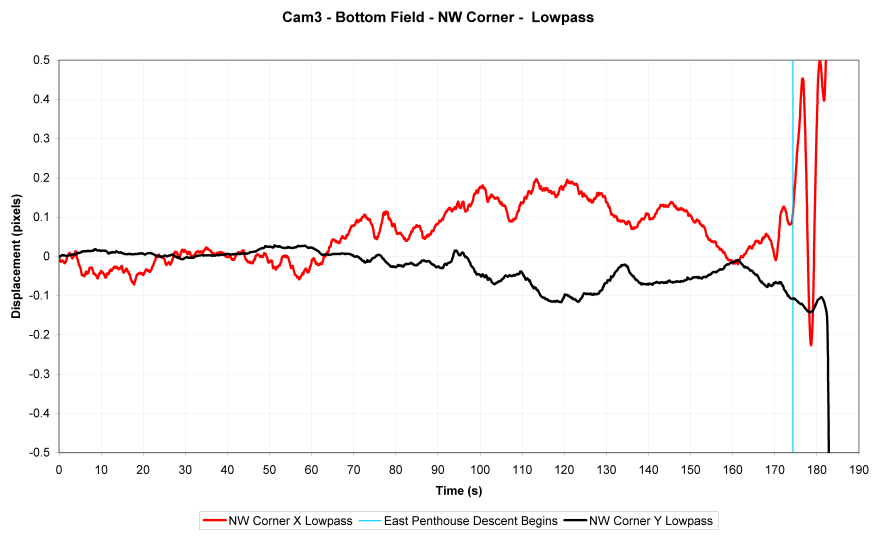
Regardless, trace data indicates a significant change in building motion behaviour roughly 2 minutes prior to release.
I'd feel better about this if you quantified your error bands, but you're probably right, given everything I've seen you post here. I don't think that anyone expects a building to just up and collapse without deforming first, and it's logical that the deformation would accelerate before the collapse.

If you're aware of any other available data which confirms early motion, great.
I'm not. Just anecdotes about the building leaning, creaking, etc. Sadly, the truthers have made google nearly useless in this regard.
 
I didn't even hint that the firemen were "mistaken." I said that it doesn't surprise me that the records from the transit are unavailable to femr2 and carlitos, 11 years later. They may not have ever even existed in written form.
I know you didn't. There may have been a bulge caused by (x), there may have been distortion of the external facade from a different reason (y). There may have been little or no bulge. There's no information to confirm or refute.

I'd feel better about this if you quantified your error bands, but you're probably right, given everything I've seen you post here. I don't think that anyone expects a building to just up and collapse without deforming first, and it's logical that the deformation would accelerate before the collapse.
Basic variance data has already been presented, being around the +/- 0.2 pixel mark. As I've said assertions are based upon change in behaviour...

This...
835427944.png

...is from footage immediately prior to...
666377698.png


In the first plot, there is clear correlation between horizontal and vertical oscillating motion.

In the second plot it can be seen that the behaviour changes significantly at the 160s mark.

Latter data in the second plot correlates with that provided by NIST using their moire method.
 
Last edited:
[qimg]http://femr2.ucoz.com/_ph/7/666377698.png[/qimg]

In the second plot it can be seen that the behaviour changes significantly at the 160s mark.
I see such a change at the 170s (or rather 168s or so) mark, not 160s.

Remember that it's your interpretations of the data what I am contending (something that both you and ozeco seem to miss often). So this kind of mistakes do you no good.

Also, can you give an error analysis for your px-to-ft conversion? The spreadsheet with the Dan Rather raw data shows a whole number of pixels and a whole number of feet. I can't find anywhere where you take that into account in your graphs and how that error influences the velocity and acceleration plots, especially the latter, and you've so far refused to do any serious error analysis.
 
I see such a change at the 170s (or rather 168s or so) mark, not 160s.
Typo...60s mark, not 160s mark. Around the 60s mark behaviour changes significantly. That is the start of significant early motion.

No idea where you're coming from with your reject 160s and replace with 168s suggestion, as there's a blatantly obvious inflexion in motion direction at the 160s mark.

Remember that it's your interpretations of the data w[t]hat I am contending (something that both you and ozeco seem to miss often). So this[ese] kind of mistakes do you no good.
LOL. Only mistake was a typo (160s typed rather that 60s). I suggest you look at your own interpretation skills. No change at the 160s mark ? :jaw-dropp

Very unlikely to take what you're saying at all seriously if you see no change in motion behaviour prior to 168s. Your interpretation of data must be "different" to mine :rolleyes:

Also, can you give an error analysis for your px-to-ft conversion?
Search the thread. Bored of repeating myself.

The spreadsheet with the Dan Rather raw data shows a whole number of pixels and a whole number of feet.
It does indeed.

I can't find anywhere where you take that into account in your graphs
Visually, not often. (Though there are a few with suggested error bands if you have a look for 'em, however, I'm not getting into the endless crap about error analysis again. tfk started to do it to his own special standards, came up with some nonsense like +/- 80ft/s (lol) then "forgot" about it)

and how that error influences the velocity and acceleration plots
Haven't done such for derivative plots. Very unlikely to do so. You're welcome to do so yourself if you feel the need. I don't. Good luck quantifying error post SG derivative ;)

you've so far refused to do any serious error analysis.
For derivative plots, correct.
 
Last edited:
In the first plot, there is clear correlation between horizontal and vertical oscillating motion.
I assume that "X" is "horizontal motion in video pixels" and "Y" is "vertical motion in video pixels" and will ask - how clear is this correlation? How did you measure this correlation? Could it all be noise?

In the second plot it can be seen that the behaviour changes significantly at the 160s mark.

Latter data in the second plot correlates with that provided by NIST using their moire method.
I don't understand your use of the silver strikethrough here. Whatever is shown at ~64 seconds looks very much like whatever is shown at ~162 seconds. Is that significant? If so, why?

I know you hate hearing this, but if you're drawing conclusions, you'd be much better served plotting and labeling your graphs in real-world measurements. Actual eastern time and feet instead of pixels.

PS - have you seen this article?
 
I assume that "X" is "horizontal motion in video pixels" and "Y" is "vertical motion in video pixels"
Correct.

and will ask - how clear is this correlation?
As clear as the graph.

How did you measure this correlation?
Measure ? I looked at the graph. Nothing complicated.

Could it all be noise?
No. Data is ~60 samples per second. First graph (very early motion) covers over 4 minutes...0ver 15000 samples. Single oscillation takes nearly all of that. Noise is at sample level.

Higher amplitude motion can be SEEN. Some of the lower amplitude motion can also be seen if observed magnified and scrubbed, but tracing with static region subtraction reveals finer detail.

And the point is that whatever noise thereis it's going to be fairly consistent over what tots up to be around 30000 samples...changes in behaviour are not caused by noise (thus me not being too bothered about others' requesting tedious and pretty pointless error analysis just for the sake of it)

I don't understand your use of the silver strikethrough here. Whatever is shown at ~64 seconds looks very much like whatever is shown at ~162 seconds. Is that significant? If so, why?
Just a typo, as my intent was to state the START of significant early motion...around the 60s mark, not the near instant inflexion in direction of both motion components at around the 160s mark. Both are significant.

I know you hate hearing this, but if you're drawing conclusions, you'd be much better served plotting and labeling your graphs in real-world measurements. Actual eastern time and feet instead of pixels.
Data for early motion is taken from cam#3 viewpoint, which would require perspective correction to translate from pixels to real-world units.

Motion vs no motion is unit independant.

And time axis translation would be subject to unacceptible synchronisation error, and would be meaningless anyway. You have a marker for EPH start, as specified by NIST (though they are not particularly accurate with that of course)

It really is more correct and appropriate to provide the data in pixels and time from start of video clip.

Yes (there are a couple of comments from me at the bottom of it May 2012) :) Credits for original single frame static smearogram has to go to the911forum member einsteen back in 2009(?) but interesting to read.
 
Last edited:
As clear as the graph.


Measure ? I looked at the graph. Nothing complicated.
All of your graphs are pictures, and I can't find your website right now. Is the data for that graph somewhere? I'd like to measure the actual correlation before commenting.

ETA - Never mind. Any lack of correlation is just error I think.

May I assume that "up" is a positive Y and "left" is a positive X?
 
Last edited:
All of your graphs are pictures
Just mine, or those from everyone else on t'planet too ? :)

May I suggest looking beyond the picture to the information represented therein ? ;)

I can't find your website right now.
Third link on googling "femr2", or...

http://femr2.ucoz.com

Is the data for that graph somewhere?
Raw cam#3 data is available at my site. (I have a more recent slightly higher quality dataset locally following sourcing the original NIST DV video files, but there's not a world of difference)

I'd like to measure the actual correlation before commenting.
For clarity, between what ?

ETA - Never mind. Any lack of correlation is just error I think.
What do you mean ?

Do you accept that the graph highlights motion behaviour change at the ~60s mark ?

May I assume that "up" is a positive Y and "left" is a positive X?
I'd need to check for the X component... generated 03-11-2010... (obviously yes for the Y component)

As highlighted to you earlier, for the purpose in hand, it doesn't matter.
 
attacking a technobabble argument

I apologize for interrupting what appears to have been a productive discussion between carlitos and femr2.

In another thread, I cited the following exchange, but ozeco41 and femr2 are disputing the factual basis for that citation. Since the exchange occurred in this thread, it seems best to review the context and technical discussion in this thread.

This exchange took place over a month ago, so I'll remind you of the context. carlitos made a sensible suggestion. ozeco41 then asked two sensible questions about that suggestion:

I think you're being facetious, but I actually suggested this (maybe a couple of years ago?) in the femr2 video thread. He's got (at least?) 2 different camera angles worth of data. In terms of analyzing the real life movement of the building(s), wouldn't it be to sync them up and look at the 3d movement? I'm not an expert on broadcast video, but I would imagine that there's a SMPTE-like code that shows real time.

An interesting idea but it seems to me to conflate two issues viz:
1) Can it be done technically; AND
2) What are the benefits.


Here's the first part of femr2's response to ozeco41's questions:

Yes, but...


With out having done so already, the pitfalls are obvious.
So far so good (although the pitfalls were less obvious to me than to femr2).

femr2 continued:

The kind of motion already extracted from videos is well sub-pixel in nature, and contains some noise.

Combining trace data from two or more viewpoints, each with their own noise sources, each with limited knowledge of exact camera location, each with...you're just ADDING noise.

You'd be MUCH better off performing an estimated perspective correction using a single viewpoint.
That first sentence ("The kind of motion already extracted...") seems okay to me, after allowing for the infelicitous phrasing we're all prone to use in these off-the-cuff posts.

That second sentence ("Combining trace data from two or more viewpoints...") is qualified by "each with limited knowledge of exact camera location", to which I will return in a moment. Stripped of that qualifying phrase, femr2's sentence denies one of the basic principles of signal processing. If you're lucky enough to have two independent but noisy time series that measured essentially the same signal, you can improve the signal-to-noise ratio by (essentially) adding those (synchronized and normalized) time series together. The signal is essentially the same for both, so adding the two time series together improves signal strength by a factor of two. The noise tends to increase also, but the noise is essentially uncorrelated so it increases by less than a factor of two. The signal-to-noise ratio improves by that factor of two divided by that number less than two.

To return to femr2's qualifying phrase: Although we don't have exact knowledge of the camera locations, we do have some knowledge. If we didn't have any knowledge of the camera locations, the "estimated perspective correction" of which femr2 spoke in the next sentence ("You'd be MUCH better off...") could not be achieved.

If our knowledge of the camera locations is good enough to achieve an "estimated perspective correction" that would be good enough to rely on the corrected form of just one time series, as femr2 advocated, then our knowledge of camera locations should be good enough to improve the signal-to-noise ratio by combining the corrected time series. Hence femr2's argument does not hold up under examination.

femr2's opinions on 2d / 3d video analysis are worthless. Silly statements like "motion already extracted from videos is well sub-pixel in nature" confirm this. One may as well say "eighth notes extracted from Charlie Parker solos are well radians per second in nature." Meaningless technobabble, designed to fool or impress the credulous.
I don't think all of femr2's opinions about 2d/3d video analysis are worthless, but the opinions femr2 expressed in the post to which carlitos was responding are indeed worthless.

carlitos appears to have been reacting to the category error in what I regard as one of the less silly sentences in femr2's post. As explained above, femr2's next two sentences were considerably sillier.

On the other hand, those two sentences were the core of femr2's argument, and they were indeed "meaningless technobabble". I also think it'd be hard to find anyone with knowledge of signal processing who'd disagree with that assessment.

Then another word for the GLOSSARY:
"technobabble" - a coded expression meaning either "I don't understand" OR "I don't want to understand" OR "I wish femr was not so explicitly clear as to his goal because I want him to have a different goal". :rolleyes:

Sort of "evaderbabble" OR "trollingbabble" but neither of those rolls of the tongue as good as techno..... :o
That was a tendentious definition of "technobabble".

tsig offered a less tendentious and more relevant definition:

Authors and others who wish to convey a feeling of technical sophistication may write or talk in technobabble. They may use jargon without considering what it actually means to give an impression that they know things that their readers or listeners do not. However, if the jargon is decoded, it becomes apparent that the originator does not really understand what has been said or is deliberately being unclear. When used in this way, technobabble is considered pretentious and often unacceptable. If used inappropriately, even novice listeners can often detect that nonsense is being spouted forth.


ozeco41 responded:

I'm aware of the accepted meanings. The point I made still stands - it is a pity those using "technobabble" here are not using the term legitimately. There is a serious topic for discussion - trivial false comments add nothing.
Contrary to ozeco41's bare assertion, carlitos was using the term legitimately. Even if carlitos had been wrong about femr2's post being technobabble, he was still using the term legitimately.

Not everything femr2 writes is technobabble. In my opinion, most of what femr2 writes here is not technobabble.

Furthermore, I'm aware that it's hard to carry on an informal discussion of technical subjects without making a few mistakes every now and then. Lapsing into technobabble is one of the mistakes we're all likely to make.

On the other hand, defending a poster's technobabble does not advance our discussion. When anyone (even so exalted a contributor as femr2) lapses into technobabble, we should be able to identify the lapse as technobabble without being accused of attacking the arguer.

When carlitos characterized femr2's argument as "meaningless technobabble", he was attacking femr2's argument, not femr2. In this particular case, carlitos was right: the argument femr2 put forth in that particular post was indeed technobabble. But this is worth repeating: Even if carlitos had been wrong about femr2's argument, he was still attacking femr2's argument. It was not a personal attack on femr2.

 
I apologize for interrupting what appears to have been a productive discussion between carlitos and femr2.
Pedantic username bolding removed.

But you just couldn't resist eh ? How very predictable.

In another thread, I cited the following exchange, but ozeco41 and femr2 are disputing the factual basis for that citation.
Correct. Your off-topic post over there is borne simply from your continuing need to (attempt and fail to) "protect" your fragile reputation by indulging in petty cat-fights with members you feel have criticised you.

Since the exchange occurred in this thread, it seems best to review the context and technical discussion in this thread.
How exciting. I'll make sure you don't distort context (your usual route to try and justify your assertions) or make your usual self-serving leaps into the irrelevant :)

This exchange took place over a month ago, so I'll remind you of the context.
And I'll correct you where your selective "context building" goes astray :)

carlitos made a sensible suggestion.
Not a particularly practical suggestion in the real world I'm afraid, as I've said, and as I'll explain to you shortly. You must also understand that the purpose of his suggestion is to generate full three dimensional data, requiring videos with significantly different viewpoints to be used. No point using Cam#3 and Dan Rather datasets...far too similar viewpoints.

His suggestion...
carlitos said:
I think you're being facetious, but I actually suggested this (maybe a couple of years ago?) in the femr2 video thread. He's got (at least?) 2 different camera angles worth of data. In terms of analyzing the real life movement of the building(s), wouldn't it be to sync them up and look at the 3d movement? I'm not an expert on broadcast video, but I would imagine that there's a SMPTE-like code that shows real time.
1) His facetious assertion is directed towards DGM, where full 3D context is determined.
2) Real life movement (in 3D) requires videos with significantly differing viewpoints.
3) Synchronising separate videos is subject to a number of different error sources.
4) Available videos do not include timecode information, nor would that negate any error source due to synchronising separate videos.

ozeco41 then asked two sensible questions about that suggestion
You assert your opinion as fact. Never a good idea. However, I have no issue with the questions from ozeco41.

So far so good (although the pitfalls were less obvious to me than to femr2).
I haven't even provided you with a full list of "pitfalls", yet :) Assumption is the mother of all...

The pitfalls are less obvious to you as you have no real experience with the specific videos on the table. The specific viewpoints. The comparative video qualities. The comparative scaling of features, etc, etc.

As is your most common personal pitfall you are speaking from a viewpoint of mathematical theory. It's different out here in the real world (especially in areas outside your comfort zone) :p

That first sentence ("The kind of motion already extracted from videos is well sub-pixel in nature, and contains some noise.") seems okay to me
And THAT single statement is what carlitos is declaring "Meaningless technobabble, designed to fool or impress the credulous.".

Not any other part of my post.

You say that "seems okay to you". Certainly not "technobabble" to YOU then ;)

That second sentence
...is not part of carlitos' asertion about "technobabble".

You're free to disagree with my viewpoint (though I should warn you to step into the real world and think about additional noise and error sources before you continue to waffle) but you understand every word of what I'm saying.

Technobabble ? Nah.

If you're lucky enough to have two independent but noisy time series that measured essentially the same signal
Which is where you start digging yourself a hole.

Could you tell me exactly which two videos will result in suitable three dimensional data being extractable ?

Could you tell me how you will synchronise those videos, and how you will eliminate error in that process ?

Could you tell me how you will confirm framerate synchronisation and eliminate error in that process ?

Could you tell me how you will match dimensions between video and how you will eliminate error in that process ?

Could you tell me how you will determine camera location accurately such that either or both perspective corrections don't end up skewing resultant data and how you will eliminate error in that process ?

Could you tell me how you will account for large differences in camera distance from WTC7 resulting in significant difference in effective resolution between datasets (WTC7 much "bigger" in one video than the other).

I could continue.

Now, given the partial list of additional noise sources you've not considered sitting within your spherical cow, would you care to quantify the error ?

Do you think it will improve data which already has sub-pixel accuracy ?

I don't.

I think the process would simply add noise and error to the data.

If you disagree, fine. Before you say "wrong" get busy and do it.

the opinions femr2 expressed in the post to which carlitos was responding are indeed worthless.
Nope.

Slightly condensed discussion for reference...

DGM said:
Ten years from now when someone figures out how to combine all videos into one in 3d. Is your data then no good?
carlitos said:
I think you're being facetious, but I actually suggested this (maybe a couple of years ago?) in the femr2 video thread. He's got (at least?) 2 different camera angles worth of data. In terms of analyzing the real life movement of the building(s), wouldn't it be to sync them up and look at the 3d movement? I'm not an expert on broadcast video, but I would imagine that there's a SMPTE-like code that shows real time.
ozeco41 said:
1) Can it be done technically; AND
2) What are the benefits.
femr2 said:
Yes, but...

With out having done so already, the pitfalls are obvious.

The kind of motion already extracted from videos is well sub-pixel in nature, and contains some noise.

Combining trace data from two or more viewpoints, each with their own noise sources, each with limited knowledge of exact camera location, each with...you're just ADDING noise.

You'd be MUCH better off performing an estimated perspective correction using a single viewpoint.

Neither methods are going to make an awful lot of difference to the level of detail that comes out of such analysis.

Certainly by the time we arrive at acceleration data there is little point asserting much beyond trend and general magnitude.
carlitos said:
The "benefits" of any analysis would be based on an evaluation of how said analysis contributes to the goal of such analysis. As there is no goal, it's impossible to gauge the benefits of the analysis.

femr2's opinions on 2d / 3d video analysis are worthless. Silly statements like "motion already extracted from videos is well sub-pixel in nature" confirm this. One may as well say "eighth notes extracted from Charlie Parker solos are well radians per second in nature." Meaningless technobabble, designed to fool or impress the credulous.
femr2 said:
The blatantly obvious goal would be to attempt improvement in vertical motion data quality or accuracy, obviously. I'm not aware of anyone, including me, who actually wants to know the specific direction of any non-vertical motion that would be separable by generation of such four dimensional data.

As I've said, I think it likely performing such would decrease data quality and accuracy, not improve it.

It would appear you simply do not understand what I'm saying, or why.

What part of my statement do you not understand ?
carlitos said:
I understand it just fine, and your edit helps. It's just a meaningless statement.
femr2 said:
Again, would you like me to explain ?
carlitos said:
Meaningless technobabble.

The kind of thirty-second notes extracted from Charlie Parker solos are well Hertz in nature.

And they contain some noise. Beautiful noise.
femr2 said:
As I said...

The kind of motion already extracted from videos is well sub-pixel in nature, and contains some noise.

The result of determining full three dimensional position (in other words correcting for perspective) for the trace data in question would be very minor, and an almost linear deskew. As the fidelity of the data is already sub-pixel, and the Dan Rather viewpoint is almost orthogonal, the resultant change to derived acceleration trend plots would also be minor. Perhaps a slight change in magnitude, and that's about it.

If you don't understand, take offers to explain to you in more detail.

Calling my statement "Meaningless technobabble" does you no favours.
carlitos said:
More technobabble. Good luck with this.


Stick to the theory W.D.Clinger. You'll ruin your public profile otherwise.
 
Pedantic username bolding removed.

But you just couldn't resist eh ? How very predictable.

Personally I think this is helpful. Odd you see it as pedantic. I do it because in this medium people can forget who the players actually are. If i was only skimming I might have missed my name mentioned by you. Could you bold in the future? :D


Not a particularly practical suggestion in the real world I'm afraid,

But, the only way to bring the data to the real world. ;)

No point using Cam#3 and Dan Rather datasets...far too similar viewpoints.

But, wouldn't the fact they are from a different view point be enough?

I see how the sub-pixel resolution would be fine with tracking movements in a 2d environment but the data can't be translated to real world at that same resolution because of the lack of the third plane. Correct?

This I believe is why people (and myself) have asked for a margin of error as it relates to the real world movement. You know, pixels to real world building feet.
 
A quick note on "technobabble"...

W.D.Clinger seems to support carlitos' quote from the wikipedia definition. Coooool :)

Here's the prior paragraph there...

Technobabble (a portmanteau of technology and babble), also called technospeak, is a form of prose using jargon, buzzwords, esoteric language, specialized technical terms, or technical slang that is incomprehensible to the listener. Various fields of practice and industry have their own specialized vocabularies (jargon) that allow those educated within that industry to concisely convey ideas that may be confusing, misleading, or nonsensical to an outside listener. So while a lay person listening to a discussion of a current research topic in mathematics may describe it as technobabble, to the mathematician, it is completely comprehensible and thus not technobabble. The key differentiator is the point of view of the listener. Technobabble can be used dishonestly to give an impression of plausibility through mystification, misdirection, and obfuscation.

...and the statement carlitos brands as "technobabble" :) ...

The kind of motion already extracted from videos is well sub-pixel in nature, and contains some noise.

The volume of subsequent discussion from such a non-mystical, non-misdirecting, non-obfuscating statement containing no jargon, buzzwords, specialised technical terms or technical slang not specifically common and well understood by anyone participating in regular discussion within this thread...is well funny :)
 
But, wouldn't the fact they are from a different view point be enough?
Enough to achieve what ?

I see how the sub-pixel resolution would be fine with tracking movements in a 2d environment but the data can't be translated to real world at that same resolution because of the lack of the third plane. Correct?
What do you mean by "real world" ?

This I believe is why people (and myself) have asked for a margin of error as it relates to the real world movement. You know, pixels to real world building feet.
Has already been provided within this thread.
 
Enough to achieve what ?

A 3d model. More accurate representation of a point on the building.


What do you mean by "real world" ?

The one we live in. :)


Has already been provided within this thread.

In the 2 dimensional plane. I'm referring to actual building movement. If I missed where you did this, maybe you could point it out. :)
 
A 3d model.
Surely you mean three dimensional feature position trace data, specifically in this context being data about motion of the NW corner of WTC7 in three dimensions ?

More accurate representation of a point on the building.
Given the partial list of additional noise and error sources I've listed above for W.D.Clinger's delectation, would you agree that it is likely that attempting to utilise multiple viewpoint video trace data to calculate pseudo three dimensional position will reduce accuracy of the relevant metrics (vertical displacement, velocity, acceleration of the NW corner of WTC7) rather than improve such ?

If not, why not ?

Start here for your other requests.
 
Which is where you start digging yourself a hole.

Could you tell me exactly which two videos will result in suitable three dimensional data being extractable ?

Could you tell me how you will synchronise those videos, and how you will eliminate error in that process ?

Could you tell me how you will confirm framerate synchronisation and eliminate error in that process ?

Could you tell me how you will match dimensions between video and how you will eliminate error in that process ?

Could you tell me how you will determine camera location accurately such that either or both perspective corrections don't end up skewing resultant data and how you will eliminate error in that process ?

Could you tell me how you will account for large differences in camera distance from WTC7 resulting in significant difference in effective resolution between datasets (WTC7 much "bigger" in one video than the other).

I could continue.
The repetitive "...eliminate error in that process ?" is a technobabble straw man. If femr2 understood video analysis, he wouldn't be acting as though it were ever possible to eliminate error.

All but the first of femr2's questions have essentially the same answer: You start with reasonable estimates and do the best you can to refine them. The fine adjustments can use various mathematical techniques, such as minimizing the sum of squared differences between signals inferred from the two time series.

Minimizing the sum of squared differences is the basis of Savitzky-Golay smoothing. I'm not sure why femr2 would feign ignorance of such techniques.

Now, given the partial list of additional noise sources you've not considered sitting within your spherical cow, would you care to quantify the error ?

Do you think it will improve data which already has sub-pixel accuracy ?

I don't.
Although we could probably improve upon the accuracy of femr2's data by employing the techniques femr2 derides, I don't see the point. Even NIST's data were accurate enough for their purposes. So far as I know, no one here has stated a real purpose for which femr2's data would be inadequate.

That does not excuse the vacuity of femr2's video analysis, nor does it excuse femr2's technobabble.

I think the process would simply add noise and error to the data.

If you disagree, fine. Before you say "wrong" get busy and do it.
Why should I do it? Deliberately pointless video analysis is femr2's hobby, not mine.

I prefer my own pointless hobbies.
 
Surely you mean three dimensional feature position trace data, specifically in this context being data about motion of the NW corner of WTC7 in three dimensions ?

Sure, let's go with that. Personally I like real world. ;)


Given the partial list of additional noise and error sources I've listed above for W.D.Clinger's delectation, would you agree that it is likely that attempting to utilise multiple viewpoint video trace data to calculate pseudo three dimensional position will reduce accuracy of the relevant metrics (vertical displacement, velocity, acceleration of the NW corner of WTC7) rather than improve such ?

Wouldn't it be easier to just say you can't track a point in space with the video at your disposal?

I know this is all pointless so I'm going to leave it here. You track and plot movement of points in a video of 9/11. Take that for what it is. :)
 
Last edited:
The repetitive "...eliminate error in that process ?" is a technobabble straw man. If femr2 understood video analysis, he wouldn't be acting as though it were ever possible to eliminate error.
ROFL. What on earth makes you think I'm suggesting such error can be eliminated ?

That it can't is exactly my point.

A whole series of additional sources or error you hadn't bothered to consider (or were incapable of identifying)...some of which are in whole pixels...which does sub-pixel accurate relative motion data no good at all, innit :)

Exactly some of the reasons why I said...

"Combining trace data from two or more viewpoints, each with their own noise sources, each with limited knowledge of exact camera location, each with...you're just ADDING noise."

Any of this sinking in yet ? :rolleyes:

All but the first of femr2's questions have essentially the same answer: You start with reasonable estimates and do the best you can to refine them. The fine adjustments can use various mathematical techniques, such as minimizing the sum of squared differences between signals inferred from the two time series.
And now you're distracting from your assertions about "technobabble".

By the process of combining multiple viewpoint trace data (taking account of the actual footage available)...do you end up reducing or increasing error ? :rolleyes:

Exactly how were you going to deal with propogation of uncertainty ? :D

Minimizing the sum of squared differences is the basis of Savitzky-Golay smoothing. I'm not sure why femr2 would feign ignorance of such techniques.
ROFL. Exactly where am I doing such ? Inventing your own arguments is really funny.

Although we could probably improve upon the accuracy of femr2's data by employing the techniques femr2 derides
ROFL. Where am I deriding a particular technique ? What techniques of resolving three dimensional position from multiple viewpoint data have been mentioned in this recent discussion ? :rolleyes:

Choosing to dig yourself a deeper hole is never a good idea. Your more appropriate response should be of the form "oh, yes, lots of additional noise and error sources I hadn't considered. I see what you mean femr2" :D
 
Last edited:
Wouldn't it be easier to just say you can't track a point in space with the video at your disposal?
Because you could generate three dimensional data. The problem is that you'd be adding a whole series of noise and error sources along the way, and given that the only identified purpose of doing so would be to increase accuracy of vertical component information...
 
Because you could generate three dimensional data. The problem is that you'd be adding a whole series of noise and error sources along the way, and given that the only identified purpose of doing so would be to increase accuracy of vertical component information...
Wouldn't this information be useful in computing what the margin of error is in the vertical component?

I didn't see in the post you linked how you did this.
 

ISF - Join now!

Every member here is approved by hand. No bots, no spam, just people who care about evidence and honest debate.

Membership is free!

Create your free account

Back
Top Bottom