
The General Theory of Stellar Metamorphosis

jeffreyw: Ignorance about what his fantasies actually predict about all planets

I wrote a paper on the predicted abundances of Neptunes here, according to stellar metamorphosis theory:
6 June 2017 jeffreyw: Ignorance about what his fantasies actually predict about all planets.
So what does a fantasy that everything in the Solar System are old stars mean? It means that the Solar System cannot exist :jaw-dropp!

The formation of planets and other bodies with the Sun means that there are physical mechanisms for the planets
  • have nearly circular orbits,
  • that are in nearly the same plane,
  • and are in the same directions,
  • to have the observed sizes from rocky planets close to the Sun to gas giants further out.
  • And the billions of other bodies (asteroids, comets, Kuiper belt objects, Oort cloud objects) to have their orbits.
That the Sun captured millions of other "stars" (just for planets and asteroids) and they all happened to form orbits in nearly the same plane and direction is delusional.
 
Ocean worlds

I watched the latest(?) video. And its very weird...I dont understand, he shows a chart of a star going from large to small apparently displaying different temperature scale in color aswell which seems to just loop around :S and in the end makes the claim that stars shrink into planets with water around :S Does he ever explain how that water was made? ) I dont think so..)

Yes, I explain how the water is made. The hydrogen combines with the oxygen in the star in an exothermic reaction.

Stellar metamorphosis posits that in order for water oceans to be formed many types of exothermic reactions, including plasma recombination, condensation and chemical synthesis reactions (including double-replacement and single replacement reactions, i.e. the mixing of acids and bases) must take place first. This means the hypothesis of comets seeding water oceans is unnecessary. It follows that since water forms on the star as it cools and dies, another principle can be attributed which follows as well under the so-called astrochemical principle,

"Stars form their water oceans as a by-product of their evolution."

http://vixra.org/pdf/1607.0440v1.pdf

http://www.vixra.org/pdf/1408.0168v1.pdf

Paper was written in 2014.

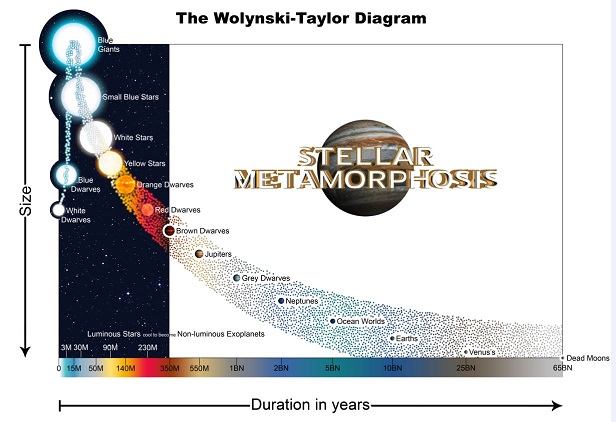
Ocean worlds are the stage of a star's evolution right after the Neptune stages. They are between Earths and Neptunes.

snip.JPG


They are predicted via stellar metamorphosis to be quite common. Examining the graph closer, you will also see that some ocean worlds are bigger than Neptunes and some are smaller than Earths. It just depends on how much matter is lost via being close to a host, or evolving over much longer periods of time so that the water formation can happen in larger amounts.

Establishment dogma has no mechanism to form water oceans, they just say comets seed oceans.
 
In stellar metamorphosis Neptune is also a star. It is a very late stage star. Of course the nebular hypothesis predicted that Neptunes would be rare, but they are not rare, they are very common.

Hello jefferyw,
Could you please state a source where the conventional mainstream model of stellar and planetary formation says that Neptune size bodies would be rare?

Thank you
 
Yes, I explain how the water is made. The hydrogen combines with the oxygen in the star in an exothermic reaction.

Stellar metamorphosis posits that in order for water oceans to be formed many types of exothermic reactions, including plasma recombination, condensation and chemical synthesis reactions (including double-replacement and single replacement reactions, i.e. the mixing of acids and bases) must take place first. This means the hypothesis of comets seeding water oceans is unnecessary. It follows that since water forms on the star as it cools and dies, another principle can be attributed which follows as well under the so-called astrochemical principle,

"Stars form their water oceans as a by-product of their evolution."

http://vixra.org/pdf/1607.0440v1.pdf

http://www.vixra.org/pdf/1408.0168v1.pdf

Paper was written in 2014.

Ocean worlds are the stage of a star's evolution right after the Neptune stages. They are between Earths and Neptunes.

[qimg]https://1.bp.blogspot.com/-Fa-snj_YZxc/WMGzhbALqBI/AAAAAAAAAYg/ks__VdicI0M1UWM1bCJz_jCehk_fv6_DwCLcB/s1600/snip.JPG[/qimg]

They are predicted via stellar metamorphosis to be quite common. Examining the graph closer, you will also see that some ocean worlds are bigger than Neptunes and some are smaller than Earths. It just depends on how much matter is lost via being close to a host, or evolving over much longer periods of time so that the water formation can happen in larger amounts.

Establishment dogma has no mechanism to form water oceans, they just say comets seed oceans.

No.
 
jeffreyw: Ignorant delusion of water being created in stars

Yes, I explain how the water is made. The hydrogen combines with the oxygen in the star in an exothermic reaction.
8 June 2017 jeffreyw: Ignorant delusion of water being created in stars at temperatures of 1000s of degrees.

Time to emphasize the long list of completely ignorant delusions that have been posted here by him:
jeffreyw: 87 items of ignorance and delusion since 15th January 2015 :eye-poppi!
  1. 11 April 2017 jeffreyw: A delusion that an ignorant, deluded PDF uploaded on a web site is a valid paper!
  2. 11 April 2017 jeffreyw: lies about working science that does predict the "differentiation, atmosphere and biological presence of material" of exoplanets.
  3. 18 April 2017 jeffreyw: A couple of abysmally ignorant delusions about stars (vapor deposition and condensation in plasma :eek:!).
  4. 23 May 2017 jeffreyw: Ignorant fantasy about meteors from worlds being destroyed based on the planets are stars delusion.
  5. 23 May 2017 jeffreyw: His lying cartoon pops up yet again.
  6. 23 May 2017 jeffreyw: The fantasy that people reading PDFs means that his delusions are supported (I have read the delusions in his PDFs!).
  7. 23 May 2017 jeffreyw: The "censored by academics" paranoia displayed so often by cranks
  8. 23 May 2017 jeffreyw: Adding more fantasies to a cartoon to support a delusion does not make less delusional.
  9. 23 May 2017 jeffreyw: Labeling science as "establishment dogma" just emphasizes the depth of your denial of the real world.
  10. 23 May 2017 jeffreyw: A lying cartoon about Walter Baade's work who defined Population I and II stars.
  11. 23 May 2017 jeffreyw: Repeats ignorance about Population I and II stars.
  12. 23 May 2017 jeffreyw: A delusion of stars being "mostly solid with iron cores".
  13. 23 May 2017 jeffreyw: Links to another ignorant and deluded crank PDF on vixra
  14. 23 May 2017 jeffreyw: A crank PDF demanding that astronomers should not classify stars does not mean anything.
  15. 23 May 2017 jeffreyw: A crank PDF being paranoid about a "1,600 Kelvin gap".
  16. 24 May 2017 jeffreyw: Delusion and ignorance about stars and conservation of energy.
  17. 24 May 2017 jeffreyw: Cannot understand the simple English of "not detected"!
  18. 24 May 2017 jeffreyw: Lie about data being ignored + fantasies about Kepler data.
  19. 24 May 2017 jeffreyw: A lie that conservation of energy and mass is ignored in astronomy.
  20. 24 May 2017 jeffreyw: Massive ignorance of planetary science which has models of planets!
  21. 24 May 2017 jeffreyw: More "evolve" delusion + ignorance of planetary science + hypocrisy.
  22. 24 May 2017 jeffreyw: Knows that the measured age of the Earth matches the Sun and lies about it!
  23. 31 May 2017 jeffreyw: An ignorant and deluded abstract about stars and hydrocarbons
  24. 6 June 2017 jeffreyw: The delusion that Neptune is a star and lies about the nebular hypothesis, etc.
  25. 6 June 2017 jeffreyw: Ignorance about what his fantasies actually predict about all planets.
 
jeffreyw: Repeat of the "establishment dogma" lie

Establishment dogma has no mechanism to form water oceans, they just say comets seed oceans.
8 June 2017 jeffreyw: Repeat of the "establishment dogma" lie.
8 June 2017 jeffreyw: Lies about astronomy not having mechanisms to explain water oceans - one is seeding by comets!

This is really simple. Comets have a lot of water. Comets hit planets. This is especially true in the early solar system (see Late Heavy Bombardment). Thus planets can gain water from comets :jaw-dropp! However this is unlikely for Earth since the isotopes of cometary water differ from terrestrial water. More likely is water-rich meteoroids.

8 June 2017 jeffreyw: Ignorance about the possible origins of water for oceans (it is not only comets).
Origin of water on Earth

jeffreyw: 112 items of ignorance and delusion since 15th January 2015 :eye-poppi!
  1. 8 June 2017 jeffreyw: Ignorant delusion of water being created in stars at temperatures of 1000s of degrees.
 
jeffreyw: A fantasy ("prediction") that is wrong - we have not detected ocean worlds

They are predicted via stellar metamorphosis to be quite common.
8 June 2017 jeffreyw: A fantasy ("prediction") that is wrong - we have not detected any ocean worlds.
As of 1 June 2017, there have been 3,610 exoplanets detected. None have been identified as ocean planets. There are only 2 possible candidates. Even if they are both confirmed to be water planets, 2 out of 3,610 is not common :eek:!
 
Last edited:
jeffreyw: An ignorant fantasy based on the solved angular momentum problem

From another thread, more ignorance from jeffreyw leads to another fantasy: The angular momentum problem, by itself, falsifies the nebular hypothesis and all variants.

Angular momentum problem (has multiple issues though)
The angular momentum problem is a problem in astrophysics identified by Leon Mestel in 1965.[1]

It was found that the angular momentum of a protoplanetary disk is misappropriated when compared to models during stellar birth. The Sun and other stars are predicted by models to be rotating considerably faster than they actually are. The Sun, for example, only accounts for about 0.3 percent of the total angular momentum of the Solar System while about 60% is attributed to Jupiter.
The reference is Losing spin: the angular momentum problem (01 October 2012) which is an explanation of the solution to the "problem" :eek:!
  • From cloud to core
    As realized by Mestel and Spitzer many years ago (Spitzer 1968), magnetic forces when coupled to gravity can play a leading role in removing angular momentum from a cloud as it condenses.
  • A problem shared is a problem halved
    Simulations show that cores naturally split up into self-gravitating sub-units, in other words they form double, triple and higher-order systems. Obviously such systems can contain large amounts of angular momentum in orbital motions.
  • And what can the disc do?
    ... The net result, somewhat ironically, is that the star is prevented from rotating faster as a result of accreting matter. In total contrast, weak-line T Tauri stars are free to rotate as they contract towards the main sequence, and in doing so spin faster!
  • Losing spin in middle age
    Basically that the spin of formation need not be retained by a star.
16 June 2017 jeffreyw: Ignorance of the solved angular momentum problem leads to a fantasy about the nebular hypothesis being falsified.
 
Last edited:
Hello jefferyw,
Could you please state a source where the conventional mainstream model of stellar and planetary formation says that Neptune size bodies would be rare?

Thank you

Scroll down. http://news.nationalgeographic.com/news/2011/02/110222-planets-formation-theory-busted-earth-science-space/

It is implication #3, and unmistakable in wording.

They state that Neptune/Uranus should be rare because migration speed is proportional to the mass of the planet. Objects between the masses of 3-15 times Earth would be consumed by their host star inside of the disk theory of their formation.

Since objects between 3-15 Earth masses are very, very common, then it means the theory has struck out.

Mind you, this article was published Feb 22, 2011, almost a whole 7 months before I made the discovery that stellar evolution is planet formation. So it is pretty wild. I honestly never knew their methods/theories/models for forming planets were incompatible with observations. So one should wonder, if I had been trying to SOLVE the mystery of planet formation trying to use their theories/models/methods I would have been S.O.L.

Fact is, if I was an educated astrophysicist, I would have never solved the mystery of planet formation/stellar evolution. I only have physics, chemistry, biology, calculus and geology courses under my belt. No astrophysics.

Their tunnel vision is getting the best of them, they needed to zoom out and question their fundamental assumptions. All the objects in our solar system were never related by formation mechanism. They only appear to be so because they are in similar orbital plane. Looking at their (Neptune/Uranus) axis of rotations should have made them seriously consider the validity and accuracy of their assumptions though, from the very beginning. Not only that, but they should have also looked at the history of the protoplanetary disk/nebular hypothesis to see that it was already falsified back in the early 20th century, when astronomers realized fully that the nebular disks were entire galaxies, and not local phenomenon (new solar systems).

So much for history. Astronomers/astrophysicists these days are not well-rounded. If they would spend more time studying history of science/astronomy they would see what I see.
 

Here is a paper called, "Neptune is a Star"

http://vixra.org/abs/1706.0002

Here is a paper called, "Uranus is a Star"

http://vixra.org/pdf/1706.0194v1.pdf

Creating different sized Earths in Stellar Metamorphosis, the TRAPPIST-1 System

http://vixra.org/pdf/1706.0365v1.pdf

The black box is where the TRAPPIST-1 objects are located. Some can be much older than others. They did not all form around the red dwarf they currently orbit, that is clearly a much younger star according to stellar metamorphosis.
 
You do understand that the article is pointing out that those theories are flawed and don't match observational data? Science learns as more information becomes available. Your pet ramblings won't ever be anything but pet ramblings.
 
Scroll down. http://news.nationalgeographic.com/news/2011/02/110222-planets-formation-theory-busted-earth-science-space/

It is implication #3, and unmistakable in wording.

They state that Neptune/Uranus should be rare because migration speed is proportional to the mass of the planet. Objects between the masses of 3-15 times Earth would be consumed by their host star inside of the disk theory of their formation.

Since objects between 3-15 Earth masses are very, very common, then it means the theory has struck out.

Mind you, this article was published Feb 22, 2011, almost a whole 7 months before I made the discovery that stellar evolution is planet formation. So it is pretty wild. I honestly never knew their methods/theories/models for forming planets were incompatible with observations. So one should wonder, if I had been trying to SOLVE the mystery of planet formation trying to use their theories/models/methods I would have been S.O.L.

Fact is, if I was an educated astrophysicist, I would have never solved the mystery of planet formation/stellar evolution. I only have physics, chemistry, biology, calculus and geology courses under my belt. No astrophysics.

Their tunnel vision is getting the best of them, they needed to zoom out and question their fundamental assumptions. All the objects in our solar system were never related by formation mechanism. They only appear to be so because they are in similar orbital plane. Looking at their (Neptune/Uranus) axis of rotations should have made them seriously consider the validity and accuracy of their assumptions though, from the very beginning. Not only that, but they should have also looked at the history of the protoplanetary disk/nebular hypothesis to see that it was already falsified back in the early 20th century, when astronomers realized fully that the nebular disks were entire galaxies, and not local phenomenon (new solar systems).

So much for history. Astronomers/astrophysicists these days are not well-rounded. If they would spend more time studying history of science/astronomy they would see what I see.

"Not well rounded" Jeffery please avail yourself to astrophysics community, they desperately need your help. Oy vey!!!!
 
jeffreyw: A lie that "objects between 3-15 Earth masses are very, very common"

Read what you cite:
Theories of gas drag also say that planets between three times Earth's mass and Jupiter's mass should be relatively rare.
The nebular hypothesis is not spelt "Theories of gas drag" :p!

19 June 2017 jeffreyw: A lie that "objects between 3-15 Earth masses are very, very common".
The article was written in 2011 so these objects were the most common exoplanets as in 2011.
Based on what planet-hunters are finding, though, UC Berkeley's Marcy argues that there are too many Neptune-size worlds for theory to be right. (See "Six New Planets: Mini-Neptunes Found Around Sunlike Star.")

The size range where there should be the fewest planets—3 to 15 times the size of Earth—are actually the most common. Planets substantially smaller than this are still too hard to detect for accurate statistics.

"Theory has struck out," Marcy said last month at a meeting of the American Astronomical Society in Seattle, Washington.
The theory being gas drag. Back in 2011 (there were 2 more years of observations from Kepler alone), the most common mass of exoplanets was 3 to 15 times the size of Earth.
The conclusion is that there are already known mechanisms other than gas drag[ that have more influence than thought before.
Marcy thinks part of the problem is that theoreticians have paid too much attention to interactions with gas and dust and not enough attention to interactions between planets.

"This might be the dominant source of migrations, slingshot[ing] them into eccentric orbits and high inclinations," he said.
 
Last edited:
jeffreyw: A deluded "Neptune is a Star" PDF on a PDF upload web site

Here is a paper called, "Neptune is a Star"...
19 June 2017 jeffreyw: A deluded "Neptune is a Star" PDF on a PDF upload web site.
19 June 2017 jeffreyw: A deluded "Uranus is a Star" PDF on a PDF upload web site.
19 June 2017 jeffreyw: A deluded, lying "TRAPPIST-1" PDF on a PDF upload web site.
This is the real TRAPPIST-1 system. The PDF contains no prediction that matches the different sizes of the TRAPPIST-1 planets and so lies. The PDF is a delusion that the size of a planet is determined by how much atmosphere it retains. The further away, the larger the planet. A glance at the masses and sizes of the planets shows that the delusion does not match reality, e.g. TRAPPIST-1c is heavier than TRAPPIST-1b but the masses of the next 2 planets decrease with distance. TRAPPIST-1h is the outermost planet and the lightest :eek:! There is a similar variation in planetary sizes.
 
Last edited:
jeffreyw: Ignorance - "nebular disks" are galaxies not stellar systems in formation

Not only that, but they should have also looked at the history of the protoplanetary disk/nebular hypothesis to see that it was already falsified back in the early 20th century, when astronomers realized fully that the nebular disks were entire galaxies, and not local phenomenon (new solar systems).
19 June 2017 jeffreyw: Abysmal ignorance about astronomy -"nebular disks" are galaxies outside of the Milky Way, not stellar systems in formation inside of the Milky Way :eye-poppi!

Astronomers have known about the different types of nebulae for centuries.
Galaxy - Distinction from other nebulae. It was in 1750 that it was first suggested that "some of the nebulae visible in the night sky might be separate Milky Ways". Immanuel Kant (who suggested that the other nebulae could be stellar systems in formation) named these types of nebular "Island Universes" in 1755.
 
Last edited:
"Not well rounded" Jeffery please avail yourself to astrophysics community, they desperately need your help. Oy vey!!!!

I've been trying to tell them. The main paper has 3,024 unique I.P. downloads so there has to be something happening. But really, I've been reading the Structure of Scientific Revolutions by Thomas Kuhn, and I wholeheartedly agree that the new paradigm that I am working on is already in "normal science" mode, and it is incommensurable, to the outdated paradigm full of counterinstances.

The main incommensurability is in the definitions of the words offered. For instance to the dogma, all stars shine in the visible spectrum. If it doesn't shine then it cannot possibly be a "star". Yet, according to the law of conservation of mass and energy, if something loses mass and energy, as do stars, then they will be less massive and less energetic.

Therefore we should expect the evolved stars to be less massive and less energetic, to the point that they no longer shine and are very small. This is very straight forward, though incommensurable. I have now defined stars that are "alive" and still evolving via chemical equilibrium. When I say "star" I mean all stages of a star, even dead ones such as Mercury. When astronomers say "star" they think objects that shine in the visible spectrum. We will talk past one another. This is partly due to them not being well-rounded and ignoring history of these types of paradigm shifts.

Stellar evolution (planet formation) is now defined in terms of chemistry, which has never been done before. It is also only natural to define planet formation as centered on the central science, chemistry. Without mentioning large scale chemical principles in reference to the old stars (which contain vast amounts of chemicals), then the theories/models used to explain the processes concerning their formation are misguided at best.

So in short, all stars can now be defined appropriately, not just from the 18-19th century assumption that they all shine brightly in the visible spectrum.

So the incommensurability is this: I refer to stars in terms of chemistry, and the dogma refers to stars in terms of nuclear reactions and planets absent chemical principles, regardless if planets are GIANT balls of chemicals and crystalline/liquid structure formed from chemical, (thermochemical/electrochemical/photochemical) reactions. I have outlined this fact in this paper:

http://vixra.org/pdf/1706.0373v1.pdf

We have two very different world views. One is situated in the early 20th century based on a plethora of assumptions that have no statistical significance (none of the early assumptions knew of stars in intermediate stages of evolution such as brown dwarfs, or the most ancient stars, mislabeled "planet/exoplanet"), and the other situated in a currently fast growing statistical analysis of the objects observed, which show a continuous pattern of mass loss, diminishing radiation, diminishing gravitational fields, changing chemical composition, shrinking atmospheres and even growing internal structure as the central object forms, as evidenced by the very ground we are walking on.

So its up to the people here. Work on the new paradigm with me, or ignore it and call me a pseudoscientist. I don't really care anymore. People do their own convincing. I'm just here to point people in the direction astronomy is headed, because I'm leading it, without approval of academics.
 
You do understand that the article is pointing out that those theories are flawed and don't match observational data? Science learns as more information becomes available. Your pet ramblings won't ever be anything but pet ramblings.

The theories are flawed and don't match observational data. I know! That's why they need to trash their current theories! The problem they face is in taking so many false assumptions as being correct, then drawing up theories based on those assumptions.

In fact, just so you know, the very basics of Thomas Kuhn's book The Structure of Scientific Revolutions says that science does not progress with "normal science" at all times. Sometimes it is interrupted with revolutionary science.

Kuhn challenged the then prevailing view of progress in "normal science". Normal scientific progress was viewed as "development-by-accumulation" of accepted facts and theories. Kuhn argued for an episodic model in which periods of such conceptual continuity in normal science were interrupted by periods of revolutionary science. The discovery of "anomalies" during revolutions in science leads to new paradigms.

The anomalies are what the article entails, the only way to fix the anomalies is to stretch outside the bounds of "normal science" and into revolutionary science. The data accumulation method you mention, "science learns as more information becomes available", is partly false. Sometimes the information HAS ALWAYS BEEN THERE. It just needed to be reinterpreted to account for the anomalies.

That is where the revolution happens. It is what I've been saying for the past 6 years. We are standing on the core of an ancient evolved star that is VASTLY older than the Sun!
 
jeffreyw: The 2011 article is that gas drag alone cannot explain exo-Neptunes

The theories are flawed and don't match observational data.
You still do not know what those theories are, jeffreyw!
19 June 2017 jeffreyw: The 2011 article is that the theories of gas drag alone cannot explain the number of exo-Neptunes. So migration through planets interacting is added.
 
jeffreyw: Kuhn's book is not that science is interrupted by ignorant delusions

In fact, just so you know, the very basics of Thomas Kuhn's book The Structure of Scientific Revolutions says that science does not progress with "normal science" at all times. Sometimes it is interrupted with revolutionary science.
19 June 2017 jeffreyw: Kuhn's book is not that science is interrupted by obscure and ignorant delusions such as an idea that planets are old stars.
Kuhn's book is that science is interrupted with published, based on evidence and knowledge, revolutionary science.
 

ISF - Join now!

Every member here is approved by hand. No bots, no spam, just people who care about evidence and honest debate.

Membership is free!

Create your free account

Back
Top Bottom